If you’ve been injured in a rideshare accident in Knoxville or elsewhere in Tennessee, determining who is legally responsible for your damages can be complex. Tennessee law creates a unique insurance framework for Uber and Lyft accidents that differs significantly from standard car accident claims. The liable party depends on the driver’s app status at the time of the collision, the circumstances of the crash, and Tennessee’s at-fault insurance system. Understanding these liability rules is critical to securing fair compensation for your medical bills, lost wages, and pain and suffering. In this blog post, Knoxville attorney Tim Elrod discusses who is liable in an Uber or Lyft accident in Tennessee and how to protect your legal rights.
Key Takeaways
- Tennessee’s at-fault insurance system means the negligent party pays for rideshare accident damages
- Driver app status determines insurance coverage, with three distinct tiers ranging from $25,000 to $1 million
- Multiple parties may share liability, including the rideshare driver, another driver, Uber/Lyft, or even vehicle manufacturers
- Tennessee’s 1-year statute of limitations requires victims to act quickly to preserve their legal rights
Liability in a Tennessee Uber or Lyft accident depends on the driver’s app status when the crash occurred. If the driver was transporting a passenger, Uber or Lyft’s $1 million insurance policy typically applies. If the driver was offline or waiting for a ride request, liability may fall on the driver’s personal insurance or Uber/Lyft’s lower-tier contingent coverage.
To Discuss Your Case, Call or Text Our Team Standing By 24/7: (865) 546-1111
About OEB Law, Your Knoxville Legal Team

This guide is provided by the experienced attorneys at OEB Law, led by Managing Attorney Timothy G. Elrod. Founded in Knoxville in 2004, our firm has over 50 years of combined experience navigating East Tennessee’s legal system.
We have successfully represented thousands of personal injury clients, developing deep expertise in Tennessee’s complex rideshare accident laws. As East Tennessee natives, we have a direct understanding of the local court systems, law enforcement agencies, and community needs. Our commitment is to provide trusted, authoritative information to our neighbors in Knoxville and the surrounding Tennessee communities. However, this information does not constitute legal advice. If you or a loved one has been injured in a rideshare accident or needs legal help, call us today for a free, no obligation, initial consultation.
Understanding Rideshare Liability in Tennessee’s At-Fault System
Tennessee operates as an “at-fault” state under Tenn. Code Ann. § 55-12-102, which requires all drivers to carry minimum liability insurance. This means the person who causes an accident is financially responsible for resulting damages. Consequently, their insurance company pays for the victim’s medical expenses, lost wages, property damage, and other losses. Unlike no-fault states where each person’s insurance covers their own injuries regardless of who caused the crash, Tennessee victims must identify and prove who was negligent.
However, rideshare accidents introduce multiple potential defendants and complex insurance layers that don’t exist in standard car crashes. The attorneys at OEB Law frequently encounter cases where three or more insurance policies may apply to a single collision. Determining which policy pays—and how much—requires understanding Tennessee’s Transportation Network Company Services Act and how rideshare companies structure their liability coverage.
In Knoxville rideshare accidents, determining fault often involves analyzing UT campus traffic patterns, Broadway tourist areas, or I-40/I-75 interchange collisions. These locations see high volumes of rideshare activity, particularly during football season and downtown events. Moreover, Knox County law enforcement procedures for investigating rideshare accidents differ slightly from standard protocols, as officers must document the driver’s app status at the time of the crash.
Why Rideshare Accidents Are Different from Standard Tennessee Car Crashes
Traditional car accidents involve two insurance policies: one for each driver. If Driver A causes the crash, their liability insurance pays Driver B’s damages. The calculation is straightforward, and Tennessee’s at-fault system makes the responsible party’s insurer cover all reasonable expenses.
Rideshare accidents, by contrast, involve layered insurance coverage that activates based on the driver’s work status. A Lyft driver’s personal auto insurance covers them during personal trips. Additionally, Lyft provides contingent liability coverage when the driver has the app on but hasn’t accepted a ride. Furthermore, Lyft maintains primary liability coverage when the driver is transporting a passenger. Understanding which layer applies determines who pays your medical bills and how much compensation is available.
Tennessee rideshare drivers often work for both Uber and Lyft simultaneously, creating additional complications. The experienced attorneys at OEB Law have handled cases where drivers had both apps running, making insurance coverage disputes particularly contentious.
Tennessee’s Three-Tier Rideshare Insurance System
Tennessee law requires rideshare companies to maintain specific insurance coverage depending on the driver’s work status. The Transportation Network Company Services Act (Tenn. Code Ann. § 55-26-101) creates three distinct liability periods, each with different insurance thresholds and responsible parties. Understanding these periods is essential because the coverage difference between Period 2 and Period 3 can mean the difference between $100,000 in available compensation versus $1 million.
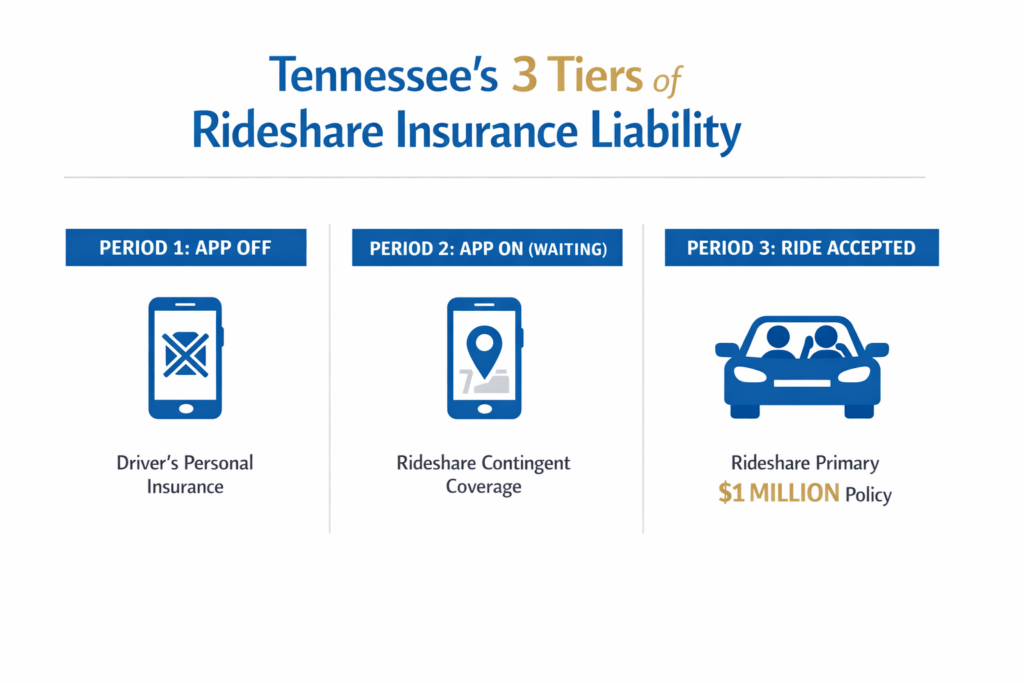
Period 1 occurs when the driver’s app is completely offline. During this time, only the driver’s personal auto insurance applies. Tennessee requires minimum liability coverage of $25,000 per person and $50,000 per accident for bodily injury, plus $15,000 for property damage. However, many personal auto policies exclude coverage when the vehicle is used for commercial purposes. If the driver’s personal insurance denies the claim based on a commercial use exclusion, victims may face significant challenges recovering compensation.
Period 2 begins when the driver turns on the Uber or Lyft app and becomes available to accept ride requests. Once the app is active, Uber and Lyft provide contingent liability coverage of $50,000 per person, $100,000 per accident, and $25,000 for property damage. Importantly, this coverage only applies if the driver’s personal insurance denies the claim. Insurance companies frequently dispute whether personal policies or rideshare contingent policies should pay, delaying settlements and creating frustration for injured victims.
Period 3 starts when the driver accepts a ride request and continues until the passenger exits the vehicle. Throughout this period, Uber or Lyft’s primary liability coverage of $1 million applies. This policy covers injuries to passengers, pedestrians, cyclists, and occupants of other vehicles. Because this coverage is primary, it pays first without requiring you to exhaust the driver’s personal insurance. The substantial $1 million limit provides meaningful compensation for serious injuries, including traumatic brain injuries, spinal cord damage, and permanent disability.
Tennessee Rideshare Insurance: The 3 Liability Periods
| Driver Status | Insurance Coverage | Coverage Limits | Who Pays? |
|---|---|---|---|
| Period 1: App Offline |
Personal auto insurance only | TN minimum ($25k/$50k/$15k) | Driver’s personal insurer |
| Period 2: Waiting for Request |
Uber/Lyft “Contingent” liability | $50k bodily injury / person $100k / accident $25k property |
Uber/Lyft (if personal denies) |
| Period 3: En Route / On Trip |
Uber/Lyft “Primary” liability | $1 million combined liability | Uber or Lyft |
Coverage FAQs
Does Uber’s insurance cover me if the driver’s app was off?
What is the difference between contingent and primary liability?
How much insurance does Lyft provide in Tennessee?
What If the Driver’s App Status Is Disputed?
Insurance companies frequently employ a common tactic to deny rideshare accident claims: they argue the driver’s app was “offline” at the time of the crash, shifting liability to the driver’s personal insurance. Personal insurers then deny coverage based on commercial use exclusions, leaving victims without compensation. This dispute can delay settlements by months while insurance adjusters fight over which policy applies.
Tennessee law permits victims to subpoena electronic data from Uber and Lyft to prove the driver’s app status. These companies maintain detailed records showing when drivers logged in, accepted rides, picked up passengers, and completed trips. Timestamps from these records can definitively establish whether the accident occurred during Period 1, 2, or 3. However, obtaining this data requires legal action, and rideshare companies often resist disclosure.
Knox County courts have seen cases where app timestamp disputes delayed settlements by six to eight months. Therefore, preserving evidence at the accident scene is critical. If possible, screenshot the driver’s phone showing the active trip. Take photos of your passenger app displaying the trip status. Document whether the driver was en route to pick you up, currently transporting you, or had completed the trip. This contemporaneous evidence prevents insurance companies from fabricating alternative timelines.
Multiple Parties Who May Be Liable in a Tennessee Rideshare Accident
Tennessee rideshare accidents often involve multiple potential defendants, each with different insurance coverage and legal defenses. Identifying all liable parties maximizes your compensation because you can pursue recovery from multiple insurance policies. Tim Elrod and the legal team at OEB Law routinely evaluate four categories of potential defendants when analyzing rideshare claims.
The rideshare driver represents the most common liable party in Tennessee Uber and Lyft accidents. If the driver caused the crash through negligence—speeding, distracted driving, running a red light, or driving under the influence—their insurance or the rideshare company’s insurance pays for damages. During Period 3 (when transporting a passenger), Uber or Lyft’s $1 million policy typically covers driver negligence. During Period 2 (waiting for requests), contingent coverage may apply. During Period 1 (app offline), only personal insurance is available.
Another driver may be partially or entirely responsible for the collision. Tennessee rideshare accidents frequently involve third-party liability when another motorist runs a stop sign, changes lanes unsafely, or rear-ends the rideshare vehicle. In these cases, you can pursue compensation from the at-fault driver’s liability insurance in addition to any applicable rideshare coverage. Multiple insurance policies mean greater potential recovery, particularly when injuries exceed a single policy’s limits.
Uber or Lyft may be directly liable in limited circumstances. Tennessee law generally protects rideshare companies from vicarious liability because drivers are independent contractors, not employees. However, exceptions exist. If Uber’s navigation app malfunctioned and caused the crash, the company could face product liability claims. If Lyft failed to conduct adequate background checks and hired a driver with a history of DUIs, negligent entrustment claims may apply under Tennessee’s common law principles.
Vehicle manufacturers may share liability if a defective part contributed to the accident. Brake failures, tire blowouts, airbag malfunctions, and steering system defects can cause or worsen crash injuries. Product liability claims allow victims to pursue compensation from manufacturers, distributors, and parts suppliers. These claims proceed under strict liability principles, meaning you don’t need to prove negligence—only that the defect existed and caused injury.
When You CAN Sue Uber or Lyft Directly: Tennessee Exceptions to Independent Contractor Defense
Tennessee law recognizes that classifying drivers as independent contractors doesn’t always protect Uber and Lyft from liability. The attorneys at OEB Law analyze several theories when considering direct claims against rideshare companies.
Negligent entrustment claims arise when companies entrust vehicles to incompetent drivers. Under Tennessee common law, a company that provides access to a vehicle despite knowing the driver is incompetent can be held liable for resulting injuries. If Lyft’s background check revealed multiple DUI convictions but the company approved the driver anyway, negligent entrustment liability may attach. Similarly, if Uber ignored complaints about a driver’s reckless behavior from previous passengers, the company may be liable for subsequent accidents.
App-related liability occurs when technology failures contribute to crashes. Uber and Lyft drivers rely on smartphone apps for navigation, ride assignments, and communication. If the app’s interface distracts drivers or provides incorrect directions that lead to accidents, the company may face negligence claims. Additionally, if app glitches cause drivers to believe they’re in Period 1 when they’re actually in Period 3, insurance coverage disputes can create company liability.
Inadequate supervision and training claims challenge rideshare companies’ minimal oversight. Unlike taxi companies that train drivers on defensive driving techniques and local traffic patterns, Uber and Lyft provide almost no training beyond app usage. If this lack of training contributes to accidents—such as unfamiliarity with East Tennessee mountain roads or winter driving conditions—negligence claims may succeed.
Tennessee’s 51% Comparative Fault Rule and Rideshare Claims
Tennessee follows a modified comparative fault system under Tenn. Code Ann. § 29-11-103, which reduces compensation based on the victim’s percentage of fault. Importantly, Tennessee applies a 51% bar rule: if you are 51% or more at fault for the accident, you recover nothing. If you are 50% or less at fault, your damages are reduced by your percentage of responsibility.
For example, if a Nashville jury determines you were looking at your phone when the Uber driver ran a red light, and assigns you 30% fault, your $100,000 in damages would be reduced to $70,000. The jury’s fault allocation directly impacts your compensation, making strong evidence and effective legal representation critical.
Insurance companies aggressively exploit Tennessee’s comparative fault rule to minimize payouts. Adjusters routinely argue victims contributed to accidents by:
- Distracting the driver with conversation or destination changes
- Failing to wear seat belts (reducing injury severity arguments)
- Being intoxicated (impairing judgment about the driver’s fitness)
- Opening doors into traffic when exiting the vehicle
In Memphis Uber accident cases, insurance companies frequently argue passengers distracted drivers by changing destinations mid-trip or requesting unsafe pickup locations. Tennessee juries sometimes accept these arguments, particularly when passengers cannot provide contrary evidence. Therefore, documenting the accident circumstances immediately—including witness statements about the driver’s behavior—protects against inflated fault assessments.
Immediate Steps to Protect Your Tennessee Rideshare Accident Claim
The actions you take in the first 24 hours after a Tennessee rideshare accident can determine whether you receive fair compensation or face claim denials. Insurance companies contact victims within 48 hours to secure low-ball settlements before they understand their rights. Following these steps protects your legal interests and strengthens your claim.

Call 911 and report the accident to Tennessee law enforcement. Tennessee law requires police reports for injury claims, and insurance companies often deny claims without official documentation. Knox County Sheriff’s Office handles accidents in unincorporated areas, while Knoxville Police Department responds to crashes within city limits. The responding officer will create an incident report documenting driver statements, weather conditions, road hazards, and visible injuries.
Document the driver’s app status immediately. Screenshot the driver’s phone if possible to show whether the trip was active, pending, or completed. Check your passenger app to verify trip status and save all in-app communication. In Davidson County Circuit Court, app timestamp evidence has proven decisive in insurance coverage disputes. Without this documentation, insurance companies will claim the driver was offline to avoid paying claims.
Gather evidence at the scene before vehicles are moved. Take photos of vehicle damage from multiple angles, including close-ups of impact points and overall scene views. Photograph street signs, traffic signals, and intersection configurations. Record witness names and phone numbers before they leave. Note weather conditions, as East Tennessee fog and winter ice are common contributing factors in rideshare accidents near the Smoky Mountains.
Seek immediate medical attention even if you feel fine. Tennessee personal injury claims require medical documentation linking injuries to the accident. Emergency room visits, urgent care facilities, and primary care physicians all provide acceptable treatment documentation. However, do not delay treatment. Tennessee’s 1-year statute of limitations clock starts at injury date, and insurance companies use treatment gaps against you, arguing injuries weren’t serious or weren’t caused by the accident.
Report the accident to Uber or Lyft through the app immediately. Both companies require in-app accident reporting to activate insurance coverage. Screenshot the report confirmation and save all communication from the rideshare company. Insurance adjusters may later claim you failed to report promptly, potentially denying coverage.
Avoid giving recorded statements to insurance adjusters. Tennessee law does not require you to give recorded statements to the at-fault driver’s insurance company or even to Uber/Lyft. Adjusters use recorded statements to lock you into descriptions before you understand your injuries or remember details clearly. Politely decline: “I need to consult with my Knoxville attorney before providing a statement.”
Contact an experienced Tennessee rideshare accident attorney before accepting settlement offers. The top attorneys in Knoxville at OEB Law provide free consultations to evaluate your claim. Insurance companies make initial offers within days, hoping to settle before victims consult lawyers. These offers typically represent 10-20% of actual claim value. Once you accept a settlement and sign a release, you cannot seek additional compensation—even if your injuries worsen or new complications develop.
“One of the most common mistakes I see is people accepting early settlement offers before they understand the full extent of their injuries. Once you sign that release, you can’t go back for more compensation, even if your medical situation worsens.” – Tim Elrod
Who Pays? Interactive Liability Flowchart
START HERE: Click to trace liability
Fault & Liability FAQs
What if both the Uber driver and another driver were at fault?
Does Tennessee require minimum insurance coverage for rideshare drivers?
Can I recover compensation if I was partially at fault?
What Compensation Can You Recover in a Tennessee Rideshare Accident?
Tennessee law allows rideshare accident victims to recover both economic and non-economic damages from liable parties. Understanding available compensation categories helps you evaluate settlement offers and determine whether they adequately cover your losses.
Economic damages compensate for tangible financial losses with specific dollar values:
- Medical expenses including emergency room treatment, hospital stays, surgeries, medications, physical therapy, and future medical care
- Lost wages from missed work during recovery, including sick leave, vacation time, and unpaid medical leave
- Reduced earning capacity if permanent injuries prevent you from returning to your previous job or require career changes
- Property damage for vehicle repairs or replacement, damaged clothing, broken phones, and other personal property
- Out-of-pocket expenses such as transportation to medical appointments, home care services, and medical equipment
Knoxville medical costs are typically lower than Nashville or Memphis, affecting settlement calculations in East Tennessee rideshare cases. However, serious injuries still generate substantial medical bills. A traumatic brain injury requiring neurosurgery and rehabilitation can exceed $200,000 in the first year alone.
Non-economic damages compensate for intangible losses without specific dollar values:
- Pain and suffering from physical discomfort, chronic pain, and limitations on daily activities
- Emotional distress including anxiety, depression, post-traumatic stress disorder, and sleep disturbances
- Loss of enjoyment of life when injuries prevent you from participating in hobbies, recreation, and family activities
- Permanent scarring or disability that affects your appearance, self-esteem, and physical capabilities
Tennessee limits non-economic damages to $750,000 in most cases under Tenn. Code Ann. § 29-39-102. However, catastrophic injury cases involving permanent disability, amputation, or severe disfigurement may exceed this cap. Tennessee courts define “catastrophic” as injuries causing permanent and substantial physical impairment.
How Tennessee’s Comparative Fault Rule Reduces Your Settlement
Tennessee’s 51% bar rule creates a mathematical formula for calculating compensation when victims share fault. Insurance adjusters will try to inflate your percentage of fault to minimize payouts, making strong evidence crucial.
Consider this example: You suffer $100,000 in damages after a Lyft driver rear-ends your vehicle at a red light. If the jury finds you 0% at fault, you recover the full $100,000. However, if the jury determines you were 20% at fault for stopping suddenly, your recovery reduces to $80,000. At 49% fault, you recover $51,000. At 51% fault, you recover nothing regardless of your injury severity.
Insurance companies frequently argue passengers contributed to rideshare accidents by:
- Requesting unsafe pickup or drop-off locations
- Distracting drivers with excessive conversation
- Failing to wear seat belts
- Being intoxicated and impairing the driver’s judgment
- Opening vehicle doors into traffic lanes
The Knoxville attorneys at OEB Law counter these arguments with witness testimony, accident reconstruction, traffic camera footage, and expert analysis. Strong evidence proving the driver’s complete responsibility prevents insurance companies from shifting fault to victims.
Tennessee’s 1-Year Deadline to File Rideshare Accident Claims
Tennessee law imposes a strict one-year statute of limitations for personal injury claims under Tenn. Code Ann. § 28-3-104. This deadline applies to all car accidents, including rideshare crashes involving Uber and Lyft. Missing this deadline permanently bars your claim regardless of injury severity or how clear the driver’s fault may be.
The one-year clock begins on the accident date in most cases. For example, if you were injured in a Knoxville Uber accident on January 15, 2025, you must file a lawsuit by January 15, 2026. Filing on January 16, 2026, is too late—the court will dismiss your case without considering its merits. Tennessee courts strictly enforce this deadline with virtually no exceptions.
Tennessee’s one-year limitation is significantly shorter than most states, which typically allow two to four years for personal injury claims. This shortened timeframe creates urgency for rideshare accident victims who may still be recovering from injuries or dealing with insurance company delays.
When Does the Clock Start for Tennessee Rideshare Accident Cases?
The statute of limitations clock generally starts on the accident date for rideshare crashes. However, Tennessee recognizes limited exceptions for specific circumstances.
The discovery rule applies when injuries are not immediately apparent. If you develop medical complications weeks or months after a Lyft accident, and those complications could not reasonably have been discovered earlier, the statute may begin when you discovered or should have discovered the injury. However, Tennessee courts apply this exception narrowly, requiring clear medical evidence that the injury was truly latent.
Minors receive extended time to file rideshare accident claims. Tennessee tolls the statute of limitations until an injured minor turns 18 years old. At that point, the minor has one year to file a lawsuit. For example, if a 16-year-old passenger was injured in a 2025 rideshare accident, they would have until 2028 (one year after turning 18) to file a claim.
Mental incapacity may toll the statute in extremely limited circumstances. If a rideshare accident victim was mentally incapacitated at the time of the crash and remains incapacitated, Tennessee may toll the deadline. However, this exception requires substantial medical documentation and rarely applies.
Even if you file within the one-year deadline, Tennessee courts need additional time to resolve cases. Davidson County Circuit Court rideshare cases typically take 18 to 24 months from filing to trial. Knox County processing times are somewhat faster, averaging 15 to 18 months. However, settlement negotiations often resolve claims before trial, particularly when liability is clear and injuries are well-documented.
What to Do If You’re Approaching the Deadline
Don’t wait until day 364 to contact an attorney. The experienced attorneys at OEB Law need adequate time to investigate your claim, gather medical records, interview witnesses, and file a properly pleaded complaint. Last-minute filings increase the risk of errors, missed deadlines, and insufficient preparation.
If your statute of limitations deadline is approaching, Tennessee courts permit emergency filing procedures. However, these rushed filings carry risks. Incomplete complaints may be dismissed, giving insurance companies leverage to delay settlement. Missing critical parties or allegations may weaken your case irreparably.
Contact OEB Law immediately if:
- Your accident date was 10-11 months ago
- Insurance companies have delayed claim processing
- You’re still receiving medical treatment but approaching the deadline
- Multiple insurance companies are disputing coverage
- Previous attorneys have failed to file timely
Tennessee law shows no mercy for missed deadlines. Even one day late means losing your right to compensation forever, regardless of how severe your injuries or how clear the driver’s fault.
Why Choose OEB Law for Your Tennessee Rideshare Accident Claim
When facing the complex liability issues in a Tennessee Uber or Lyft accident, having experienced legal representation can mean the difference between a fair settlement and financial hardship. The top attorneys in Knoxville at OEB Law understand the three-tier insurance system, Tennessee’s comparative fault rules, and the tactics insurance companies use to minimize payouts. Knoxville personal injury attorney Tim Elrod has represented numerous rideshare accident victims throughout Knox County, Davidson County, and surrounding East Tennessee communities, recovering significant compensation for medical expenses, lost wages, and pain and suffering.

Our attorneys know which evidence strengthens rideshare claims and how to counter insurance company arguments that victims contributed to accidents. We handle app data subpoenas, insurance coverage disputes, and multi-party liability cases where several insurance policies may apply. Most importantly, we work on a contingency fee basis for personal injury cases—you don’t pay attorney fees unless we successfully secure compensation in your case.
Who is OEB Law and Why Are They Good for the Community?
Led by Managing Attorney Timothy G. Elrod and Our Experienced Legal Team
Founded in 2004 in Knoxville, Tennessee, OEB Law has grown over nearly two decades to now serve clients across multiple states. Tim Elrod established the firm with a simple but powerful mission: we care and we help people. Today, together with attorneys Michael Bernard, Billy Sivyer, Gena Lewis, and Logan Wade, our team brings over 50 years of combined experience representing clients throughout Tennessee and Kentucky in personal injury and criminal defense cases.
Our Legal Expertise
Our attorneys have built their reputation through:
- Successfully representing thousands of personal injury and criminal defense clients
- Developing specialized knowledge across all types of accident and injury cases
- Mastering the complexities of Tennessee’s legal system through decades of practice
Why Trust Us
At OEB Law, our reputation speaks for itself:
- Proven Results: We’ve recovered significant compensation for our clients through both settlements and courtroom verdicts
- Client Satisfaction: Our numerous 5 Star Google Reviews showcase our commitment to responsive, caring, and effective legal representation
- No Fee Unless We Win: You don’t pay attorney fees unless we successfully secure compensation in your case
- Local Knowledge: As East Tennessee natives, we understand our community and care deeply about the people we serve
- Personalized Approach: We personalize each case to meet our clients’ specific needs, ensuring you’re never just another file number
Community Commitment
Our dedication extends beyond the courtroom. We proudly support:
- Local high school football programs through Rivalry Thursday sponsorships
- The Knoxville Ice Bears and community fundraising initiatives
- Numerous youth, student, and community organizations throughout East Tennessee
As Tim Elrod says, “We don’t just take—we give back because the people you’re giving back to are the people who are supporting your firm.“
Have a personal injury or criminal defense case? We’re available 24/7 to help.
Get In Touch
- Call or Text: (865) 546-1111
- Visit: https://oeblawtn.com/
- Available: Standing by 24/7
Why OEB Law? Because They’re Good For The Community.
TEXT or CALL (865) 546-1111 for HELP NOW. Standing By 24/7.
Follow Us on Social Media
Stay connected with OEB Law for the latest Knoxville and East Tennessee legal insights, community updates, and important legal information. Follow us on X, YouTube, Facebook, Instagram, LinkedIn, and TikTok for exclusive content, client stories, and expert legal guidance from our team.
FAQ:
How long do I have to file a claim after a rideshare accident in Tennessee?
Tennessee law requires personal injury victims to file lawsuits within one year of the accident date under Tenn. Code Ann. § 28-3-104. This deadline applies to all rideshare accidents involving Uber and Lyft, regardless of injury severity. Missing this deadline permanently bars your claim, even if the driver’s fault is obvious and your injuries are catastrophic. Unlike insurance settlement negotiations, which can be informal and ongoing, the lawsuit filing deadline is absolute. Contact Knoxville attorney Tim Elrod or another experienced Tennessee rideshare accident attorney immediately if your accident date was more than six months ago to ensure adequate time for investigation and filing.

