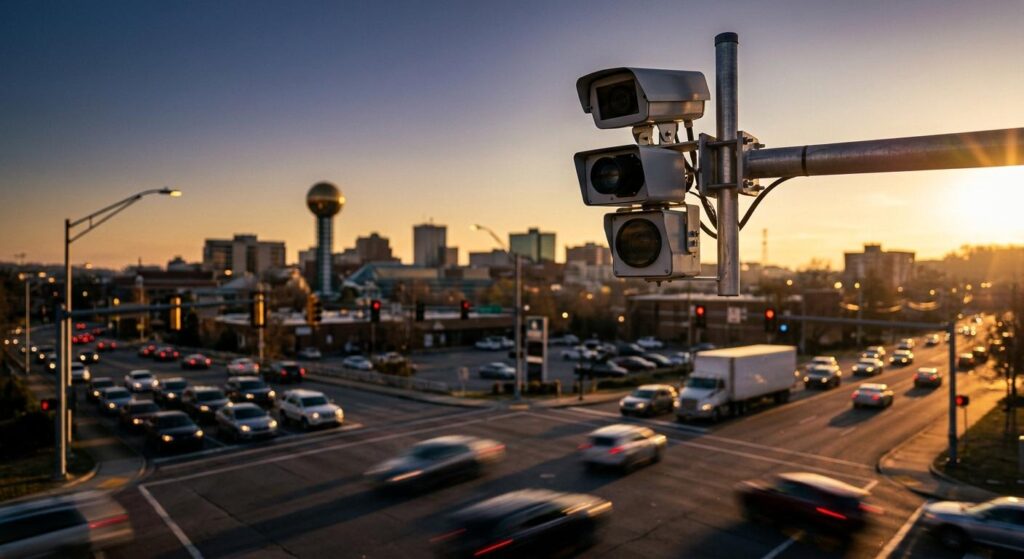
If you were involved in an accident at a Knoxville intersection equipped with a traffic camera, that footage could be the most important piece of evidence in your personal injury claim. Knoxville operates its own Red Light Photo Enforcement Program alongside TDOT SmartWay monitoring cameras, and the rules governing each are not identical to what you would find in other Tennessee cities. At OEB Law, our attorneys have spent over 20 years helping East Tennessee accident victims navigate exactly these kinds of local legal complexities. Understanding how Knoxville’s camera laws work, and how quickly footage disappears, can be the difference between winning and losing your claim. In this blog post, Knoxville attorney Tim Elrod discusses why Knoxville’s unique traffic camera laws impact your accident claim.
Key Takeaways
- Knoxville operates a Red Light Photo Enforcement Program governed by both Tennessee state law and city ordinances, creating rules that differ from other Tennessee cities.
- Traffic camera footage disappears fast—KPD enforcement cameras and TDOT SmartWay cameras have different retention windows, and once footage is overwritten, it is gone permanently.
- Tennessee’s modified comparative fault rule bars recovery if you are 50% or more at fault, meaning camera footage can either protect your claim or seriously damage it.
- An attorney must act within 24 to 48 hours to send a spoliation letter preserving footage—waiting too long costs you this critical evidence.
Knoxville’s traffic camera laws impact accident claims in two critical ways: they determine what footage exists as evidence, and they govern how long that footage is retained before it is permanently deleted. Because Knoxville uses both red-light enforcement cameras managed by KPD and TDOT SmartWay monitoring cameras, the rules for accessing footage differ depending on which system captured your accident. Understanding which type of camera recorded your crash, and acting immediately to preserve that footage, is essential to protecting your right to compensation under Tennessee law.
To Discuss Your Case, Call or Text Our Team Standing By 24/7: (865) 546-1111
About OEB Law, Your Knoxville Legal Team
This guide is provided by the experienced attorneys at OEB Law, led by Managing Attorney Timothy G. Elrod. Founded in Knoxville in 2004, our firm has over 50 years of combined experience navigating East Tennessee’s legal system.
We have successfully represented thousands of personal injury clients, developing deep expertise in Tennessee’s complex wrongful death and accident laws. As East Tennessee natives, we have a direct understanding of the local court systems, law enforcement agencies, and community needs. Our commitment is to provide trusted, authoritative information to our neighbors in Knoxville and the surrounding Tennessee communities. However, this information does not constitute legal advice. If you or a loved one has been injured in an accident or needs legal help, call us today for a free, no obligation, initial consultation.
Knoxville Traffic Camera Types: Retention Windows & Evidence Access
| Camera Type | Operated By | Primary Purpose | Estimated Retention Window | How to Request Footage |
|---|---|---|---|---|
| Red-Light Enforcement Camera | KPD / Photo Enforcement Program | Issue citations for red-light violations | Days (confirm with KPD) | Public Records Request to KPD — TPRA (TCA § 10-7-503) |
| TDOT SmartWay Monitoring Camera | TDOT | Traffic monitoring / incident management | Hours to 72 hours | Contact TDOT SmartWay Operations Center |
| Private Business / Parking Lot Camera | Private owner | Security / property monitoring | 7–30 days (varies by owner) | Spoliation / preservation letter to business owner |
| Dashcam (other driver or your vehicle) | Vehicle owner | Personal recording | Until overwritten or device recovered | Subpoena or voluntary request |
Knoxville’s Red Light Photo Enforcement Program: What Makes It Unique
Knoxville’s Red Light Photo Enforcement Program operates under Tenn. Code Ann. § 55-8-198, which classifies red-light camera violations as non-criminal, non-moving violations. This classification is distinctly different from a moving violation ticket issued by a police officer at the scene. Because violations are classified as non-moving, they do not appear on a driver’s record and do not directly affect insurance premiums the same way a traditional moving violation would. However, this distinction carries important nuances for accident claims that most drivers do not realize.
Tennessee law requires a certified law enforcement officer to review camera footage before any citation is issued. This procedural safeguard matters for accident claims because it confirms the footage was reviewed and authenticated by law enforcement. Additionally, under state law, citations must be mailed within 20 business days of the violation. That timeline confirms footage was retained long enough for officer review, which gives attorneys a critical window to act and request preservation.
“Most people assume that a red-light camera ticket is the same as a moving violation, but in Tennessee, those are two very different things. The ticket itself carries limited weight in a civil claim—the footage, however, is a different story entirely.” – Knoxville attorney Tim Elrod
Red Light Camera Tickets vs. Moving Violations: Why the Difference Matters for Your Claim
Because a red-light camera citation is non-criminal, it cannot be used as a criminal conviction to establish fault in a civil lawsuit. However, the underlying footage that generated that citation is fully admissible as evidence. Therefore, even if a driver ignores their camera ticket entirely, the footage captured at that Knoxville intersection can still be used against them in a personal injury claim. This is a nuance that an experienced personal injury attorney understands well.
How to Request Traffic Camera Footage After a Knoxville Accident
Tennessee’s Public Records Act, Tenn. Code Ann. § 10-7-503, gives any person the right to request government-held footage. Agencies must respond within 7 business days. However, 7 business days may already be too late. Many camera systems overwrite footage within 24 to 72 hours, making immediate action after a Knoxville accident absolutely essential.

Two separate agencies control camera footage in Knoxville, and each has its own request process:
- KPD (Knoxville Police Department): Controls red-light enforcement camera footage. Public records requests should be directed to KPD directly.
- TDOT SmartWay: Controls highway monitoring cameras on interstates and major corridors. A separate request process applies through TDOT’s SmartWay Operations Center.
What Is a Spoliation Letter and Why Does It Matter?
Spoliation is the destruction or alteration of evidence. In Tennessee, if an agency or party destroys evidence after receiving formal written notice to preserve it, courts can impose serious sanctions against that party. An attorney sends a spoliation of evidence letter immediately upon being contacted, which legally obligates the agency to preserve the footage while the public records request is processed.
Here are the steps to take immediately after a Knoxville accident involving a traffic camera:
- Document the intersection—note the camera location, your direction of travel, and any visible camera housings.
- Contact a car accident attorney within 24 hours—preservation letters must be sent before footage is overwritten.
- Your attorney files a public records request with KPD or TDOT.
- Your attorney simultaneously sends a spoliation of evidence letter creating a legal preservation obligation.
- If a private business camera may have captured the accident (for example, on Cumberland Avenue, Gay Street, or the Turkey Creek corridor), a preservation letter must go to that business immediately as well.
How Camera Footage Affects Fault and Compensation Under Tennessee Law
Tennessee follows modified comparative fault with a 50% threshold under Tenn. Code Ann. § 29-11-103. If you are found 50% or more at fault for an accident, you recover nothing under Tennessee law. Traffic camera footage can establish fault percentage with significant precision, and that precision works both ways. A camera showing a driver running a red light at full speed versus a driver who entered on a stale yellow creates very different fault allocations.
Camera footage can help or hurt your claim depending on what it shows. If the footage shows you were speeding, distracted, or partially responsible for the collision, the defense and insurance companies will use that footage against you. Furthermore, insurance companies have the right to request traffic camera footage and routinely do so when investigating claims, often before the accident victim’s attorney has acted. Speed matters.
When Camera-Induced Braking Causes a Rear-End Collision
A common scenario in Knoxville involves a driver braking hard at a red-light camera intersection to avoid a citation, causing the vehicle behind to rear-end them. In this situation, the camera footage may actually support the rear driver’s claim that the lead driver stopped abruptly without reasonable justification. Tennessee courts look at the totality of evidence, and camera footage is one piece of a larger picture that also includes expert analysis of stopping distances, speed data, and road conditions.
“Insurance adjusters know exactly how to use camera footage to minimize what they pay you. That’s why we move fast—preserving footage and analyzing it before the other side gets to frame the narrative first.” – Knoxville attorney Tim Elrod
For accident victims evaluating their options, an experienced attorney like Timothy G. Elrod can help you understand how camera evidence affects your specific fault percentage and total compensation. Using our car accident settlement calculator is a good first step to estimate your claim’s potential value.
Are Traffic Camera Tickets Enforceable in Tennessee?
Under state law, red-light camera tickets in Tennessee are civilly enforceable but are classified as non-criminal civil penalties. They are not moving violations. Non-payment of a red-light camera ticket in Knoxville does not result in driver’s license suspension, points on your driving record, or direct credit reporting under the current statutory framework outlined in Tenn. Code Ann. § 55-8-198.
This enforceability gap creates a widespread misconception. Many Knoxville drivers ignore camera tickets believing there are no real consequences. However, the underlying footage that generated that ticket is still fully admissible as evidence in a personal injury lawsuit. Additionally, insurance companies may factor camera violations into their internal risk assessments even if the violation does not appear on a state driving record. That subtle distinction can affect how an insurer values your claim.
Key facts about Tennessee traffic camera ticket enforceability:
- Camera tickets are civil penalties, not criminal violations.
- They do not add points to your Tennessee driver’s license.
- Non-payment typically does not directly affect your credit score under current Tennessee law.
- The ticket itself cannot be used as a criminal conviction in a civil case—but the footage can be used as evidence.
- Citations must be mailed within 20 business days of the violation.
Tim Elrod has reviewed numerous camera-related accident cases in Knoxville and consistently advises clients that the ticket is not the evidence—the footage is. Understanding this distinction before dealing with an insurance adjuster can protect your claim significantly.
Timeline: What Happens to Traffic Camera Footage After a Knoxville Accident
Step 1 — Day 0 (Accident)
Accident occurs at camera-equipped intersection. Footage exists on camera system. The clock starts immediately.
Step 2 — Day 1 (24 Hours)
Highest risk window. TDOT SmartWay cameras may overwrite within hours. Act NOW to contact an attorney.
Step 3 — Day 1-2 (24-48 Hours)
Attorney sends spoliation letter to KPD and/or TDOT creating a legal preservation obligation. Attorney files public records request.
Step 4 — Day 2-3
KPD confirms receipt of request. Footage preservation window confirmed. Attorney begins authentication process.
Step 5 — Day 7 (7 Business Days)
Tennessee Public Records Act deadline for agency to respond to the footage request.
Step 6 — Day 8+
Footage is delivered to the attorney. Analysis begins. Evidence is used to build a comparative fault argument and negotiate with insurance companies.
DANGER ZONE: Days 1-3
If no preservation letter is sent, footage may be permanently deleted. After Day 3 without action, evidence recovery becomes significantly less certain.
Why Choose OEB Law for Your Knoxville Traffic Camera Accident Claim
When traffic camera footage becomes the centerpiece of your accident claim, you need an attorney who knows Knoxville’s specific camera programs, not a generic personal injury firm. OEB Law has worked with Knoxville’s local court system and KPD’s public records processes for over 20 years, giving our team a practical understanding of how to obtain and authenticate camera footage efficiently. We know which major intersections throughout Knox County are camera-equipped, from the I-40 and I-75 corridor to high-volume areas like Kingston Pike and Cumberland Avenue, and we know how to move fast enough to preserve evidence before it disappears.
Timothy G. Elrod and the experienced legal team at OEB Law have earned hundreds of 5 Star Google Reviews from East Tennessee clients who experienced exactly this kind of responsive, knowledgeable representation. As top attorneys in Knoxville, we act within hours of your call to send spoliation letters and file public records requests, and you pay nothing unless we win your case.
Who is OEB Law and Why Are They Good for the Community?
Led by Managing Attorney Timothy G. Elrod and Our Experienced Legal Team
Founded in 2004 in Knoxville, Tennessee, OEB Law has grown over nearly two decades to now serve clients across multiple states. Tim Elrod established the firm with a simple but powerful mission: we care and we help people. Today, our team brings over 50 years of combined experience representing clients throughout Tennessee in personal injury and criminal defense cases.
Our Legal Expertise
Our attorneys have built their reputation through:
- Successfully representing thousands of personal injury and criminal defense clients
- Developing specialized knowledge across all types of accident and injury cases
- Mastering the complexities of Tennessee’s legal system through decades of practice
Why Trust Us
At OEB Law, our reputation speaks for itself:
- Proven Results: We’ve recovered significant compensation for our clients through both settlements and courtroom verdicts
- Client Satisfaction: Our numerous 5 Star Google Reviews showcase our commitment to responsive, caring, and effective legal representation
- No Fee Unless We Win: You don’t pay attorney fees unless we successfully secure compensation in your case
- Local Knowledge: As East Tennessee natives, we understand our community and care deeply about the people we serve
- Personalized Approach: We personalize each case to meet our clients’ specific needs, ensuring you’re never just another file number
Community Commitment
Our dedication extends beyond the courtroom. We proudly support:
- Local high school football programs through Rivalry Thursday sponsorships
- The Knoxville Ice Bears and community fundraising initiatives
- Numerous youth, student, and community organizations throughout East Tennessee
“We don’t just take—we give back because the people you’re giving back to are the people who are supporting your firm.” – Tim Elrod
Have a personal injury or criminal defense case? We’re available 24/7 to help.
Get In Touch
- Call or Text: (865) 546-1111
- Visit: https://oeblawtn.com/
- Available: Standing by 24/7
Why OEB Law? Because They’re Good For The Community.
TEXT or CALL (865) 546-1111 for HELP NOW. Standing By 24/7.
Follow Us on Social Media
Stay connected with OEB Law for the latest Knoxville and East Tennessee legal insights, community updates, and important legal information. Follow us on X, YouTube, Facebook, Instagram, LinkedIn, and TikTok for exclusive content, client stories, and expert legal guidance from our team.
Yes. Insurance companies have the right to request traffic camera footage under Tennessee’s Public Records Act, and they routinely do so when investigating accident claims. If the footage shows you running a red light, speeding, or otherwise contributing to the accident, the insurer may use that evidence to reduce or deny your claim under Tennessee’s modified comparative fault rule. Because Tennessee bars recovery if you are 50% or more at fault, the content of camera footage can have significant financial consequences. An experienced Knoxville personal injury attorney can review the footage first, assess how it affects your fault percentage, and develop a strategy to protect your compensation.
Under state law, red-light camera tickets in Tennessee are classified as non-criminal civil penalties, not moving violations. They do not add points to your Tennessee driver’s license, and non-payment typically does not result in license suspension or direct credit reporting under the current statutory framework. However, the footage that generated the ticket remains fully admissible as evidence in a personal injury lawsuit.
Retention windows vary significantly depending on the camera type. TDOT SmartWay monitoring cameras may overwrite footage within hours to 72 hours, while KPD red-light enforcement camera footage may last slightly longer before being overwritten. Because there is no single universal retention window, contacting an attorney within 24 hours is critical so a formal spoliation letter can be sent to legally preserve the footage before it is deleted.

