
Every school morning in Knoxville, parents drop off children at schools across Knox County while other drivers scroll phones, check texts, and ignore the flashing yellow lights overhead. The legal ramifications of distracted driving in Knoxville school zones extend far beyond a simple traffic ticket, touching criminal penalties, license suspensions, and serious civil liability that can affect your entire family. At OEB Law, our Knoxville attorneys have represented families throughout East Tennessee who discovered too late that a moment of distraction near a school carried consequences they never anticipated. Tennessee law specifically enhances penalties when school zone flashers are operating, and Knoxville’s automated enforcement cameras are raising the stakes even higher. In this blog post, Knoxville attorney Tim Elrod discusses the legal ramifications of distracted driving in Knoxville school zones and what every local parent needs to know.
Key Takeaways
- Tennessee’s Hands-Free Law imposes up to a $200 fine for using a handheld device in an active school zone when flashers are operating
- Drivers under 18 face a complete cell phone ban in Tennessee school zones, as hands-free devices do not protect minors from citations
- Knoxville is deploying 72 automated speed cameras across 41 school zones, creating a new automated enforcement layer every parent must understand
- Tennessee’s Family Purpose Doctrine can make parents financially liable if their teenager causes a distracted driving accident in a school zone
To Discuss Your Case, Call or Text Our Team Standing By 24/7: (865) 546-1111
About OEB Law, Your Knoxville Legal Team

This guide is provided by the experienced attorneys at OEB Law, led by Managing Attorney Timothy G. Elrod. Founded in Knoxville in 2004, our firm has over 50 years of combined experience navigating East Tennessee’s legal system.
We have successfully represented thousands of personal injury clients, developing deep expertise in Tennessee’s complex wrongful death and accident laws. As East Tennessee natives, we have a direct understanding of the local court systems, law enforcement agencies, and community needs. Our commitment is to provide trusted, authoritative information to our neighbors in Knoxville and the surrounding Tennessee communities. However, this information does not constitute legal advice. If you or a loved one has been injured in an accident or needs legal help, call us today for a free, no obligation, initial consultation.
Tennessee School Zone Distracted Driving Penalties at a Glance
| Violation Type | Base Fine | School Zone Fine (Flashers Active) | License Points | Misdemeanor Class |
|---|---|---|---|---|
| Handheld device use (adult) | $50 | Up to $200 | 3 points | Class C |
| Any cell phone use (driver under 18) | $50 | Up to $200 | 6-7 points (novice) | Class C |
| Speeding in active school zone | Varies | Enhanced | 3-6 points | Class C |
| Reckless driving | Up to $500 | Enhanced | Additional points | Class B |
Tennessee’s Hands-Free Law in Knoxville School Zones
In Tennessee, distracted driving in an active school zone is a Class C misdemeanor carrying fines up to $200 when flashers are operating, with additional license points that can affect both adult and teen drivers. Knoxville enforces these laws aggressively through both officer patrols and a growing network of automated speed cameras. Beyond traffic penalties, a distracted driving crash in a Knox County school zone can expose the at-fault driver and potentially their parents to civil liability under Tennessee law.
Tennessee’s Hands-Free Act, codified at T.C.A. § 55-8-199, prohibits holding or using a phone while driving. This prohibition applies even when a vehicle is stopped at a red light. That fact surprises many Knoxville drivers who assume a full stop creates a legal window to check a notification. Inside an active school zone, however, the law goes further. Enhanced penalties apply specifically when those yellow flashers are lit and operating.
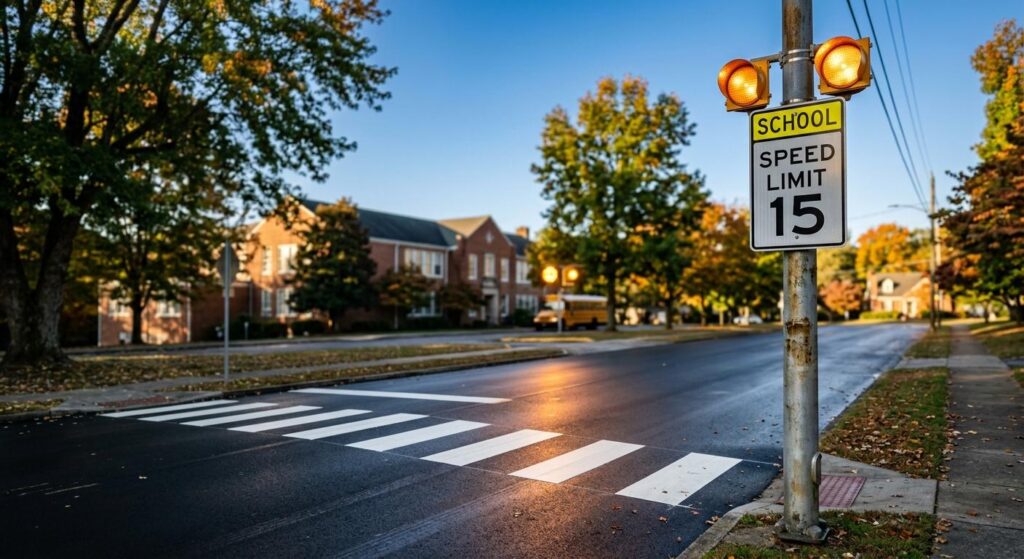
The key phrase is “active school zone.” A school zone sign alone, without operating flashers, does not trigger the enhanced $200 fine or Class C misdemeanor classification. However, once those lights are flashing, every driver in that zone is subject to heightened scrutiny and heavier consequences for any phone-related violation.
Knox County crash data illustrates exactly why enforcement has intensified. Recent data shows the county recorded 803 distracted driving crashes in a single reporting year. That figure drives home why Knoxville police actively patrol school zone flasher windows and why the city is now adding automated enforcement on top of officer patrols.
What Is Prohibited in a Tennessee School Zone?
The Hands-Free Act covers more conduct than most drivers realize. Prohibited activities include handheld calls, texting, video streaming, checking social media, and even briefly glancing at a phone while holding it. Simply holding the device qualifies as a violation, regardless of whether a driver is actively using it.
For adult drivers, hands-free GPS navigation through a mounted device remains permitted. That exception does not extend to drivers under 18, as discussed in the next section. When in doubt, the safest rule is simple: if you are touching your phone in an active Knoxville school zone, you are breaking the law.
Do Knoxville School Zones Have Specific Time Limits?
School zones are only active when yellow flashers are operating. Flasher schedules align with Knox County Schools bell schedules, typically covering morning drop-off and afternoon pickup windows. Outside those windows, standard speed limits apply and enhanced penalties do not.
One practical complication is that early dismissals, weather delays, and schedule changes can shift flasher windows without advance notice to drivers. A route that feels routine on a normal school day may trigger enhanced enforcement on a half-day schedule. Knoxville parents who drive the same route repeatedly should pay attention to the flashers themselves rather than relying on a memorized time window.
“A lot of Knoxville parents don’t realize the enhanced school zone penalties only kick in when those yellow flashers are actually operating. But here’s the thing: KPD officers don’t wait for you to notice the flashers. They’re actively patrolling those windows, and the cameras that are coming will be even less forgiving.” – Knoxville attorney Tim Elrod
Teen Drivers and Knoxville School Zone Laws
Tennessee imposes a complete cell phone ban on drivers under 18 in active school zones. Unlike adult drivers, teenagers cannot rely on a hands-free device to avoid a citation. Whether they are using speakerphone, earbuds, or a Bluetooth system, any phone use by a novice driver inside an active school zone is prohibited under state law.
This stricter standard reflects Tennessee’s graduated licensing framework and the specific provisions of the Eddie Conrad Act. This law governs how the point system applies to novice drivers. Under the Eddie Conrad Act, young drivers accumulate points at an accelerated rate compared to adults. Consequently, a single violation near a Knoxville school can have outsized consequences for a teenager’s driving privileges.
Understanding the point thresholds is important for every Knox County family with a teen driver. A novice driver who reaches 6 points faces a 6-month license suspension. Reaching 7 points triggers a 12-month suspension. By comparison, an adult driver faces 3 points for the same school zone phone violation. One citation near West High School, Powell High, or Hardin Valley Academy could push a teen driver to the suspension threshold.
The Eddie Conrad Act and Novice Drivers
The Eddie Conrad Act imposes the accelerated point schedule that governs Tennessee novice drivers. Under this framework, a school zone phone violation carries 6 to 7 points for a driver under 18, compared to 3 points for an adult. Because novice drivers start from a lower tolerance threshold, a single school zone citation can functionally eliminate a teenager’s ability to drive themselves to school or work.
Parents should also understand that the Hands-Free Act and the novice driver restrictions operate simultaneously. A teen driver near a Knox County high school is subject to both layers of law at once. If that driver causes a car accident while violating either restriction, the consequences extend well beyond points on a license.
Knoxville’s New Automated School Zone Speed Cameras
Knoxville is deploying 72 automated speed cameras across 41 school zones as part of the city’s Vision Zero traffic safety initiative. The camera program is set to activate during the upcoming school year, representing a fundamental shift in how school zone enforcement works across the city.
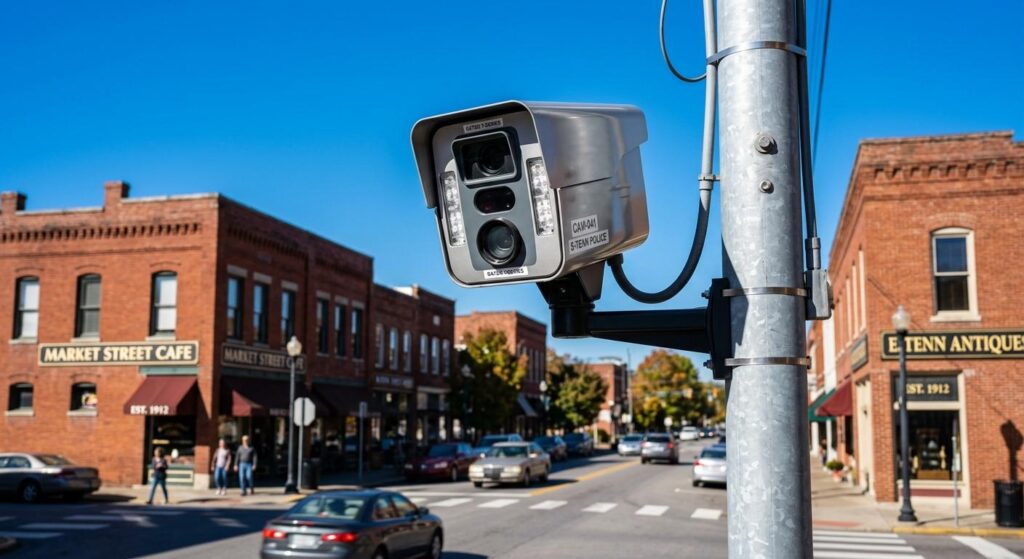
Unlike officer patrols that operate during specific shifts, automated cameras monitor school zones continuously during active flasher windows. A Knoxville Police Department officer reviews each camera-flagged image before a citation is issued, so the process is not fully automated. However, the volume and consistency of coverage is dramatically higher than traditional patrol-based enforcement.
Parents should verify whether camera-issued citations affect driving record points in the same way as officer-issued tickets. Many automated camera enforcement programs issue civil citations rather than criminal traffic violations, which may not add license points. That distinction matters for families tracking a teen driver’s point total under the Eddie Conrad Act.
Which Knoxville Schools Are in the Camera Program?
The full list of 41 covered school zones is available through the Knoxville Police Department’s Vision Zero initiative website. Knoxville’s Geographic Information System also provides a school zone search utility that allows residents to check whether specific routes pass through covered zones.
Practically speaking, parents who drive carpool routes, school drop-off lines, or regular commutes near Knox County schools should verify their route against the camera program. The 72-camera network covers school zones in West, North, and South Knoxville neighborhoods. The coverage is broad enough that most Knoxville families will have at least one camera-covered zone on a regular route.
“The automated camera rollout changes the enforcement landscape completely. Before, you might have driven through a school zone at 28 mph while flashers were on and gotten lucky. These cameras don’t take breaks, don’t have quotas, and don’t miss. Every Knoxville parent needs to recalibrate how seriously they take those yellow flashers.” – Knoxville attorney Tim Elrod
Parental Liability and Civil Claims in Knoxville School Zone Accidents
The legal consequences of distracted driving in a Knoxville school zone do not stop at traffic penalties. When a crash occurs, especially one involving a child near a Knox County school, civil liability enters the picture. Tennessee law creates specific pathways for injured families to pursue compensation. Additionally, those same pathways can expose parents to significant financial risk when their teenager is the at-fault driver.
Tennessee’s Family Purpose Doctrine holds that parents who allow a family member to use a household vehicle can be vicariously liable when that driver causes a crash. Three conditions typically apply: the parent owns or controls the vehicle, the vehicle is maintained for family use, and a family member was driving with the parent’s express or implied permission. When a teenager rear-ends a pedestrian while checking a phone in an active Knox County school zone, that civil lawsuit may name the teen’s parents alongside the teen as defendants.
Negligence per se adds another layer of risk. When a driver violates T.C.A. § 55-8-199 in an active school zone, that statutory violation can serve as automatic evidence of negligence in a civil lawsuit. The plaintiff does not need to separately prove the driver was careless. The traffic citation does that work for them. This significantly strengthens any personal injury claim filed on behalf of an injured child.
If your child was injured, Tennessee’s minor tolling statute at T.C.A. § 28-1-106 provides important protection. The standard one-year personal injury statute of limitations generally does not begin running until an injured child turns 18. This gives families more time than most parents realize. However, evidence disappears quickly, including school zone camera footage that may be overwritten. Therefore, prompt legal consultation remains strongly recommended.
Tennessee also applies modified comparative fault at the 50% threshold under T.C.A. § 29-11-103. A distracted driver who is 50% or more at fault cannot recover damages. This rule typically favors injured families in clear-cut distracted driving cases, ensuring that the at-fault party is held responsible. You can estimate potential claim values using a settlement calculator as a starting point.
What to Do If Your Child Was Hit by a Distracted Driver
If a distracted driver strikes your child near a Knox County school, these steps protect your family’s legal rights:
- Call 911 and request documentation of the school zone location and active flasher status
- Preserve any available footage from KPD school zone cameras or school security systems
- Collect witness contact information from school staff, other parents in carpool lines, and bystanders
- Seek immediate medical attention and document all injuries thoroughly
- Request the Knox County police report and incident number within 24 to 48 hours
- Do not speak with the at-fault driver’s insurance company before consulting an attorney
- Contact a Knoxville personal injury attorney as soon as possible to preserve evidence and meet filing deadlines
OEB Law’s managing attorney, Timothy G. Elrod, has represented families throughout East Tennessee in complex personal injury cases involving distracted drivers.
What to Do After a School Zone Accident in Knox County
Why Choose OEB Law for Knoxville School Zone Accident Claims
Knoxville school zone accidents involving distracted drivers are not simple traffic matters. They involve a specific intersection of Tennessee traffic law, enhanced school zone statutes, the Family Purpose Doctrine, and civil personal injury claims, all of which must be navigated simultaneously. OEB Law has represented families throughout Knox County and East Tennessee for over 20 years. The top attorneys in Knoxville at our firm possess deep familiarity with Knoxville’s school zone enforcement patterns, Knox County General Sessions Court procedures, and the evidence preservation steps that matter most in the first 48 hours after a crash. When the stakes involve a child’s safety near a Knox County school, families deserve experienced attorneys who understand both the local legal landscape and the urgency of acting quickly.
Who is OEB Law and Why Are They Good for the Community?
Led by Managing Attorney Timothy G. Elrod and Our Experienced Legal Team
Founded in 2004 in Knoxville, Tennessee, OEB Law has grown over nearly two decades to now serve clients across multiple states. Tim Elrod established the firm with a simple but powerful mission: we care and we help people. Today, our team brings over 50 years of combined experience representing clients throughout Tennessee in personal injury and criminal defense cases.
Our Legal Expertise
Our attorneys have built their reputation through:
- Successfully representing thousands of personal injury and criminal defense clients
- Developing specialized knowledge across all types of accident and injury cases
- Mastering the complexities of Tennessee’s legal system through decades of practice
Why Trust Us
At OEB Law, our reputation speaks for itself:
- Proven Results: We’ve recovered significant compensation for our clients through both settlements and courtroom verdicts
- Client Satisfaction: Our numerous 5 Star Google Reviews showcase our commitment to responsive, caring, and effective legal representation
- No Fee Unless We Win: You don’t pay attorney fees unless we successfully secure compensation in your case
- Local Knowledge: As East Tennessee natives, we understand our community and care deeply about the people we serve
- Personalized Approach: We personalize each case to meet our clients’ specific needs, ensuring you’re never just another file number
Community Commitment
Our dedication extends beyond the courtroom. We proudly support:
- Local high school football programs through Rivalry Thursday sponsorships
- The Knoxville Ice Bears and community fundraising initiatives
- Numerous youth, student, and community organizations throughout East Tennessee
“We don’t just take—we give back because the people you’re giving back to are the people who are supporting your firm.” – Tim Elrod
Have a personal injury or criminal defense case? We’re available 24/7 to help.
Get In Touch
- Call or Text: (865) 546-1111
- Visit: https://oeblawtn.com/
- Available: Standing by 24/7
Why OEB Law? Because They’re Good For The Community.
TEXT or CALL (865) 546-1111 for HELP NOW. Standing By 24/7.
Follow Us on Social Media
Stay connected with OEB Law for the latest Knoxville and East Tennessee legal insights, community updates, and important legal information. Follow us on X, YouTube, Facebook, Instagram, LinkedIn, and TikTok for exclusive content, client stories, and expert legal guidance from our team.
Tennessee’s Hands-Free Act (T.C.A. § 55-8-199) prohibits holding or using a phone while driving, including at red lights. Inside an active school zone when flashers are operating, penalties are enhanced to a fine of up to $200 and a Class C misdemeanor classification. Drivers under 18 face a complete cell phone ban in school zones, including hands-free devices.
An adult driver caught using a handheld device in an active Tennessee school zone faces a fine of up to $200 and 3 points added to their license. Novice drivers under 18 face 6 to 7 points under the Eddie Conrad Act, which can trigger a 6 to 12-month license suspension depending on the total point accumulation. Additional Knox County court costs typically increase the total financial penalty beyond the base fine.
Yes. Tennessee’s Family Purpose Doctrine can hold parents vicariously liable when a teenager causes a crash while driving a family vehicle with the parent’s permission. If the teen also violated T.C.A. § 55-8-199 in an active school zone, that statutory violation serves as automatic evidence of negligence under the negligence per se doctrine. Families facing this situation should consult a Knoxville personal injury attorney as soon as possible to understand their rights and obligations.

