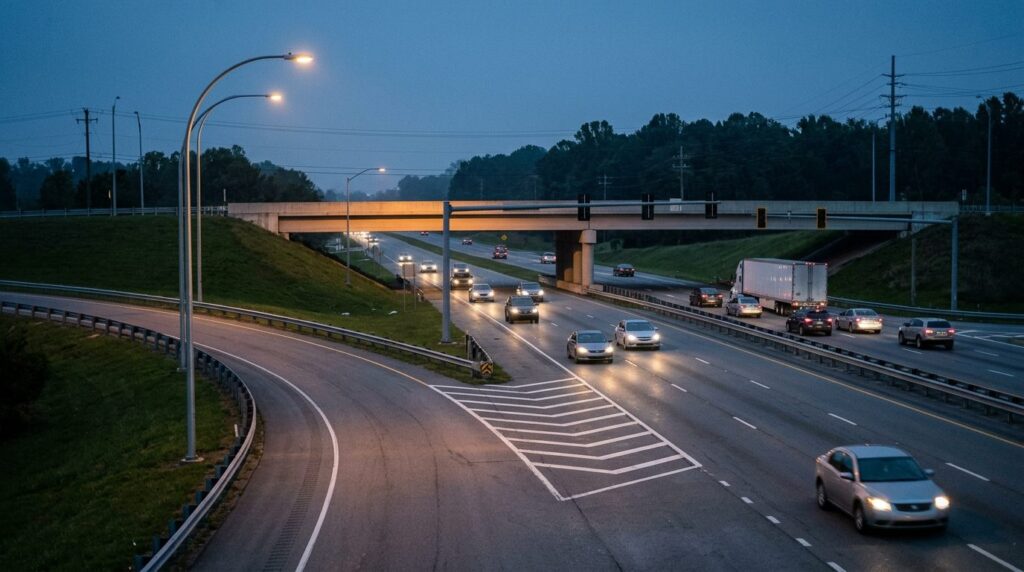
Western Avenue has a split personality, and the crash records show it plainly. Half of everything that happens on this road happens on one two mile stretch around the Interstate 640 interchange, where the traffic is heaviest, the driveways are constant and the crashes are mostly bent bumpers. That half of the road has killed two people in twelve years. The thin stretch out past Third Creek toward Karns carries less than a fifth of the crashes and has killed twelve. Of the 2,874 reported crashes on Western Avenue in Knox County since 2015, 113 of them, under four percent, account for 14 of the corridor’s 23 deaths. This guide covers Western Avenue in Knoxville, the State Route 62 corridor running northwest from downtown through Mechanicsville, Lonsdale, Beaumont and Pleasant Ridge, under the interstate and out toward Karns. At OEB Law, our Knoxville team handles claims on this corridor, and we know how its intersections, its responding agencies and the Knox County courts actually work. In this blog post, Knoxville attorney Tim Elrod discusses what to do after a car accident on Western Avenue in Knoxville.
Key Takeaways
- The half of Western Avenue that crashes is not the half that kills. The two miles around the Interstate 640 and I-75 interchange hold 1,433 of the corridor’s 2,874 crashes and 2 of its 23 deaths. The stretch from Third Creek out to Karns holds 513 crashes and 12 deaths, a death rate 17 times higher per crash, per OEB Law’s crash-data analysis.
- Under four percent of the crashes produced 61 percent of the deaths. The 113 crashes that were head-on, involved a motorcycle, or struck someone on foot killed 14 people. The 2,532 ordinary car-against-car crashes killed 7.
- Western Avenue kills more people per crash than any other Knoxville surface street of its size. It records 8.0 deaths per 1,000 crashes against Kingston Pike’s 2.3, on fewer than half as many crashes.
- The road is getting quieter and much deadlier. Crashes fell about 28 percent from 2015 through 2018 to 2022 through 2025, while deaths rose from 3 to 12 and the death rate per 1,000 crashes rose five and a half times.
- Tennessee gives you only one year to file a personal injury claim, which is one of the shortest deadlines in the country.
To Discuss Your Case, Call or Text Our Team Standing By 24/7: (865) 546-1111
About OEB Law, Your Knoxville Legal Team
This guide is provided by the experienced attorneys at OEB Law, led by Managing Attorney Timothy G. Elrod. Founded in Knoxville in 2004, our firm has over 50 years of combined experience navigating East Tennessee’s legal system.
We have successfully represented thousands of personal injury clients, developing deep expertise in Tennessee’s complex wrongful death and accident laws. As East Tennessee natives, we have a direct understanding of the local court systems, law enforcement agencies, and community needs. Our commitment is to provide trusted, authoritative information to our neighbors in Knoxville and the surrounding Tennessee communities. However, this information does not constitute legal advice. If you or a loved one has been injured in an accident or needs legal help, call us today for a free, no obligation, initial consultation.
In This Guide
What the twelve sections below cover, in order.
- Which Western Avenue This Guide Is AboutThe exact road every figure here describes, and why Oak Ridge Highway on the same route number is excluded.
- Half the Crashes, One Twelfth of the DeathsWhy the busiest two miles of this corridor and its deadliest miles are not the same place.
- Where Western Avenue Goes Wrong, Mile by MileThe five stretches from downtown to Karns, and what changes between them.
- The Junctions That Crash and the Junctions That HarmEvery crash mapped to its nearest cross street, and why the two rankings barely overlap.
- Fewer Crashes, More DeathsCrashes are down about 28 percent since 2015. Deaths have quadrupled.
- Why Western Avenue Is on the High Injury NetworkThe formal regional safety designation this corridor carries, and what it proves about notice.
- The Fault Fight Depends on Which Crash You HadRear end, angle, head-on and pedestrian claims each turn on different proof.
- First Steps: Emergency and Medical ResponseWhich agency writes your report, where you are likely treated, and what to do in the first week.
- Who Can Be Held LiableEvery party and every policy worth identifying before the coverage runs short.
- Tennessee Law and Which Court Hears Your CaseThe one year deadline, the 50 percent fault bar, the damages cap and the Knox County venue.
- What Your Claim May Be WorthWhat the value is actually built from, and why severity changes the shape of the case.
- Frequently Asked QuestionsThe eight questions we are asked most often after a crash on this corridor.
Which Western Avenue This Guide Is About
Every figure in this guide describes one specific road: Western Avenue in Knoxville, Knox County, which appears in the regional crash records as Western Ave. It carries State Route 62. It begins downtown at the Henley Street and Broadway junction near the L&N, runs northwest past the Knoxville College campus in Mechanicsville, through Lonsdale and Beaumont, past Texas Avenue and Pleasant Ridge Road, under the Interstate 640 and I-75 interchange, out past Third Creek and Sullivan Road, and continues toward Karns. That is roughly seven miles of road, and 2,874 reported crashes on it since 2015.
We are specific about this for a reason that matters if you ever check our numbers against the raw data yourself. Keep going northwest past Karns and the same State Route 62 stops being called Western Avenue and becomes Oak Ridge Highway, which is a separate road name in the crash records with 2,081 crashes and 18 deaths of its own, and which runs on into Anderson County. A guide that silently merged the two would nearly double the crash total and import a different road’s fatalities into a Knoxville claim. Oak Ridge itself also has a Northwestern Avenue, and a database search for the letters “Western Ave” picks it up, which adds 14 crashes from a town 20 miles away.
So when this guide says Western Avenue, it means the Knoxville arterial carrying State Route 62 inside Knox County, and nothing else. The figures below are all drawn on that basis.
Western Avenue in Knoxville: Where the Crashes Are and Where the Deaths Are
Western Avenue in Knox County, recorded as Western Ave., carrying State Route 62, from the Henley Street and Broadway junction downtown northwest toward Karns. 2015 through 2026. Oak Ridge Highway, which is the same route under a different name past Karns, and Oak Ridge’s separate Northwestern Avenue are both excluded.
How these crashes happen
| Crash group | Crashes | Deaths | Deaths per 1,000 crashes |
|---|---|---|---|
| Ordinary vehicle against vehicle: rear-end, angle or same-direction sideswipe, no motorcycle, no pedestrian | 2,532 | 7 | 2.8 |
| Head-on, motorcycle involved, or struck a person on foot | 113 | 14 | 123.9 |
| Everything else | 229 | 2 | 8.7 |
Figures come from OEB Law’s crash-data analysis drawing on the Knox County Transportation Planning Organization (Knox TPO) Interactive Crash Map, covering Western Ave. in Knox County only. The 2026 figures are a partial year. Percentages are rounded, and the bar chart omits smaller crash types, so the bars do not total 100 percent. The three groups in the table are mutually exclusive and total the corridor’s 2,874 crashes and 23 deaths. Three crashes were both head-on and involved a motorcycle and are counted once in the middle row.
Half the Crashes, One Twelfth of the Deaths
The single most useful thing to understand about a Western Avenue crash is that the corridor’s crash volume and the corridor’s death toll sit at opposite ends of the road. Read the totals alone and Western Avenue looks like a busy commercial arterial with an ordinary safety record. Look at where people actually died and it reads like a rural highway. Both readings are correct, because they describe different stretches of the same street.
The Interchange Strip Is Where Western Avenue Crashes
Three quarters of the reported crashes on Western Avenue, 2,157 of 2,874, are recorded as property damage only, with no injury reported at all. Another 623 involved a minor or possible injury. That is the corridor’s ordinary business, and it is concentrated: the two mile stretch from Piedmont Street west to Hinton Drive, which contains the Interstate 640 and I-75 interchange and the retail strip on either side of it, holds 1,433 crashes. That is 50 percent of everything recorded on a road that runs about seven miles.
The crash types there are exactly what that environment produces. Rear end collisions make up 614 of that stretch’s crashes and angle collisions another 554, with 148 same direction sideswipes on top. It is a 45 mph road carrying between about 23,200 and 23,700 vehicles a day into and out of an interstate interchange, with drivers braking for signals and turning across traffic into parking lots.
Here is the part that matters. Those 1,433 crashes, over twelve years, killed two people between them. The interchange ramps themselves recorded 182 crashes and killed nobody at all, with three suspected serious injuries in the entire record.
The Two Ends Are Where It Kills
Western Avenue has recorded 23 deaths and 96 suspected serious injuries since 2015. Twelve of those 23 deaths, more than half, came out of the 513 crashes recorded from Third Creek west toward Karns. That stretch is 18 percent of the corridor’s crashes and 52 percent of its deaths, a rate of 23.4 deaths per 1,000 crashes against 1.4 on the interchange strip.
The inner end does something similar on a smaller scale. The stretch from Middlebrook Pike out to Keith Avenue, through Mechanicsville and past Knoxville College, recorded 245 crashes and 5 deaths, which is 20.4 per 1,000. It is posted at 35 mph for its entire length, so this is not a speed limit story in the way the western end is. It is a street grid story: 119 of its 245 crashes are angle collisions, the highest share anywhere on the corridor, because a 35 mph four lane arterial is crossed there by a dense grid of residential streets, most of them unsignalized.
Under Four Percent of the Crashes, Sixty-One Percent of the Deaths
The severity on this corridor is not spread thinly across its crash types. It is packed into three of them.
Head-on collisions account for 62 crashes on Western Avenue, 2.2 percent of the total, and they killed 7 people. Crashes involving a motorcycle account for 40 crashes, 1.4 percent, and killed 5. Crashes that struck someone on foot account for just 14, half a percent of the corridor, and killed 2. Allowing for the three crashes that were both head-on and involved a motorcycle, those categories together are 113 crashes, 3.9 percent of everything on the road, and they produced 14 of its 23 deaths.
Set that against the rest. The 2,532 crashes that were rear end, angle or same direction sideswipe collisions with no motorcycle and no pedestrian involved, 88 percent of the corridor, killed 7 people in twelve years. That is 2.8 deaths per 1,000 crashes against 123.9 in the other group, a gap of roughly 45 times.
Two more cuts sharpen it. The 156 crashes recorded where Western Avenue is posted at 55 mph are 5.4 percent of the corridor and hold 6 of the 23 deaths. And although only about 17 percent of crashes here happen after dark on a lit street, those 490 crashes hold 10 of the 23 deaths, the same number as the 2,136 crashes recorded in daylight.
Western Avenue Against the Rest of Knoxville
Knoxville surface streets with more than 2,000 recorded crashes since 2015, ranked by deaths per crash rather than by crash count. Interstates are excluded because they are a different kind of road.
Deaths per crash, Knoxville’s busiest surface streets
| Road | Crashes | Killed | Suspected serious injuries | Deaths per 1,000 crashes |
|---|---|---|---|---|
| Western Avenue | 2,874 | 23 | 96 | 8.0 |
| North Broadway | 3,891 | 26 | 135 | 6.7 |
| Chapman Highway | 3,122 | 19 | 128 | 6.1 |
| Clinton Pike | 2,135 | 11 | 91 | 5.2 |
| Kingston Pike | 7,065 | 16 | 144 | 2.3 |
Western Avenue is the fifth busiest road in Knoxville by crash count and the third deadliest by number of people killed. Measured per crash, it is first among the city’s major surface streets. Kingston Pike absorbs nearly two and a half times Western Avenue’s crash volume and has killed seven fewer people.
What the deaths have in common
| Circumstance | Share of crashes | Share of deaths |
|---|---|---|
| Recorded along the roadway rather than at an intersection | 38.2 percent (1,098) | 65 percent (15 of 23) |
| After dark on a lit street | 17.1 percent (490) | 43 percent (10 of 23) |
| Where the road is posted at 55 mph | 5.4 percent (156) | 26 percent (6 of 23) |
| A motorcycle was involved | 1.4 percent (40) | 22 percent (5 of 23) |
| Alcohol was recorded | 1.5 percent (43) | 13 percent (3 of 23) |
| A teen driver was involved | 21.8 percent (626) | 4 percent (1 of 23) |
The last row is there because it is the one most people would guess wrong. Teen drivers are involved in more than a fifth of all crashes on Western Avenue, far more than any other factor recorded here, and in one death in twelve years. Volume and severity are separate questions on this road, and that is true of its crash types, its stretches, its junctions and its drivers.
Figures come from OEB Law’s crash-data analysis drawing on the Knox County Transportation Planning Organization (Knox TPO) Interactive Crash Map. Western Avenue figures cover Western Ave. in Knox County only; comparison roads are measured inside the Knoxville city boundary used in the same records. The 2026 figures are a partial year. Rows in the second table overlap with one another and are not additive. Percentages are rounded.
Where Western Avenue Goes Wrong, Mile by Mile
Western Avenue is not one uniform road. Across its seven miles the posted speed changes four times, the lane configuration changes and the surroundings go from downtown to suburban to almost rural. The crash pattern changes with all of it, and not in the direction most people would expect, because the traffic volume runs the opposite way to the intuition: the narrow downtown end carries the least traffic on the corridor, around 15,200 to 16,400 vehicles a day, while the open, fast western end is recorded at around 23,700, the same as the busy interchange strip.
Downtown to Middlebrook Pike
The first stretch runs from the Henley Street and Broadway junction out past Dale Avenue, the Ailor Avenue cluster and North 17th Street to the Middlebrook Pike and University Avenue junction. It recorded 444 crashes, 3 deaths and 10 suspected serious injuries. Most of it is posted at 35 mph, with a 45 mph section, and 312 of its 444 crashes happened at an intersection rather than between intersections. This is the stretch where Western Avenue behaves most like a downtown street, and its crashes reflect that: 189 rear end and 161 angle collisions, with only 8 head-on crashes and no deaths among them.
Mechanicsville and Knoxville College
From Middlebrook Pike to Keith Avenue, Western Avenue runs four lanes at 35 mph through Mechanicsville, past the Knoxville College campus, Knoxville College Drive and North 21st Street. It recorded 245 crashes, 5 deaths and 21 suspected serious injuries, which is the second highest death rate on the corridor and a serious injury count out of all proportion to its crash volume.
This is also where Western Avenue is most dangerous on foot. Only 14 pedestrian crashes are recorded on the whole corridor, but the only two that killed someone, one in 2023 and one in 2026, happened within about half a mile of each other on this stretch, both where the road is posted at 35 mph. Four of the corridor’s 14 pedestrian crashes are here, on a stretch holding only 8.5 percent of its traffic crashes.
The KCDC Transforming Western redevelopment is reshaping the neighborhoods on either side of this stretch. Its groundbreaking was in August 2023, it is funded in part by a 40 million dollar federal Choice Neighborhoods grant, and its plans call for 240 rehabilitated units and 479 new ones across phases running to 2028. More residents and more people on foot along a 35 mph four lane arterial is the pattern that has already produced both of this corridor’s pedestrian deaths.
Lonsdale and Beaumont to Pleasant Ridge
From Keith Avenue to Piedmont Street, past Mynderse Avenue, Texas Avenue and the Dayton Street and Pleasant Ridge Road junction, the corridor recorded 239 crashes, 1 death and 5 suspected serious injuries. It is posted at 35 mph throughout. This is the quietest and, per crash, the safest stretch of Western Avenue, at 4.2 deaths per 1,000.
The Interstate 640 and I-75 Interchange and the Commercial Strip
From Piedmont Street west to Hinton Drive, Western Avenue carries the interchange with Interstate 640 and I-75, the Knoxville Bypass, along with the retail and service strip around Copper Kettle Street, Ed Shouse Drive, Randy Tyree Street, Sanderson Road and Shoppers Lane. It recorded 1,433 crashes, 2 deaths and 36 suspected serious injuries. Most of it is posted at 45 mph. All but 6 of the corridor’s 182 ramp crashes are here.
Half the corridor’s crashes and under nine percent of its deaths. If your crash happened on this stretch, the fight is very unlikely to be about whether you were badly hurt in a catastrophic sense and very likely to be about the extent of a soft tissue injury and who had the right of way.
Third Creek to Karns
From the Ball Camp Pike and Third Creek Road junction west past Sullivan Road, Matlock Drive, McKamey Road, Palmetto Road, John May Drive and Short Road, Western Avenue leaves the commercial strip behind. The posted limit rises to 40 mph and then to 55 mph, and the signals get much further apart. It recorded 513 crashes, 12 deaths and 24 suspected serious injuries.
What it does not do is get quieter. This stretch is recorded at about 23,700 vehicles a day on the crash records, essentially the same as the interchange strip that produces half the corridor’s crashes, and far above the 15,200 to 16,400 on the downtown end. Traffic volumes in this dataset are attached to long stretches of road rather than measured at each junction, so treat the two as equal rather than ranking one above the other. Equal is the point: the same volume of traffic, moving faster with far fewer places to stop it, produces a third as many crashes and six times as many deaths. That is the clearest evidence on this corridor that its severity pattern is about speed and signal spacing rather than congestion.
Head-on collisions are what make it the deadliest stretch on the corridor by a wide margin. Seventeen of the corridor’s 62 head-on crashes are here and they killed 5 people. The single worst crash on the entire corridor in the twelve year record happened on this stretch: in June 2024, in the 6000 block near John May Drive, a westbound SUV crossed into the eastbound lanes and struck an oncoming vehicle head-on before a third vehicle struck the SUV. Three people died, including a ten year old child, and three more children were seriously hurt. The Knoxville Police Department said evidence suggested the driver who crossed the centerline may have suffered a medical event. In September 2025 another head-on crash on this stretch, near Sullivan Road, killed a driver.
Western Avenue Segment by Segment, Downtown to Karns
Half of this corridor’s crashes and one twelfth of its deaths are on the same two miles. Figures cover Western Ave. in Knox County, 2015 through 2026.
| Segment | Crashes | Deaths | Suspected serious injuries | Deaths per 1,000 crashes | Posted limit | Vehicles per day |
|---|---|---|---|---|---|---|
| Downtown: Henley St and Broadway to Middlebrook Pike | 444 | 3 | 10 | 6.8 | 35 and 45 mph | 15,200 to 16,400 |
| Mechanicsville and Knoxville College: Middlebrook Pike to Keith Ave | 245 | 5 | 21 | 20.4 | 35 mph | 16,400 |
| Lonsdale and Beaumont to Pleasant Ridge: Keith Ave to Piedmont St | 239 | 1 | 5 | 4.2 | 35 mph | 23,200 |
| I-640 and I-75 interchange and the commercial strip: Piedmont St to Hinton Dr | 1,433 | 2 | 36 | 1.4 | 45 mph | 23,200 to 23,700 |
| Third Creek to Karns: Ball Camp Pike to Nickle Rd | 513 | 12 | 24 | 23.4 | 40 and 55 mph | 23,700 |
Why does the busiest stretch of Western Avenue have the lowest death rate?
Signals and driveways. The two miles around the Interstate 640 and I-75 interchange carry the corridor’s heaviest traffic into and out of a retail strip, so vehicles are constantly slowing to turn, and the result is a very high number of crashes at very low speeds. That stretch holds 1,433 of the corridor’s 2,874 crashes, half of everything on a seven mile road, and 2 of its 23 deaths. Its 182 interchange ramp crashes killed nobody at all and produced three serious injuries in twelve years.
Why is the stretch out toward Karns so much deadlier?
Not because it is quieter in traffic terms, which is the usual explanation and is wrong here. This stretch is recorded at about 23,700 vehicles a day, the same as the interchange strip. What changes is that the posted limit rises to 40 and then 55 mph and the signals are much further apart, so the same volume of traffic moves faster with fewer places to stop it. It produced 513 crashes and 12 deaths, a rate of 23.4 per 1,000 against 1.4 on the interchange strip, 17 times higher. Seventeen of the corridor’s 62 head-on collisions are on this stretch and they killed 5 people.
Which stretch is most dangerous on foot?
Mechanicsville, from Middlebrook Pike to Keith Avenue. Only 14 pedestrian crashes are recorded on the whole of Western Avenue, but 4 of them are on this one stretch, and both of the two that killed someone, in 2023 and in 2026, happened within about half a mile of each other here, where the road is posted at 35 mph. This stretch also holds 21 of the corridor’s 96 suspected serious injuries on only 8.5 percent of its crashes, and the Knoxville College Drive and North 21st Street junction on it has recorded more serious injuries than any other junction on the road.
Figures come from OEB Law’s crash-data analysis drawing on the Knox County Transportation Planning Organization (Knox TPO) Interactive Crash Map. Segments are defined by the mapped coordinates of each crash and named for the neighborhoods and cross streets they run between, so segment boundaries are approximate on the ground. Posted limits and vehicle counts are the values recorded on the crash reports within each segment and vary within it. The five segments account for all 2,874 crashes, all 23 deaths and all 96 suspected serious injuries on the corridor. The 2026 figures are a partial year.
The Junctions That Crash and the Junctions That Harm
Totals for a corridor tell you very little about the junction where your own crash happened, so we mapped every recorded crash on Western Avenue to the nearest named cross street. About 80 percent of them resolve to a specific junction. The remaining 20 percent are the mid block story, and they are not minor: those 582 crashes hold 8 of the corridor’s 23 deaths, including the June 2024 crash, which happened between junctions rather than at one. Across the whole corridor, 1,098 crashes are recorded as happening along the roadway rather than at an intersection, and those hold 15 of the 23 deaths.
Among the junctions themselves, the ranking by crash count and the ranking by harm are almost unrelated.
The busiest junction on Western Avenue is the Copper Kettle Street, Ed Shouse Drive and Randy Tyree Street cluster on the commercial strip, with 412 recorded crashes. It has killed nobody in twelve years, with 9 suspected serious injuries. The Clifton Road and Sanderson Road junction just east of it is second with 228 crashes, also with no deaths, and 11 serious injuries.
Now compare the Knoxville College Drive and North 21st Street junction in Mechanicsville. It recorded 86 crashes, a fifth of the busiest junction’s volume, and 12 suspected serious injuries, which is more than any other junction on the road. One death. Or the Sullivan Road junction out west: 55 crashes, 2 deaths and 5 serious injuries. Matlock Drive: 59 crashes and 2 deaths. McKamey Road: 126 crashes and 2 deaths. The Middlebrook Pike and University Avenue junction: 159 crashes and 2 deaths.
The practical point for a claim is that the junction with 412 crashes and no deaths is a place where insurers see the same low speed collision over and over and price it accordingly, while a crash at one of the quieter junctions out west or in Mechanicsville sits in a far more severe local pattern. Knowing which one you were in changes what the claim needs to prove.
Western Avenue Junction by Junction
Every recorded crash on the corridor mapped to its nearest named cross street. Ordered by crash count, so the last column is the one to read: the junction with the most crashes is close to the least harmful per crash.
| Junction | Crashes | Killed | Suspected serious injuries | Killed or seriously hurt per 100 crashes | Stretch |
|---|---|---|---|---|---|
| Copper Kettle St, Ed Shouse Dr and Randy Tyree St | 412 | 0 | 9 | 2.2 | Interchange strip |
| Clifton Rd and Sanderson Rd | 228 | 0 | 11 | 4.8 | Interchange strip |
| Middlebrook Pike and University Ave | 159 | 2 | 0 | 1.3 | Downtown |
| Shoppers Ln | 147 | 0 | 4 | 2.7 | Interchange strip |
| Hinton Dr | 135 | 1 | 3 | 3.0 | Interchange strip |
| Dale Ave | 127 | 1 | 4 | 3.9 | Downtown |
| McKamey Rd | 126 | 2 | 4 | 4.8 | Third Creek to Karns |
| Knoxville College Dr and N 21st St | 86 | 1 | 12 | 15.1 | Mechanicsville |
| Texas Ave | 81 | 0 | 1 | 1.2 | Lonsdale and Beaumont |
| Palmetto Rd | 73 | 0 | 3 | 4.1 | Third Creek to Karns |
| Dayton St, Pleasant Ridge Rd and Waverly St | 69 | 0 | 2 | 2.9 | Lonsdale and Beaumont |
| Matlock Dr | 59 | 2 | 1 | 5.1 | Third Creek to Karns |
| Ball Camp Pike and Third Creek Rd | 59 | 1 | 3 | 6.8 | Third Creek to Karns |
| Sullivan Rd | 55 | 2 | 5 | 12.7 | Third Creek to Karns |
| Ailor Ave, Carrick St, College St and Deaderick Ave | 53 | 1 | 3 | 7.5 | Downtown |
| Keith Ave | 27 | 1 | 2 | 11.1 | Mechanicsville |
| Between junctions, not resolving to any cross street | 582 | 8 | 13 | 3.6 | Whole corridor |
The two highlighted rows are the ones that matter most for a claim. Knoxville College Drive and North 21st Street has a fifth of the busiest junction’s crash volume and more suspected serious injuries than any other junction on Western Avenue. Sullivan Road has an eighth of that volume and has killed two people. Keith Avenue, further down the same Mechanicsville stretch, has 27 recorded crashes and has killed one. Meanwhile the junction with 412 crashes has killed nobody in twelve years. A crash report that says “Western Avenue” tells an insurance adjuster almost nothing about which of these situations you were in.
The final row is not a rounding error. Nearly 20 percent of crashes on this corridor do not resolve to any named cross street, and they hold 8 of its 23 deaths, including the June 2024 crash that killed three people in the 6000 block. Mid block is where this road is most dangerous, and a mid block crash has no signal timing, no intersection camera and often no independent witness to establish what happened.
Figures come from OEB Law’s crash-data analysis drawing on the Knox County Transportation Planning Organization (Knox TPO) Interactive Crash Map. Each crash was matched to the nearest named junction on the corridor within about 150 metres, after merging junction nodes within about 120 metres of each other, which resolves 2,292 of the 2,874 crashes, or 79.7 percent. Junctions are listed under the names of the streets meeting Western Avenue at that point. The 16 junctions shown account for 1,896 crashes and 14 of the 23 deaths. Those 14 plus the 8 recorded between junctions leave one further death, which occurred at a junction with only four recorded crashes in the whole period, too few for a rate to mean anything, so it is not listed. Smaller junctions are otherwise omitted, which is why the rows do not total the corridor. The 2026 figures are a partial year.
Fewer Crashes, More Deaths
Western Avenue is getting quieter and considerably deadlier at the same time, and the shift is far sharper than the falling crash count would ever suggest.
In the four years from 2015 through 2018, Western Avenue recorded 1,180 crashes and 3 deaths. In the four years from 2022 through 2025, it recorded 853 crashes and 12 deaths. Crashes fell about 28 percent. Deaths quadrupled. As a rate, deaths per 1,000 crashes went from 2.54 to 14.07, a five and a half fold increase. The worst single year in the record is 2024, with 198 crashes and 6 deaths.
The explanation visible in the data is the mix, not the volume. Fewer low speed collisions are being recorded on the busy interchange strip, which is what drives the total down, while the crashes that happen on the 40 and 55 mph western end and in the 35 mph Mechanicsville grid have gone the other way. If you are told that Western Avenue has become safer because the crash count has dropped, that is the opposite of what the severity record shows.
Why Western Avenue Carries a High Injury Network Designation
The Knoxville Regional Transportation Planning Organization maintains a High Injury Network as part of its federal Safe Streets and Roads for All work, which identifies the specific road segments across the region that produce a disproportionate share of deaths and serious injuries. Western Avenue carries 17 of those segments, totaling about 4.57 miles, of which roughly 2.03 miles are in the top Tier 1 category and 2.54 miles in Tier 2. For context, the entire regional network is 418 segments.
This matters for two practical reasons beyond the safety planning it was built for. First, it is independent confirmation that the severity pattern described above is real and recognized, rather than something a law firm assembled from a favorable reading of the numbers. Second, it establishes notice. When a corridor has been formally identified by the regional planning organization as a high injury road, arguments about whether the hazards on it were known and foreseeable look very different.
The Fault Fight Depends on Which Western Avenue Crash You Had
A Western Avenue claim is not one kind of case. The corridor produces four distinct crash patterns, and each turns on different proof.
Rear End Collisions: Liability Is Usually Clear, the Fight Is Over Your Injury
Rear end collisions are the largest single category on Western Avenue at 1,156 crashes, 40.2 percent of the corridor, and most of them are on the interchange strip. In these cases the following driver is usually at fault and the insurer rarely contests it seriously. The dispute is almost always about the injury: whether a soft tissue injury is as significant as you say, whether a gap in treatment means you recovered, whether your symptoms predate the crash. These claims are won on consistent, documented medical care from the first week forward, and they are lost by waiting to see whether the pain goes away.
Angle Collisions: Both Drivers Say They Had the Right of Way
Angle collisions are the second largest category at 1,136 crashes, and they are where the real injuries are: 53 of the corridor’s 96 suspected serious injuries and 8 of its 23 deaths. On Western Avenue these split into two different arguments. On the signalized commercial strip it is the classic contested green, resolved by signal phasing at that specific intersection, the damage pattern showing the angle and relative speed of impact, independent witnesses, and camera footage from the businesses lining the road. In the Mechanicsville grid it is more often a vehicle pulling out of an unsignalized residential street across four lanes of 35 mph traffic, where the fight is about sight lines, parked vehicles, vegetation and whether the through driver could have stopped.
In both versions the decisive evidence is physical and perishable: camera footage where any exists, which those systems typically overwrite within days, and the state of the sight lines, which changes with the season and with whatever happened to be parked there that day.
Head-On Collisions and the Medical Emergency Defense
Head-on collisions are only 2.2 percent of Western Avenue crashes and nearly a third of its deaths, and they are concentrated on the western end. These are the catastrophic cases on this corridor, and they bring a defense that most crash claims never see.
When a driver crosses the centerline, the obvious conclusion is negligence. But Tennessee recognizes that a driver who is suddenly and unforeseeably incapacitated, by a heart attack, a stroke, a seizure or a similar event, may not be liable for what the vehicle then does, because negligence requires a failure to exercise reasonable care and an unconscious driver cannot exercise any. The defense is narrow and the party asserting it carries the burden. It fails where the medical event was foreseeable, which is the heart of most of these cases: a driver with a known condition, a recent episode, a medication warning, a physician’s advice not to drive, or a license restriction. It also fails where the driver had warning signs and kept driving instead of pulling over.
The Knoxville Police Department said evidence in the June 2024 Western Avenue crash suggested the driver who crossed the centerline may have had a medical event. That is exactly the scenario where a claim lives or dies on medical records, prescription history and driving history that have to be obtained through the legal process, not on the police report. If you were hit head-on by a driver who crossed into your lane on this road, do not accept at face value that nobody is responsible.
If You Were on Foot
Only 14 pedestrian crashes are in the Western Avenue record, and 2 of them killed someone. That ratio, roughly one death in every seven, is what a four lane arterial does to a person on foot. Tennessee uses modified comparative fault, so your recovery is reduced by the share of fault assigned to you and eliminated only if that share reaches 50 percent, and the defense will build its case on where you were crossing. That is not the end of the analysis. The driver’s speed, lane position, headlight use, the sight line and the condition of the street lighting are all part of the allocation, and on this corridor the long gaps between signalized crossings are part of the picture too.
What Disappears, and How Fast
On Western Avenue the evidence that decides a contested claim is almost all perishable, and most of it is owned by somebody with no reason to keep it. This is the order to work in.
At the scene, or as soon as you are able
- Photograph all vehicles from several angles, including the undamaged sides, and the final resting positions before anything is moved.
- Photograph the roadway: lane markings, the centerline if a vehicle crossed it, skid marks, debris spread, signals and signs, and what you could and could not see from your approach.
- Note the exact location in a way that will still mean something later: the nearest cross street and the nearest business address. “Western Avenue” is not enough, and on this corridor a mile either way is a different kind of case.
- Get names and numbers for every witness, including anyone who stopped and left before police arrived.
- Be medically evaluated the same day even if you feel fine.
Camera footage, before it overwrites
- Write down every business within sight of the crash. On the commercial strip around the interchange there are often several, and their cameras aimed at parking lots usually see the roadway.
- Ask each one, in person, whether their system recorded it and how long it retains footage. Many retain seven days or fewer.
- On the western end past Third Creek there may be no business cameras at all, which makes residential doorbell cameras and any dash cameras in passing vehicles the only footage that exists.
- Have a lawyer send written preservation letters. A verbal request to a shift manager is not a legal hold.
Records and vehicle data
- Request the crash report and check the location, direction of travel, diagram and narrative for errors.
- Do not let your vehicle be scrapped or sold by the insurer. Its event data recorder holds pre-impact speed, braking and seat belt data, and it leaves with the car.
- In a head-on or crossing-the-centerline crash, the other driver’s vehicle matters as much as yours, and so does any claim of a sudden medical event. Those are proved or disproved from medical, prescription and driving records obtained through the legal process.
- Photograph the street lighting after dark if the crash happened at night. Ten of the corridor’s 23 deaths happened after dark on a lit street, and a light that was out gets repaired without a record you can find later.
- Keep every medical record, bill, prescription and work absence note from day one, with no gaps in treatment.
First Steps: Emergency and Medical Response on Western Avenue
Which Agency Writes Your Report
For most of the corridor the Knoxville Police Department responds, and it covers Western Avenue from downtown through Mechanicsville, Lonsdale, Beaumont and Pleasant Ridge and out along the commercial strip. Toward the western end the corridor approaches unincorporated Knox County, where the Knox County Sheriff’s Office responds. Because Western Avenue carries State Route 62, the Tennessee Highway Patrol also has authority and a trooper may be the reporting officer anywhere on it. At the Interstate 640 and I-75 interchange it depends on whether you were on the ramp, the interstate or Western Avenue itself.
This matters because a crash report requested from the wrong place comes back empty. Tennessee crash reports from all of these agencies are filed into the state system and sold through the Tennessee Department of Safety’s crash report portal at purchasetncrash.gov. The Knoxville Police Department records unit also provides reports, and body camera or in car video is a separate request with its own fee. Get the report, check that the responding agency and the location on it match where you actually were, and read the narrative and the diagram rather than just the citation line.
Where You Are Likely Treated
The University of Tennessee Medical Center on Alcoa Highway is the only Level I trauma center in the region and has held that designation since 1988, so a serious injury anywhere on this corridor is likely to end up there regardless of which end of the road you were on. For a crash at the downtown end, Fort Sanders Regional Medical Center on Clinch Avenue, with its emergency entrance on Laurel Avenue, is the nearest full emergency department. For the western end, Parkwest Medical Center in West Knoxville is the closer option.
One local fact is worth knowing if you are trying to understand response times on the inner part of this corridor. The hospital that used to be nearest to it, Physicians Regional Medical Center on East Oak Hill Avenue, the former St. Mary’s, closed at the end of December 2018. Everything after that date on the Mechanicsville and Lonsdale stretch has been transported further.
Whichever end you were on, be evaluated even if you feel fine. Adrenaline masks injuries that surface two or three days later, and a gap between the crash and your first medical visit is the single most common thing an insurer uses to argue that your injury came from something else.
What To Do in the First Week
- Photograph the scene, the vehicles, the roadway, the signals or lack of them, the sight lines and any skid marks, and do it before anything is moved or repaired.
- Write down the names of every business within sight of the crash. On this corridor that is often the only camera evidence that exists, and it is usually gone within days.
- Get the crash report and check it for errors in the location, the direction of travel and the diagram.
- Keep every medical record, bill and work absence note from day one.
- Do not give a recorded statement to the other driver’s insurer before you have advice, and do not accept an early offer made before the full extent of your injury is known.
- Contact a lawyer quickly if the crash was head-on, involved a motorcycle, involved someone on foot, or happened on the western end of the corridor, because those are the cases where the evidence that decides them disappears fastest.
Who Can Be Held Liable
More than one party is often responsible for a Western Avenue crash, and more than one insurance policy is often available. Identifying all of them early matters, because a single policy limit can be exhausted long before a serious injury is fully valued.
- The other driver, under their own liability coverage.
- The driver’s employer, where the driver was working at the time. The corridor carries a meaningful amount of commercial traffic, with 146 truck or bus involved crashes recorded, and a commercial policy is typically far larger than a personal one.
- The vehicle’s owner, where that is someone other than the driver.
- A bar or restaurant, in the narrow circumstances where Tennessee’s dram shop law applies. Alcohol was recorded in 43 crashes on this corridor, and those 43 crashes hold 3 of its 23 deaths and 9 of its serious injuries.
- A vehicle or parts manufacturer, where a defect contributed, which is worth considering in any single vehicle crash that is otherwise unexplained.
- A road authority or contractor, where a design, maintenance, signal or signage failure contributed. Claims against government entities in Tennessee run on their own rules and shorter notice deadlines, so these have to be identified early.
- Your own insurer, through uninsured and underinsured motorist coverage, which is frequently the most important policy in a serious crash on this road because the at fault driver’s limits are often far too low.
Who Can Be Held Liable for a Western Avenue Crash
More than one party is often responsible, and more than one policy is often available. On a corridor where a single crash has killed three people, a single policy limit can be exhausted long before a serious injury is fully valued.
The other driver
Their liability coverage is the first policy, and on this corridor it is frequently far too small for the injury. Tennessee’s minimum limits have not kept pace with the cost of a serious crash.
Every crashThe driver’s employer
If the driver was working, a commercial policy applies and it is typically many times larger than a personal one. Western Avenue records 146 crashes involving a truck or bus, concentrated on the commercial strip and the interchange.
146 truck or bus crashesThe vehicle’s owner
Where the driver was not the owner, the owner’s policy may also respond, and in some circumstances the owner is independently responsible for entrusting the vehicle.
Borrowed and family vehiclesA bar or restaurant
In the narrow circumstances where Tennessee’s dram shop law applies. Alcohol was recorded in 43 crashes on Western Avenue, and those 43 crashes hold 3 of the corridor’s 23 deaths and 9 of its serious injuries.
43 alcohol crashes, 3 deathsA vehicle or parts manufacturer
Where a defect contributed. Worth considering in any single vehicle crash that is otherwise unexplained, and in a crossing-the-centerline crash where the driver reports a mechanical failure.
138 crashes with no other vehicleA road authority or contractor
Where a design, maintenance, signal, signage or lighting failure contributed. Ten of the corridor’s deaths happened after dark on a lit street, which makes street lighting a live question. Claims against government entities run on their own shorter notice rules.
Shorter deadline, identify earlyYour own insurer
Uninsured and underinsured motorist coverage is often the single most important policy in a serious crash here, because it is the one that responds when the at fault driver’s limits run out. Check your own declarations page early.
Frequently the largest recoveryMore than one driver
The corridor’s worst crash involved three vehicles. Where a second or third vehicle contributed, each carries its own policy, and Tennessee allocates fault among them by percentage.
95.5 percent of crashes are multi-vehicleCrash figures come from OEB Law’s crash-data analysis drawing on the Knox County Transportation Planning Organization (Knox TPO) Interactive Crash Map, covering Western Ave. in Knox County, 2015 through 2026. Nothing here is legal advice about your own claim, and which parties apply depends entirely on your facts.
Tennessee Law and Which Court Hears Your Case
The One Year Deadline
Tennessee requires most personal injury lawsuits to be filed within one year of the injury. That is among the shortest limitation periods in the United States, and it catches people out regularly, particularly when an insurer has been responsive and settlement discussions have been ongoing. Those discussions do not pause the clock. In limited circumstances involving a criminal prosecution arising from the same crash the period can be longer, but you should never plan around that possibility.
For a wrongful death claim the same general timing applies, and the claim belongs to a defined set of surviving family members in a statutory order of priority, which is worth getting clear early in order to avoid a dispute about who is entitled to bring it. On a corridor where more than half the deaths involved a head-on collision, a motorcycle or a pedestrian, this comes up more than the raw crash totals would suggest.
Modified Comparative Fault and the 50 Percent Bar
Your recovery is reduced by the percentage of fault assigned to you, and if your share reaches 50 percent you recover nothing. On Western Avenue this rule does the most work in three scenarios: the contested angle collision at a signal on the commercial strip, the vehicle pulling out of an unsignalized side street in the Mechanicsville grid, and the pedestrian crash, where the defense will argue the crossing itself was the primary cause. In all three, the outcome turns on evidence gathered early rather than on argument made later.
A Cap on Non-Economic Damages
Tennessee caps non-economic damages such as pain and suffering in most cases, with a higher limit for defined categories of catastrophic injury and exceptions for specific aggravating conduct. How an injury is categorized therefore affects what the claim is worth, which is a reason to get an accurate medical assessment early rather than after the fact. Economic damages are not capped.
Which Courthouse
Western Avenue runs entirely within Knox County, so a case arising from a crash on this corridor is heard in Knox County Circuit Court in Knoxville. That is simpler than it is on some other corridors we cover, where a crash a mile in either direction can land in a different county’s courthouse. Keep driving northwest on State Route 62 past Karns and the road becomes Oak Ridge Highway and eventually crosses into Anderson County, but that is past the end of this corridor. The practical variable on Western Avenue is not which court, it is which agency responded and therefore where the report lives.
The Tennessee Rules That Decide a Western Avenue Claim
Four rules do most of the work, and the first one is the reason most viable claims are lost.
The shortest clock in the country, or close to it
Tennessee requires most personal injury lawsuits to be filed within one year of the injury. Settlement discussions with an insurer do not pause it, and a responsive adjuster is not an extension. A wrongful death claim runs on the same general timing and belongs to a defined set of surviving family members in a statutory order of priority.
A claim against a city, county or state road authority runs on its own separate and shorter notice rules, which can expire while the ordinary one year period is still open.
Your share reduces the recovery, and at 50 percent it ends it
Your recovery is reduced by the percentage of fault assigned to you, and if that share reaches 50 percent you recover nothing. On Western Avenue this does the most work in the contested angle collision at a signal on the commercial strip, in the vehicle pulling out of an unsignalized side street in the Mechanicsville grid, and in the pedestrian crash, where the defense will argue the crossing itself was the primary cause.
Pain and suffering is limited; your actual losses are not
Tennessee caps non-economic damages such as pain and suffering in most cases, with a higher limit for defined categories of catastrophic injury and exceptions for specific aggravating conduct. Economic damages, meaning medical costs, future care and lost earning capacity, are not capped. How an injury is categorized therefore changes what the claim is worth, which is a reason to get an accurate medical assessment early rather than after the fact.
One county, one courthouse, but more than one responding agency
Western Avenue runs entirely within Knox County, so a case from this corridor is heard in Knox County Circuit Court in Knoxville. The variable here is not which court, it is which agency responded: the Knoxville Police Department for most of the corridor, the Knox County Sheriff’s Office toward the unincorporated western end, and the Tennessee Highway Patrol anywhere on it because Western Avenue carries State Route 62.
Keep going northwest past Karns and the same route becomes Oak Ridge Highway and eventually crosses into Anderson County, but that is beyond the end of this corridor.
One year is not long, and the evidence goes first. Talk to us before the footage overwrites.
Call or Text (865) 546-1111What Your Claim May Be Worth
No honest answer to this question comes in the form of a number before the facts are known. What can be described is what the value is built from.
Economic Damages
These are the documented, countable losses: emergency treatment, hospitalization, surgery, imaging, rehabilitation and future care, lost wages during recovery, and reduced earning capacity where an injury is permanent. Vehicle damage and out of pocket costs sit here too. In a serious head-on or motorcycle case on the western end of this corridor the future care component is frequently the largest single element, and it requires expert input rather than an estimate.
Non-Economic Damages
Pain, suffering, permanent impairment, disfigurement and loss of enjoyment of life. These are real and compensable, they are subject to Tennessee’s statutory cap in most cases, and they are the part of the claim an insurer works hardest to minimize.
Why Severity Changes the Shape of the Case
The Western Avenue crash profile splits claims into two very different processes, and the dividing line runs roughly down the middle of the road geographically. A rear end collision with a soft tissue injury on the interchange strip is usually a documentation exercise, resolved on medical records and bills. A head-on collision on the western end, a motorcycle crash, or a pedestrian crash in Mechanicsville is an investigation, requiring the scene, the lighting, the sight lines, the vehicle data, the other driver’s medical and driving history and the medical future all to be established. Those cases take longer and they are worth a great deal more, and the single biggest threat to them is evidence that disappeared in the first week.
Hurt in a Crash on Western Avenue? Get a Free Case Review.
The camera footage that shows who crossed the centerline, and the records that show whether the other driver should have been driving at all, are gone within days. Call or text OEB Law now for a free, no obligation consultation. You don’t pay unless we win.
Our team is standing by 24/7.Why Choose OEB Law for Your Western Avenue Car Accident Case
A Western Avenue claim is not a generic car accident claim, and it is not handled well by treating it as one. Our attorneys know this corridor specifically: that half its crashes and a twelfth of its deaths sit on the two miles around the interstate interchange while the quiet western end produces the catastrophic cases, that a head-on crash here can bring a medical incapacity defense that has to be taken apart with records rather than argument, that the contested cases on the commercial strip turn on business camera footage that overwrites within days, that the Mechanicsville grid produces angle and pedestrian claims with their own proof problems, and how Knox County Circuit Court handles these cases. We move quickly to send preservation letters for camera footage and vehicle data, we work to identify every liable party and every available policy, and we build the case while the evidence still exists. You can learn more about our background from Timothy G. Elrod and our experienced attorneys. Best of all, you don’t pay unless we win, so pursuing justice carries no financial risk.
Who is OEB Law and Why Are They Good for the Community?
Led by Managing Attorney Timothy G. Elrod and Our Experienced Legal Team
Founded in 2004 in Knoxville, Tennessee, OEB Law has grown over nearly two decades to now serve clients across multiple states. Tim Elrod established the firm with a simple but powerful mission: we care and we help people. Today, our team brings over 50 years of combined experience representing clients throughout Tennessee in personal injury and criminal defense cases.
Our Legal Expertise
Our attorneys have built their reputation through:
- Successfully representing thousands of personal injury and criminal defense clients
- Developing specialized knowledge across all types of accident and injury cases
- Mastering the complexities of Tennessee’s legal system through decades of practice
Related Reading
- Injury Crash At Henley Street And Western Avenue In Knoxville What Are Your Legal Rights In Tennessee
- Western Avenue At Chillicothe Street Injury Crash What Are Your Legal Rights In Knoxville Tennessee
- I-640 Injury Crash At Western Avenue And Ed Shouse Drive What Are Your Legal Rights In Tennessee
- Western Avenue Ridgedale Road Injury Crash What Are Your Legal Rights In Tennessee
- I 640e At The Western Ave Ramp Injury Crash What Are Your Legal Rights After A Knoxville Highway Accident
Why Trust Us
At OEB Law, our reputation speaks for itself:
- Proven Results: We’ve recovered significant compensation for our clients through both settlements and courtroom verdicts
- Client Satisfaction: Our numerous 5 Star Google Reviews showcase our commitment to responsive, caring, and effective legal representation
- No Fee Unless We Win: You don’t pay attorney fees unless we successfully secure compensation in your case
- Local Knowledge: As East Tennessee natives, we understand our community and care deeply about the people we serve
- Personalized Approach: We personalize each case to meet our clients’ specific needs, ensuring you’re never just another file number
Community Commitment
Our dedication extends beyond the courtroom. We proudly support:
- Local high school football programs through Rivalry Thursday sponsorships, part of over $500,000 donated to the community across 16 years
- The Knoxville Ice Bears and community fundraising initiatives
- Numerous youth, student, and community organizations throughout East Tennessee
As Tim Elrod says, “We don’t just take, we give back because the people you’re giving back to are the people who are supporting your firm.“
Have a personal injury or criminal defense case? We’re available 24/7 to help.
Get In Touch
- Call or Text: (865) 546-1111
- Visit: https://oeblawtn.com/
- Available: Standing by 24/7
Why OEB Law? Because They’re Good For The Community.
TEXT or CALL (865) 546-1111 for HELP NOW. Standing By 24/7.
Follow Us on Social Media
Stay connected with OEB Law for the latest Knoxville and East Tennessee legal insights, community updates, and important legal information. Follow us on X, YouTube, Facebook, Instagram, LinkedIn, and TikTok for exclusive content, client stories, and expert legal guidance from our team.
Frequently Asked Questions
Is Western Avenue in Knoxville a dangerous road?
It depends on which part of it you are on. In OEB Law’s crash-data analysis drawing on the Knox County Transportation Planning Organization Interactive Crash Map, Western Avenue in Knox County has recorded 2,874 crashes since 2015, and three quarters of them involved no injury at all. But it has also killed 23 people, which is more deaths per crash than any other major surface street in Knoxville. Kingston Pike carries nearly two and a half times Western Avenue’s crash volume and has killed seven fewer people. The crash volume says ordinary commercial arterial. The death rate says something closer to a rural highway.
Which stretch of Western Avenue is the most dangerous?
The stretch from Third Creek west toward Karns, and it is not close. That stretch holds 513 of the corridor’s 2,874 crashes, 18 percent, and 12 of its 23 deaths, 52 percent. Its death rate is 23.4 per 1,000 crashes against 1.4 on the two miles around the Interstate 640 and I-75 interchange, which is 17 times higher. The usual explanation, that quieter roads are deadlier, does not apply here: the western stretch is recorded at about 23,700 vehicles a day, the same as the interchange strip and far above the downtown end. What differs is that the posted limit rises to 40 and then 55 mph and the signals are much further apart. The second deadliest stretch is Mechanicsville, at 20.4 deaths per 1,000, where the road is posted at 35 mph throughout and crossed by a dense grid of unsignalized residential streets.
Do Western Avenue crash statistics include Oak Ridge Highway?
They should not, and this is an easy mistake to make, because they are the same route. Western Avenue carries State Route 62, and northwest of Karns that same route continues as Oak Ridge Highway, which appears under its own name in the crash records with 2,081 crashes and 18 deaths, and which runs on into Anderson County. Merging the two nearly doubles the crash total and imports another road’s fatalities into a Knoxville claim. Oak Ridge also has a separate Northwestern Avenue, which a database search for the letters “Western Ave” picks up and which adds 14 crashes from 20 miles away. Every figure in this guide covers Western Ave. in Knox County only.
The driver who crossed into my lane says they had a medical emergency. Does that end my claim?
No, and you should not accept it at face value. Tennessee does recognize that a driver who is suddenly and unforeseeably incapacitated, by a heart attack, a stroke, a seizure or a similar event, may not be liable for what the vehicle then does, because negligence requires a failure to exercise reasonable care. But the defense is narrow, the party asserting it carries the burden of proving it, and it fails where the event was foreseeable. A known condition, a recent episode, a medication warning, a physician’s advice not to drive, a license restriction, or warning symptoms the driver ignored instead of pulling over all defeat it. This comes up on Western Avenue more than on most roads: head-on collisions are only 2.2 percent of its crashes and 7 of its 23 deaths, and the Knoxville Police Department said evidence in the June 2024 crash that killed three people suggested the driver who crossed the centerline may have had a medical event. These cases are decided on medical, prescription and driving records obtained through the legal process, not on the police report.
Why are motorcycle crashes on Western Avenue so much more serious?
Because the corridor’s dominant crash type is the one that is most dangerous to a rider. Angle collisions, where a vehicle turns or crosses into another’s path, are 39.5 percent of Western Avenue crashes, and a rider has no structure around them when it happens. Only 40 crashes on the corridor involved a motorcycle, 1.4 percent of the total, and they killed 5 people, which is 22 percent of all deaths on the road. That is roughly one death in every eight motorcycle crashes recorded here. Practically, it means a motorcycle claim on this road is almost never the documentation exercise that a rear end car claim is, and it almost always attracts a comparative fault argument about the rider’s speed and visibility that has to be answered with evidence.
Which police department handles a crash on Western Avenue in Knoxville?
For most of the corridor it is the Knoxville Police Department, which covers Western Avenue from downtown through Mechanicsville, Lonsdale, Beaumont and Pleasant Ridge and out along the commercial strip. Toward the western end the corridor approaches unincorporated Knox County, where the Knox County Sheriff’s Office responds. Because Western Avenue carries State Route 62, the Tennessee Highway Patrol also has authority and a trooper may be the reporting officer anywhere on it. At the Interstate 640 and I-75 interchange it depends on whether you were on the ramp, the interstate or Western Avenue itself. This matters because a crash report requested from the wrong place comes back empty. Tennessee crash reports from all of these agencies are sold through the state Department of Safety portal at purchasetncrash.gov, and the Knoxville Police Department records unit also provides them.
Crashes on Western Avenue have gone down. Does that mean the road is getting safer?
No, and the opposite is closer to the truth. In OEB Law’s analysis, Western Avenue recorded 1,180 crashes and 3 deaths in the four years from 2015 through 2018, and 853 crashes and 12 deaths in the four years from 2022 through 2025. Crashes fell about 28 percent while deaths quadrupled. As a rate, deaths per 1,000 crashes rose from 2.54 to 14.07, five and a half times higher. The worst single year in the record is 2024, with 198 crashes and 6 deaths. What is falling is the number of low speed collisions on the busy interchange strip, which is most of the total. The severe crashes on the fast western end and in the Mechanicsville grid have gone the other way.
How soon after a Western Avenue crash should I contact a lawyer?
Within days if you can. Tennessee’s one year filing deadline is only part of the reason. The evidence that decides these cases is short lived: business camera footage on the commercial strip overwrites within days to weeks, a burned out streetlight gets repaired without a record, and a vehicle’s event data recorder leaves with the car when an insurer disposes of it. On the western end of the corridor there may be no business cameras at all, which makes a doorbell camera or a passing dash camera the only footage that ever existed. If a public road authority or utility may share responsibility, that claim runs on a shorter deadline of its own and can expire while the ordinary one year period is still open. If you or a loved one was hurt in a crash on Western Avenue in Knoxville, call or text Knoxville attorney Tim Elrod for a free, no obligation consultation. You don’t pay unless we win.

