Electric scooters have become a common sight on Knoxville streets, from the busy corridors of Cumberland Avenue near the University of Tennessee to the downtown business district along Gay Street. With companies like Lime and Veo operating throughout the city, these convenient transportation options have raised important questions about safety rules and legal requirements. Understanding the specific laws that govern e-scooter use in Knoxville is crucial, especially if you’re involved in an accident and need to determine fault and liability. In this blog post, Knoxville attorney Tim Elrod discusses whether there is a speed limit or helmet requirement for e-scooters in Knoxville, Tennessee, and what these rules mean for your safety and legal rights.
Yes, there are both speed limits and helmet requirements for e-scooters in Knoxville, though they’re more nuanced than most people realize. Tennessee state law sets a maximum speed of 20 mph for electric scooters, but Knoxville’s city ordinances impose a stricter 15 mph limit for rental scooters in the downtown district. Helmets are legally required only for riders under 16 years old, though rental companies typically restrict use to riders 18 and older.
Key Takeaways
- Knoxville imposes a 15 mph speed limit for rental e-scooters downtown, which is stricter than Tennessee’s statewide 20 mph limit
- Helmets are legally mandatory only for riders under 16, but rental companies require riders to be 18 or older
- Riding e-scooters on sidewalks is prohibited in Knoxville’s business districts, and violations can establish fault in accident cases
- E-scooters are classified differently than mopeds under Tennessee law, affecting licensing and DUI implications
To Discuss Your Case, Call or Text Our Team Standing By 24/7: (865) 546-1111
About OEB Law, Your Knoxville Legal Team

This guide is provided by the experienced attorneys at OEB Law, led by Managing Attorney Timothy G. Elrod. Founded in Knoxville in 2004, our firm has over 50 years of combined experience navigating East Tennessee’s legal system.
We have successfully represented thousands of personal injury clients, developing deep expertise in Tennessee’s complex wrongful death and accident laws. As East Tennessee natives, we have a direct understanding of the local court systems, law enforcement agencies, and community needs. Our commitment is to provide trusted, authoritative information to our neighbors in Knoxville and the surrounding Tennessee communities. However, this information does not constitute legal advice. If you or a loved one has been injured in an accident or needs legal help, call us today for a free, no obligation, initial consultation.
Understanding E-Scooter Speed Limits in Knoxville
The speed limit question for e-scooters in Knoxville involves a critical distinction that many riders—and even some websites—get wrong. Tennessee Code Annotated § 55-8-101 defines electric scooters as vehicles capable of speeds up to 20 miles per hour. However, the City of Knoxville established stricter regulations when it approved its permanent e-scooter program in 2021. Under Knoxville’s city ordinances, rental e-scooters from operators like Lime and Veo are limited to 15 mph in the downtown core and other high-pedestrian areas.
This difference matters significantly if you’re involved in an accident. A rider traveling at 20 mph outside the geofenced downtown zone may be operating legally under state law, while a rider going the same speed on Market Square or Gay Street could be violating city ordinances. These violations can establish what attorneys call “negligence per se”—essentially, breaking the law creates a legal presumption of fault. Insurance companies often seize on these technical violations to reduce or deny claims, which is why understanding the specific rules for where you’re riding is essential.
The geofencing technology used by rental companies automatically reduces scooter speeds in designated zones, but this doesn’t eliminate liability concerns. If a scooter malfunctions and exceeds the speed limit, or if a rider uses a privately-owned e-scooter not subject to geofencing, the 15 mph downtown limit still applies. Knoxville personal injury attorney Timothy G. Elrod regularly handles cases where speed violations become central to determining compensation.
| Requirement | Tennessee State Law | Knoxville City Law | Key Notes |
|---|---|---|---|
| Speed Limit | 20 mph maximum statewide | 15 mph in downtown zones | Geofencing automatically reduces speed in restricted zones. Violations can establish negligence per se. |
| Helmet Requirement | Required under age 16 only | Required under age 16 only | No helmet requirement for adults (16+), but recommended. Insurance may argue comparative fault if injured without helmet. |
| Minimum Age | No state minimum | No city minimum | Rental companies require 18+ through app terms of service. |
| Sidewalk Riding | Varies by local ordinance | Prohibited in business districts | Riding on prohibited sidewalks (Gay Street, Market Square) can establish fault in accident cases. |
| License Required | No license required | No license required | E-scooters classified differently than mopeds. However, DUI on e-scooter can suspend your driver’s license. |
| Insurance Required | No insurance required | No insurance required | Rental companies carry liability insurance, but coverage gaps exist. Your auto insurance likely won’t cover e-scooter injuries. |
“Insurance adjusters frequently try to shift blame onto scooter riders by pointing to any rule violation, no matter how minor. Understanding the difference between state and city speed limits is crucial when we’re negotiating settlements or presenting cases to a jury. A rider who was going 18 mph might have been following state law but violating city ordinances, and that distinction can determine whether they recover full compensation or nothing at all.” – Knoxville attorney Timothy G. Elrod
Helmet Requirements: Separating Fact from Fiction
One of the most widespread misconceptions about e-scooter laws in Tennessee involves helmet requirements. Many websites and even some AI-generated responses incorrectly state that helmets are mandatory for all e-scooter riders in Knoxville. The actual law is far more specific and less restrictive than commonly believed.
Under Tennessee Code Annotated § 55-8-307, helmets are legally required only for riders under 16 years of age. If you’re 16 or older, Tennessee law does not mandate helmet use for electric scooters, though wearing one is certainly recommended for safety. This creates an interesting dynamic with rental companies like Lime and Veo, which require riders to be at least 18 years old and agree to their terms of service through a smartphone app. Because rental companies restrict access to legal adults, the state’s helmet law rarely applies to rental scooter riders in practical terms.
What Happens if There is No Helmet
However, the absence of a legal helmet requirement doesn’t mean helmets are irrelevant to injury claims. Insurance companies often argue that an injured rider’s decision not to wear a helmet contributed to their injuries—a concept known as “comparative fault.” In Tennessee, if you’re found to be 50% or more at fault for your own injuries, you cannot recover any compensation. Even if you’re less than 50% at fault, your compensation is reduced by your percentage of responsibility. A Knoxville personal injury attorney understands how to counter these arguments by demonstrating that the defendant’s negligence, not the absence of a helmet, was the primary cause of your injuries.
For parents, the under-16 helmet requirement is absolute. If your child is riding a personal e-scooter (not a rental, which wouldn’t be available to them anyway), they must wear a helmet. Failure to do so could result in citations and, more importantly, could complicate any injury claim if your child is hurt while riding.
Where You Can (and Cannot) Ride E-Scooters in Knoxville
Location matters as much as speed and safety equipment when it comes to e-scooter regulations in Knoxville. The city has established clear rules about where scooters are permitted, and violations of these location restrictions can be devastating to an injury claim. Knoxville’s ordinances prohibit riding e-scooters on sidewalks within the city’s business districts, which includes the downtown corridor along Gay Street, Market Square, and the area surrounding the Tennessee Theatre.
The prohibition on sidewalk riding serves both safety and liability purposes. Sidewalks are designed for pedestrian traffic, and the mix of scooters traveling at 10-15 mph with walking pedestrians creates dangerous conditions. From a legal perspective, riding on a prohibited sidewalk establishes negligence per se. If you’re hit by a car while illegally riding on a sidewalk—for example, when a vehicle exits a parking garage onto Gay Street—the insurance company will argue that your violation of the sidewalk rule caused the accident, even if the driver was also at fault.
E-scooter riders in Knoxville are permitted to use bike lanes, standard traffic lanes, and designated greenway trails like the Third Creek Greenway. However, riders must follow the same rules as bicyclists, including stopping at red lights and stop signs, yielding to pedestrians in crosswalks, and using proper hand signals when turning. On the University of Tennessee campus, additional restrictions apply during high-traffic times, particularly on game days when pedestrian congestion around Neyland Stadium creates hazardous conditions.
Parking Regulations
Parking regulations also carry legal weight. Knoxville requires e-scooter users to park in designated corrals or bike racks and prohibits blocking sidewalks, ADA ramps, or building entrances. While parking violations typically result in warnings or fines from the rental company rather than city citations, improperly parked scooters that cause pedestrian accidents can create liability for the person who parked them. The top attorneys in Knoxville at OEB Law have handled cases involving pedestrians injured by scooters left in walkways, and the legal responsibility can extend to both the rider who parked improperly and the rental company that failed to retrieve the hazardously placed scooter.
The Critical Distinction: E-Scooters vs. Mopeds Under Tennessee Law
Much confusion in online legal resources stems from conflating electric scooters with mopeds or motor-driven cycles. These are entirely different vehicle classifications under Tennessee law, with dramatically different legal requirements. Understanding this distinction is crucial if you’re facing a DUI charge, need to know licensing requirements, or are determining liability after an accident.
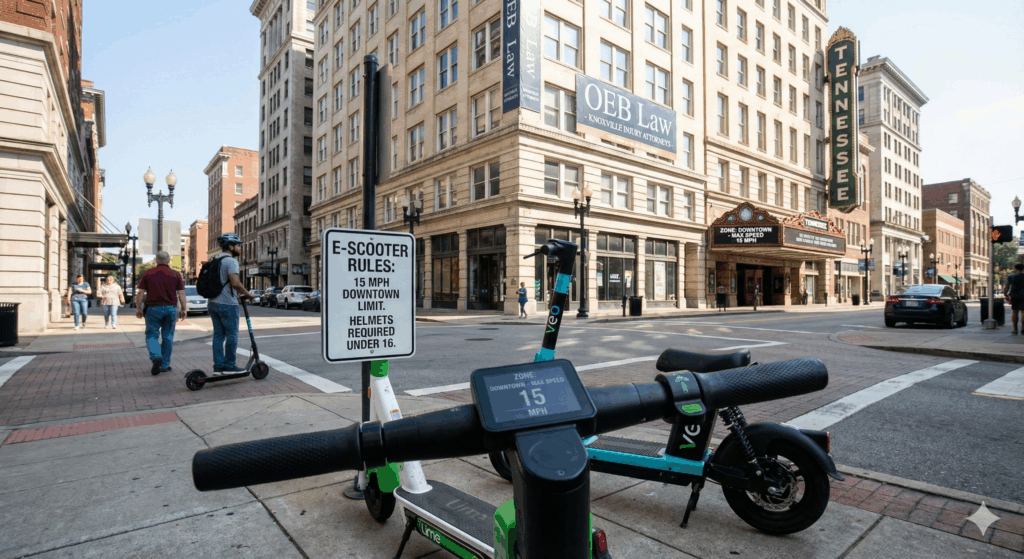
Electric scooters (the Bird, Lime, and Veo devices you see on Knoxville streets) are defined under Tennessee Code Annotated § 55-8-101 as devices with handlebars, a floorboard designed to be stood upon, and an electric motor capable of propelling the device up to 20 mph. Critically, these devices require no driver’s license, no vehicle registration, and no insurance to operate legally. They are classified more like bicycles than motor vehicles for most legal purposes.
Mopeds and motor-driven cycles, by contrast, are defined under T.C.A. § 55-8-101(36) as having motors capable of propelling the vehicle at speeds up to 30 mph. These require a valid driver’s license, vehicle registration, and proof of insurance. The distinction is vital for DUI enforcement: both electric scooters and mopeds are considered “vehicles” for purposes of Tennessee’s DUI statute (T.C.A. § 55-10-401), meaning you absolutely can be arrested and convicted for DUI while riding either one.
Some older legal resources incorrectly describe scooters with gas engines up to 125cc as falling under the same category as electric kick scooters. This is dangerously wrong. Any gas-powered device with an engine larger than 50cc is classified as a motorcycle under Tennessee law and requires a motorcycle endorsement on your license. The Knoxville attorneys at OEB Law frequently see DUI cases where the defendant was surprised to learn that their electric scooter ride home from the bars resulted in a criminal charge that affects their driver’s license.
“Many people think that because e-scooters don’t require a license to operate, they also can’t result in a DUI that affects their driving privileges. That’s a costly misconception. A DUI conviction on an e-scooter in Tennessee can suspend your driver’s license just as surely as a DUI in a car, and the consequences for your insurance rates and employment can be severe. We’ve successfully defended clients by challenging the traffic stop or the field sobriety testing procedures, but prevention through understanding the law is always better than fighting charges after the fact.” – attorney Tim Elrod
DUI on E-Scooters: Yes, It’s Possible (And Serious)
Perhaps the most dangerous myth about e-scooter laws in Tennessee is the belief that DUI rules don’t apply to these devices. The reality is precisely the opposite: Tennessee’s DUI statute explicitly includes any vehicle, and courts have repeatedly held that electric scooters fall within this definition. If you’re riding an e-scooter in Knoxville with a blood alcohol concentration of 0.08% or higher—or while impaired by drugs—you can be arrested, charged, and convicted of DUI.
The consequences of an e-scooter DUI are identical to those of a car DUI. A first offense carries penalties including up to 11 months and 29 days in jail, fines up to $1,500, mandatory alcohol education classes, and a one-year driver’s license suspension. Yes, your driver’s license—even though you were on a scooter that doesn’t require a license to operate. The suspension applies to your privilege to operate any motor vehicle in Tennessee, effectively eliminating your ability to drive to work, school, or anywhere else.
Law enforcement in East Tennessee has increased DUI enforcement for e-scooter riders, particularly in downtown Knoxville’s entertainment districts along Market Square and Jackson Avenue. Officers conduct the same field sobriety tests used for vehicle DUIs, including the horizontal gaze nystagmus test, walk-and-turn test, and one-leg stand test. However, these tests are notoriously difficult to perform accurately after riding a scooter, which requires balance and coordination. Many false positives occur when a sober rider performs poorly on balance tests due to fatigue from riding rather than intoxication.
Contact OEB Law for Help
If you’ve been charged with DUI on an e-scooter, contacting an experienced criminal defense attorney immediately is crucial. Challenges to the traffic stop’s legality, the officer’s probable cause to believe you were impaired, and the accuracy of field sobriety tests can all provide viable defenses. The OEB Law’s attorneys have successfully defended numerous clients facing e-scooter DUI charges by demonstrating that the initial stop lacked legal justification or that the testing procedures were flawed.
What to Do After an E-Scooter Accident in Knoxville
E-scooter accidents can result in severe injuries, from road rash and broken bones to traumatic brain injuries and spinal cord damage. Because riders lack the protective shell of a car, even low-speed collisions can cause catastrophic harm. If you’ve been injured in an e-scooter accident—whether you were riding the scooter or were struck by one—understanding your legal rights and taking the right steps immediately after the accident is critical.
| Action Required | Why This Matters |
|---|---|
| Step 1 Seek Medical Attention Immediately – Even if you feel fine, go to urgent care, your doctor, or the ER | Many serious injuries (concussions, internal injuries) don’t show immediate symptoms. Medical records create crucial documentation linking injuries to the accident. Insurance companies argue delayed treatment means injuries weren’t serious. |
| Step 2 Document Everything – Take photos of: accident scene, your injuries, property damage, scooter condition, any rule violations | Evidence disappears quickly. Photos prove conditions at the time of accident. Specific location matters (prohibited sidewalk vs. bike lane affects liability). |
| Step 3 Get Police Report – Call police if possible and obtain the incident report number | Official police reports establish facts, determine preliminary fault, and provide third-party documentation. Report numbers allow your attorney to obtain full records. |
| Step 4 Preserve Scooter Evidence – Note scooter ID number and rental company. DO NOT move or touch unnecessarily | Rental companies collect GPS data, speed records, maintenance logs, and user information. This data proves crucial for establishing fault, but companies only preserve it if formally requested by an attorney. |
| Step 5 Contact an Attorney BEFORE Insurance – Do not speak with any insurance company until you have legal representation | Insurance adjusters are trained to minimize payouts. They ask seemingly innocent questions designed to get you to admit fault or downplay injuries. |
| Step 6 Remember: One-Year Statute of Limitations – Tennessee law gives you only one year from the accident date to file a lawsuit | Missing this deadline eliminates your right to compensation entirely, regardless of how severe your injuries or how clear the other party’s fault. |
Medical Attention
First, seek medical attention, even if you feel fine initially. Many serious injuries, particularly internal injuries and concussions, may not present immediate symptoms. Documentation from a medical professional creates a crucial record linking your injuries to the accident. Insurance companies often argue that delayed medical treatment means injuries weren’t serious or weren’t caused by the accident.
Documentation
Second, document everything. Take photos of the accident scene, your injuries, property damage, and any visible rule violations (like a scooter left in an ADA ramp or evidence of sidewalk riding). Get contact information from witnesses, and if police respond, obtain the incident report number. The specific location matters significantly—an accident on a prohibited sidewalk creates different liability issues than one in a bike lane.
Preserve Evidence
Third, preserve evidence from the scooter itself if possible. Rental companies like Lime and Veo collect extensive data from their scooters, including GPS location, speed at the time of the accident, maintenance records, and user information. This data can prove crucial in establishing fault, but rental companies will only preserve it if formally requested by an attorney through proper legal channels. Once you’re represented, your attorney can issue preservation letters requiring the company to maintain this evidence.
Contact OEB Law for Help
Finally, contact a Knoxville personal injury attorney before speaking with any insurance company. Insurance adjusters—whether from your health insurance, the rental company’s liability policy, or the at-fault driver’s auto insurance—are trained to minimize payouts. They will ask seemingly innocent questions designed to get you to admit partial fault or downplay your injuries. Having an attorney handle all communications protects your rights and prevents these tactics from reducing your compensation.
Tennessee’s one-year statute of limitations for personal injury claims means you have limited time to act. Missing this deadline eliminates your right to compensation entirely, regardless of how severe your injuries or clear the other party’s fault. Early consultation with an attorney ensures that all deadlines are met and that evidence is preserved before it disappears.
Insurance Gaps and Coverage Issues in E-Scooter Accidents
One of the most frustrating aspects of e-scooter accidents for injury victims is navigating the complex web of insurance coverage—or more accurately, the lack thereof. Unlike car accidents where multiple insurance policies typically provide coverage, e-scooter accidents often involve significant coverage gaps that leave injured victims struggling to pay medical bills.
Your standard auto insurance policy likely excludes coverage for injuries sustained while riding an e-scooter. Most policies contain specific exclusions for vehicles with fewer than four wheels or for vehicles you don’t own. If you’re injured while riding a rental scooter, your car insurance generally won’t cover your injuries. Your health insurance becomes your primary source of coverage for medical bills, but health insurance companies often assert subrogation rights, meaning they can demand repayment from any settlement you receive.
Rental Company Policy
Rental companies like Lime and Veo carry liability insurance, but these policies only cover situations where the scooter itself malfunctioned or where the company was negligent in maintaining the scooter or placing it in service. If another vehicle hits you while you’re riding legally, the rental company’s insurance typically has no liability. You must pursue the at-fault driver’s auto insurance policy. If that driver is uninsured or underinsured, you may face substantial out-of-pocket costs unless your own auto policy includes uninsured/underinsured motorist coverage that extends to you as a pedestrian or cyclist.
The situation becomes even more complicated when a pedestrian is struck by an e-scooter rider. The scooter rider generally has no insurance covering this liability, and the rental company’s policy may exclude coverage for the rider’s negligent operation. The injured pedestrian may have no clear source of compensation unless the rider has sufficient personal assets to satisfy a judgment. This reality makes e-scooter accidents uniquely challenging from a legal perspective and highlights the importance of understanding your own insurance coverages before an accident occurs.
Injured in an Accident?
For injury victims, pursuing maximum compensation requires identifying all potentially responsible parties and all available insurance policies. An experienced attorney will investigate whether the accident involved a defective scooter component (potential product liability claim), inadequate road maintenance (potential governmental liability), or third-party negligence (such as a property owner whose negligent maintenance created the hazard). The 5 star Google reviews for OEB Law reflect our thoroughness in investigating all potential sources of recovery to ensure our clients receive full compensation.
Why Choose OEB Law for Your E-Scooter Accident Case
When you’ve been injured in an e-scooter accident in Knoxville, the complexity of the applicable laws, the challenges of proving fault when multiple parties may be responsible, and the insurance coverage gaps make experienced legal representation essential. The personal injury attorneys at OEB Law understand the unique aspects of e-scooter accidents and have successfully represented clients injured as scooter riders, pedestrians struck by scooters, and motorists involved in collisions with scooter riders.

Our firm’s deep knowledge of both Tennessee state law and Knoxville’s specific city ordinances allows us to build compelling cases that account for the nuanced rules governing where scooters can be ridden, what speeds are permitted, and what duties both riders and motorists owe to each other. We know how to counter insurance company arguments that attempt to blame injured riders for not wearing helmets (when no law required them) or for minor technical violations that had nothing to do with causing the accident. Use our settlement calculator to get an estimate of your potential claim value.
Most importantly, we understand that behind every e-scooter accident case is a real person dealing with painful injuries, mounting medical bills, lost wages, and uncertainty about the future. Our commitment is to handle every aspect of your legal case so you can focus on your physical recovery and getting your life back to normal. We investigate thoroughly, negotiate aggressively, and when necessary, litigate skillfully to achieve the best possible outcome for our clients.
Who is OEB Law and Why Are They Good for the Community?
Founded in 2004 in Knoxville, Tennessee, OEB Law has grown over nearly two decades to now serve clients across multiple states. Tim Elrod established the firm with a simple but powerful mission: we care and we help people. Today, together with attorneys Michael Bernard, Billy Sivyer, Gena Lewis, and Logan Wade, our team brings over 50 years of combined experience representing clients throughout Tennessee and Kentucky in personal injury and criminal defense cases.
Our Legal Expertise
Our attorneys have built their reputation through:
- Successfully representing thousands of personal injury and criminal defense clients
- Developing specialized knowledge across all types of accident and injury cases
- Mastering the complexities of Tennessee’s legal system through decades of practice
Why Trust Us
At OEB Law, our reputation speaks for itself:
- Proven Results: We’ve recovered significant compensation for our clients through both settlements and courtroom verdicts
- Client Satisfaction: Our numerous 5-Star Google Reviews showcase our commitment to responsive, caring, and effective legal representation
- No Fee Unless We Win: You don’t pay attorney fees unless we successfully secure compensation in your case
- Local Knowledge: As East Tennessee natives, we understand our community and care deeply about the people we serve
- Personalized Approach: We personalize each case to meet our clients’ specific needs, ensuring you’re never just another file number
Community Commitment
Our dedication extends beyond the courtroom. We proudly support:
- Boys & Girls Clubs of Tennessee Valley programs and toy drives
- Local high school football programs through Rivalry Thursday sponsorships
- The Knoxville Ice Bears and community fundraising initiatives
- Numerous youth, student, and community organizations throughout East Tennessee
As Tim Elrod says, “We don’t just take—we give back because the people you’re giving back to are the people who are supporting your firm.“
Have a personal injury or criminal defense case? We’re available 24/7 to help.
Get In Touch
- Call or Text: (865) 546-1111
- Visit: https://oeblawtn.com/
- Available: Standing by 24/7
Why OEB Law? Because They’re Good For The Community.
TEXT or CALL (865) 546-1111 for HELP NOW. Standing By 24/7.
FAQ about e-scooters
Yes, you absolutely can be charged with and convicted of DUI while operating an electric scooter in Knoxville. Tennessee’s DUI statute applies to any vehicle, and courts have consistently ruled that e-scooters fall within this definition. A DUI conviction on an e-scooter carries the same penalties as a car DUI, including fines up to $1,500, potential jail time, mandatory alcohol education, and suspension of your driver’s license for one year. If you’ve been charged with DUI on an e-scooter, contact an experienced criminal defense attorney immediately to protect your rights and explore potential defenses.
Stay Connected with OEB Law
Stay up to date with the latest legal news, safety tips, and community updates by following OEB Law on social media:
- X (Twitter): https://www.x.com/oeblaw
- YouTube: https://www.youtube.com/channel/UCAXZKU70z00qAvWCX4NjFDQ
- Facebook: https://www.facebook.com/OEBlaw/
- Instagram: https://www.instagram.com/oeb_lawknox/
- LinkedIn: https://www.linkedin.com/company/oeb-law-pllc/
- TikTok: https://www.tiktok.com/@oeb_law

