Electric bikes have become increasingly popular on Knoxville’s sidewalks and greenways, offering convenient transportation for students, delivery drivers, and commuters. However, when an e-bike collides with a pedestrian on a sidewalk, questions about liability and legal rights immediately arise. The laws governing e-bike accidents differ significantly from standard bicycle incidents, and understanding these distinctions is crucial for injury victims. In this blog post, Knoxville attorney Tim Elrod discusses whether you have a case if hit by an e-bike on a Knoxville sidewalk and what factors determine liability.
Yes, you likely have a case if hit by an e-bike on a Knoxville sidewalk, provided the rider failed to yield or give an audible warning as required by law. While e-bike riding is generally permitted on most Knoxville sidewalks, riders must follow strict safety rules, and violations that cause pedestrian injuries typically establish clear liability.
Key Takeaways
- E-bike riders on Knoxville sidewalks must yield to pedestrians and provide audible signals before passing
- Class 3 e-bikes (capable of speeds over 28 mph) face additional restrictions under Tennessee law
- Failure to yield or signal constitutes negligence, making the rider liable for pedestrian injuries
- Your case value depends on injury severity, the rider’s insurance coverage, and available evidence
To Discuss Your Case, Call or Text Our Team Standing By 24/7: (865) 546-1111
About OEB Law, Your Knoxville Legal Team

This guide is provided by the experienced attorneys at OEB Law, led by Managing Attorney Timothy G. Elrod. Founded in Knoxville in 2004, our firm has over 50 years of combined experience navigating East Tennessee’s legal system.
We have successfully represented thousands of personal injury clients, developing deep expertise in Tennessee’s complex wrongful death and accident laws. As East Tennessee natives, we have a direct understanding of the local court systems, law enforcement agencies, and community needs. Our commitment is to provide trusted, authoritative information to our neighbors in Knoxville and the surrounding Tennessee communities. However, this information does not constitute legal advice. If you or a loved one has been injured in an accident or needs legal help, call us today for a free, no obligation, initial consultation.
Understanding E-Bike Laws on Knoxville Sidewalks
The legal landscape for e-bikes in Knoxville involves both state and local regulations. Under Tennessee Code § 55-8-306, electric bicycles are classified into three categories based on their motor assistance capabilities.
| E-Bike Class | Speed Limit | Throttle | Pedal Assist | Sidewalk Status in Knoxville |
|---|---|---|---|---|
| Class 1 | 20 mph max | No | Yes | Generally permitted with yielding |
| Class 2 | 20 mph max | Yes | Optional | Generally permitted with yielding |
| Class 3 | 28 mph max | No | Yes | Restricted in many areas |
- Class 1 e-bikes provide assistance only while pedaling and stop at 20 mph.
- Class 2 e-bikes have a throttle and also max out at 20 mph.
- Class 3 e-bikes can reach speeds of 28 mph with pedal assistance and face stricter regulations.
Knoxville’s Specific Sidewalk Requirements
Knoxville City Code § 17-448 permits bicycle riding on sidewalks throughout most of the city, but with critical safety requirements:
- Yield to all pedestrians – Riders must give pedestrians the right-of-way at all times
- Provide audible signals – Riders must ring a bell, shout, or make noise before overtaking pedestrians
- Exercise reasonable care – Riders must operate at safe speeds for conditions
- Follow posted restrictions – Some areas prohibit all wheeled traffic
These requirements apply to e-bikes just as they do to traditional bicycles. The ordinance treats the failure to yield as a violation that can establish liability in injury cases.
Special Restrictions in Downtown Areas
Certain areas of downtown Knoxville maintain additional restrictions:
- Market Square – Pedestrian-priority zone requiring extreme caution
- Gay Street business district – Enhanced pedestrian protections during business hours
- University of Tennessee campus – Separate regulations may apply on campus walkways
- Old City entertainment district – Higher liability standards due to foot traffic
The business district designation can affect whether riding was permitted at all, strengthening a pedestrian’s case.
“Many people don’t realize that while e-bike riding might be legal on a Knoxville sidewalk, the rider still has a legal duty to yield and signal. When riders violate these safety rules and hit a pedestrian, they are almost always liable for the resulting injuries.” – Knoxville personal injury attorney Timothy G. Elrod
Establishing Liability in E-Bike Sidewalk Accidents
Proving liability in an e-bike accident requires demonstrating that the rider breached their duty of care. The yielding and signaling requirements under Knoxville City Code create clear standards that riders must follow.
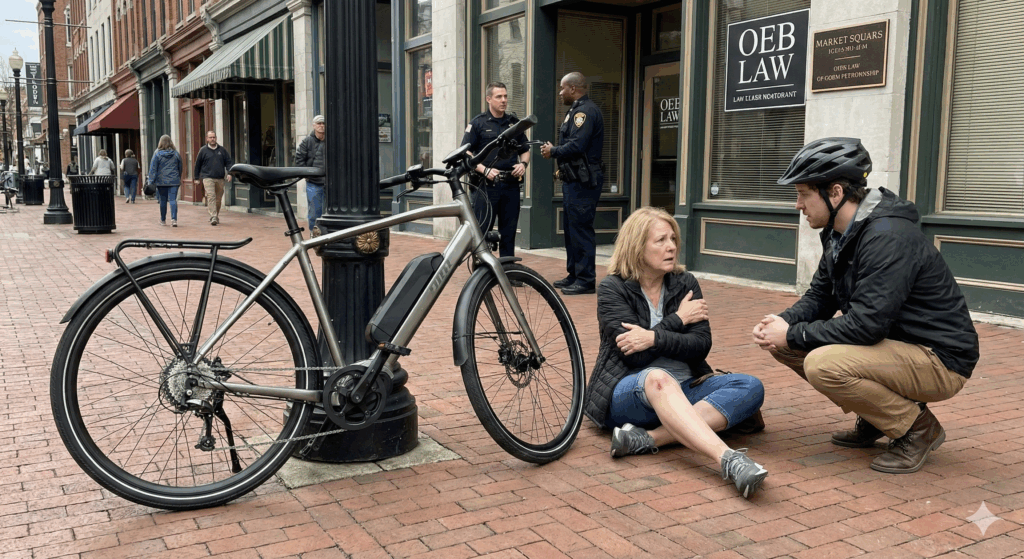
How Negligence Is Proven
When a rider fails to follow the law, they commit negligence per se in Tennessee. This legal principle makes liability much easier to establish:
The rider violated the law if they:
- Failed to give an audible warning before passing
- Did not yield the right-of-way to you as a pedestrian
- Operated at excessive speed for the conditions
- Rode in a prohibited area like Market Square during restricted hours
Evidence that strengthens your case:
- Speed differential – E-bikes travel at 20-28 mph while pedestrians walk at 3 mph
- Witness statements – Bystanders who saw the collision and heard no warning
- Physical evidence – Skid marks, point of impact, debris patterns
- Security footage – Cameras from businesses along Cumberland Avenue or Gay Street
- Rider’s response – Whether they stopped or fled the scene
The Critical “Audible Signal” Requirement
Knoxville’s ordinance requiring an audible signal before passing pedestrians creates a specific, enforceable safety standard. This requirement means riders must ring a bell, shout a verbal warning, or make some other sound to alert pedestrians of their approach.
The failure to provide this warning constitutes a direct violation of city code. In personal injury cases, this violation establishes negligence per se, meaning negligence is presumed. The rider cannot argue they were being reasonably careful if they admittedly violated the signaling requirement.
The “silent speed” characteristic of e-bikes makes this requirement particularly important. Unlike motorcycles or scooters, e-bikes produce minimal operational noise. Pedestrians walking on Third Creek Greenway or along Cumberland Avenue cannot hear approaching e-bikes until they are dangerously close.
Common Injuries from E-Bike Collisions
E-bike accidents cause more severe injuries than traditional bicycle collisions due to the higher speeds involved. The unexpected impact often prevents pedestrians from bracing themselves, leading to falls that cause secondary injuries.
Common Injuries from E-Bike Collisions
Head and Brain Injuries
- Traumatic brain injuries (TBI) Even at moderate speeds, head impacts cause serious damage
- Concussions Loss of consciousness or confusion following impact
- Skull fractures Severe impacts can crack or fracture skull bones
- Facial trauma Broken nose, jaw, cheekbones, or eye socket injuries
Orthopedic Injuries
- Broken arms and wrists From trying to catch yourself during a fall
- Fractured legs and ankles Direct impact or fall-related injuries
- Hip fractures Particularly serious for elderly pedestrians
- Shoulder and collarbone breaks Common when victims hit the pavement
- Spinal injuries Potentially causing permanent disabilities
Soft Tissue & Internal Injuries
- Whiplash Sudden head movement causing neck strain
- Back injuries May not manifest immediately but develop into chronic pain
- Sprains and strains Damage to ligaments and muscles
- Internal bruising Deep tissue damage from blunt force impact
Psychological Impact
- Post-traumatic stress Anxiety about walking on sidewalks
- Depression From pain, disability, or lifestyle changes
- Sleep disturbances Nightmares or difficulty sleeping after the accident
- Social withdrawal Avoiding activities due to fear or physical limitations
Head and Brain Injuries
- Traumatic brain injuries (TBI) – Even at moderate speeds, head impacts cause serious damage
- Concussions – Loss of consciousness or confusion following impact
- Skull fractures – Severe impacts can crack or fracture skull bones
- Facial trauma – Broken nose, jaw, cheekbones, or eye socket injuries
Orthopedic Injuries
- Broken arms and wrists – From trying to catch yourself during a fall
- Fractured legs and ankles – Direct impact or fall-related injuries
- Hip fractures – Particularly serious for elderly pedestrians
- Shoulder and collarbone breaks – Common when victims hit the pavement
- Spinal injuries – Potentially causing permanent disabilities
Soft Tissue and Internal Injuries
- Whiplash – Sudden head movement causing neck strain
- Back injuries – May not manifest immediately but develop into chronic pain
- Sprains and strains – Damage to ligaments and muscles
- Internal bruising – Deep tissue damage from blunt force impact
Psychological Impact
- Post-traumatic stress – Anxiety about walking on sidewalks
- Depression – From pain, disability, or lifestyle changes
- Sleep disturbances – Nightmares or difficulty sleeping after the accident
- Social withdrawal – Avoiding activities due to fear or physical limitations
These emotional damages are compensable under Tennessee law when documented properly by mental health professionals.
“E-bike collisions often cause more serious injuries than people expect because of the speed and weight involved. We’ve seen everything from simple bruises to traumatic brain injuries, and the victim’s recovery process directly impacts the value of their case.” – attorney Tim Elrod
Insurance and Compensation Challenges
One of the biggest obstacles in e-bike accident cases involves identifying available insurance coverage. Many e-bike riders carry no liability insurance specific to their e-bike use.
Common Insurance Scenarios
Homeowners or renters insurance:
- Sometimes provides liability coverage for e-bike accidents
- Many riders are unaware this coverage exists
- Coverage limits vary widely by policy
University of Tennessee student riders:
- Parental homeowners insurance may provide coverage under family liability provisions
- Age and residency status affect whether students are still covered
- Proving the familial relationship requires investigation
Delivery drivers (UberEats, DoorDash, etc.):
- Companies typically provide some coverage while drivers are actively delivering
- Coverage gaps exist between deliveries
- Personal e-bikes versus company equipment creates complications
- Determining “on the clock” status becomes critical
Your Own Insurance Options
Your auto insurance may provide compensation through uninsured motorist (UM) or underinsured motorist (UIM) coverage. While these provisions typically apply to motor vehicles, some Tennessee policies extend coverage to accidents involving motorized bicycles.
Steps to check your coverage:
- Review your auto policy’s definitions section
- Look for “motorized bicycle” or “low-speed electric vehicle” language
- Contact your insurance agent to clarify coverage extensions
- Consult with a Knoxville attorney to interpret policy language
Building Your Case After an E-Bike Accident
Immediate evidence collection significantly impacts case success. The steps you take in the hours and days following the accident can make the difference between a successful claim and a denied one.
At the Scene – Document Everything
Photograph immediately:
- The accident location from multiple angles
- All visible injuries on your body
- Torn or damaged clothing
- Any property damage (phone, bags, glasses)
- The e-bike if still present (including make, model, and any Class labels)
- Nearby signage or warnings
- Road/sidewalk conditions
Gather information:
- Rider’s name, phone number, and address
- E-bike identification (brand, color, distinguishing features)
- Insurance information if available
- Names and phone numbers of all witnesses
- Nearby businesses that might have security cameras
Note critical details:
- Did you hear any warning signal before being hit?
- Approximately how fast was the e-bike traveling?
- What was the rider doing after the collision? (Stopped to help? Fled?)
- Weather and lighting conditions
In the Following Days
Seek medical attention promptly:
- Visit an emergency room, urgent care, or your doctor
- Many serious injuries don’t show symptoms immediately
- Medical records create documentation linking injuries to the accident
- Follow all treatment recommendations consistently
Report the accident:
- File a report with Knoxville Police Department
- The report creates an official record with rider information
- Officers may document preliminary fault determinations
- Essential for hit-and-run cases and insurance claims
Preserve evidence:
- Request businesses save security camera footage immediately
- Many systems overwrite recordings after 7-14 days
- Contact witnesses while memories are fresh
- Keep all medical bills, prescriptions, and treatment records
Avoid common mistakes:
- Don’t post about the accident on social media
- Don’t accept quick settlement offers without legal advice
- Don’t sign anything from insurance companies
- Don’t delay seeking medical treatment
Special Considerations for High-Traffic Areas
Certain Knoxville locations see elevated e-bike traffic and corresponding accident rates. Understanding the specific challenges of these areas helps establish liability.
Cumberland Avenue (“The Strip”)
Why it’s dangerous:
- Heavy e-bike use by students commuting to UT campus
- Narrow sidewalks with high pedestrian volumes
- Riders often travel at excessive speeds despite crowding
- Mixed bike lanes and sidewalk usage creates confusion
Liability factors:
- Recent road reconstruction has added bike lanes
- Riders using sidewalks instead of lanes show poor judgment
- Dense foot traffic requires extra caution from riders
Gay Street Downtown
Unique challenges:
- Mixed-use sidewalks with window shoppers and business patrons
- Pedestrians frequently stop unpredictably
- Evening entertainment crowds increase congestion
- Pedestrian-priority designation strengthens liability claims
Business district protections:
- Enhanced pedestrian rights in commercial zones
- Rider liability is nearly automatic in collisions
- Courts may find riders reckless even at moderate speeds
Third Creek Greenway
Multi-use path complications:
- Mixture of walkers, runners, cyclists, and e-bikes
- Designed for 10-15 mph cycling speeds
- E-bikes traveling 20+ mph create foreseeable hazards
- Congestion during peak times increases accident risk
Special liability considerations:
- Greenway rules may differ from street sidewalk rules
- Passing on blind curves is particularly dangerous
- Speed restrictions are often posted but ignored
Old City and Market Square
Entertainment district factors:
- Stricter pedestrian protections due to high foot traffic
- Pedestrians may be less attentive due to restaurant and bar activities
- Higher liability standards apply to all riders
- Evening and weekend hours see increased conflicts
Why Choose OEB Law for Your E-Bike Accident Case
When you’ve been injured by an e-bike on a Knoxville sidewalk, you need attorneys who understand both the specific local ordinances and the emerging legal issues surrounding electric mobility devices. The top attorneys in Knoxville at OEB Law have successfully represented pedestrians injured in bicycle and e-bike accidents throughout East Tennessee.
Our E-Bike Accident Experience
How to prove rider liability:
- Demonstrating violations of the yielding requirement
- Establishing failure to provide audible warnings
- Documenting excessive speed for conditions
- Proving Class 3 e-bike restrictions were violated
We understand the insurance complexities:
- Identifying coverage through homeowners policies
- Pursuing parental liability for student riders
- Navigating gig economy delivery driver coverage
- Accessing your own UM/UIM coverage when riders are uninsured
We have the resources to investigate thoroughly:
- Obtaining security footage from businesses
- Interviewing witnesses while memories are fresh
- Consulting accident reconstruction experts
- Working with medical professionals to document injuries
With our 5 star Google reviews reflecting our commitment to client service, you can trust that your case will receive the focused attention it deserves. We work on a contingency fee basis for personal injury cases, meaning you don’t pay unless we win your case.
Who is OEB Law and Why Are They Good for the Community?

Founded in 2004 in Knoxville, Tennessee, OEB Law has grown over nearly two decades to now serve clients across multiple states. Tim Elrod established the firm with a simple but powerful mission: we care and we help people. Today, together with attorneys Michael Bernard, Billy Sivyer, Gena Lewis, and Logan Wade, our team brings over 50 years of combined experience representing clients throughout Tennessee and Kentucky in personal injury and criminal defense cases.
Our Legal Expertise
Our attorneys have built their reputation through:
- Successfully representing thousands of personal injury and criminal defense clients
- Developing specialized knowledge across all types of accident and injury cases
- Mastering the complexities of Tennessee’s legal system through decades of practice
Why Trust Us
At OEB Law, our reputation speaks for itself:
- Proven Results: We’ve recovered significant compensation for our clients through both settlements and courtroom verdicts
- Client Satisfaction: Our numerous 5-Star Google Reviews showcase our commitment to responsive, caring, and effective legal representation
- No Fee Unless We Win: You don’t pay attorney fees unless we successfully secure compensation in your case
- Local Knowledge: As East Tennessee natives, we understand our community and care deeply about the people we serve
- Personalized Approach: We personalize each case to meet our clients’ specific needs, ensuring you’re never just another file number
| Reviewer | Rating | Highlight | View Original |
|---|---|---|---|
| Todd Guigar | ⭐️⭐️⭐️⭐️⭐️ | “OEB Law Firm was absolutely fantastic to work with! They were on top of everything from start to finish and always called whenever they needed something — no waiting around or wondering what was going on. They were patient, professional, and made the whole process easy and completely hassle-free. I couldn’t have asked for a smoother experience. Highly recommend OEB Law Firm to anyone who needs reliable, dedicated representation!” | View Review |
Community Commitment
Our dedication extends beyond the courtroom. We proudly support:
- Local high school football programs through Rivalry Thursday sponsorships
- The Knoxville Ice Bears and community fundraising initiatives
- Numerous youth, student, and community organizations throughout East Tennessee
As Tim Elrod says, “We don’t just take—we give back because the people you’re giving back to are the people who are supporting your firm.“
Have a personal injury or criminal defense case? We’re available 24/7 to help.
Get In Touch
- Call or Text: (865) 546-1111
- Visit: https://oeblawtn.com/
- Available: Standing by 24/7
Why OEB Law? Because They’re Good For The Community.
TEXT or CALL (865) 546-1111 for HELP NOW. Standing By 24/7.
FAQ:
If the e-bike rider fled after hitting you, they committed a hit-and-run offense under Tennessee law. This strengthens your civil case significantly. Report the incident to Knoxville Police Department immediately and provide any description of the rider or e-bike you can remember. Check with nearby businesses for security camera footage that might have captured the incident or the rider’s direction of travel. Your uninsured motorist coverage may provide compensation even if the rider is never identified. Our Knoxville attorneys can help you navigate this claims process to ensure you receive the medical treatment and compensation you deserve despite the rider’s flight.
Stay Connected with OEB Law
Stay updated on legal news, safety tips, and community events by following OEB Law on social media:

