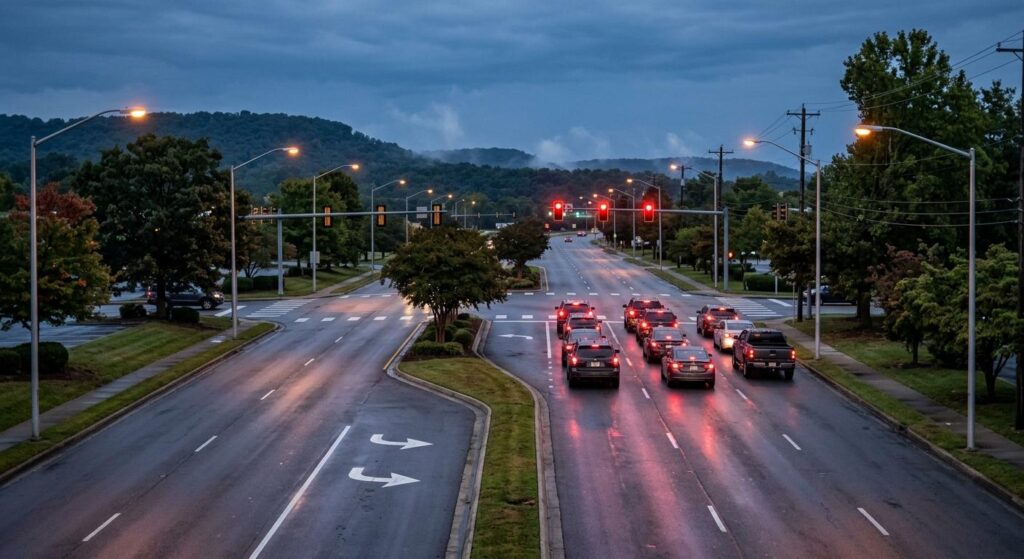
Rutledge Pike is four lanes wide from the moment it leaves East Knoxville to the moment it crosses into Grainger County. That is the first thing most people notice about it, and it is the reason the road does not feel dangerous. A four-lane highway reads as a modern road. But the four lanes change character about halfway out, and the crash record changes with them. Carried as US-11W and State Route 1, Rutledge Pike begins where US-11, US-11E and US-70 meet in East Knoxville, runs past Zoo Knoxville, crosses I-40 at Exit 392, and heads northeast through the John Sevier industrial area, Mascot and Shipetown before entering Blaine. According to OEB Law’s analysis of the Knox County Transportation Planning Organization (Knox TPO) Interactive Crash Map, the corridor has recorded 1,088 crashes and 15 people killed since 2015. That is roughly two and a half times the Knox County death rate per crash. What separates the deadly half of this road from the safe half is not traffic volume and not driver behavior. It is the median. At OEB Law, our Knoxville team handles these cases, and we have mapped this corridor junction by junction. In this blog post, Knoxville attorney Tim Elrod discusses what to do after a car accident on Rutledge Pike (US-11W) in East Knox County.
Key Takeaways
- An angle crash on the 55 mph stretch of Rutledge Pike is about ten times more likely to kill someone than the identical crash on the 45 mph stretch. 222 angle crashes at 45 mph produced one death. 155 angle crashes at 55 mph produced seven.
- The Knox TPO crash record shows 1,088 reported wrecks, 15 people killed and 79 seriously injured on the corridor from 2015 through 2026.
- Two thirds of the deaths happen outside Knoxville city limits on 32% of the crashes, where the Knox County Sheriff’s Office or the Tennessee Highway Patrol responds rather than the Knoxville Police Department.
- Rear-end crashes in the 45 mph zone killed nobody in eleven years. 225 crashes, zero deaths. The danger on this road is turning across traffic, not following too closely.
- Rutledge Pike carries the highest truck and bus involvement of any Knox County arterial we measured, at 8.8%, and most of it is inside the city near the rail yard and the quarry traffic.
- Tennessee gives you only one year to file a personal injury claim, one of the shortest deadlines in the country.
To Discuss Your Case, Call or Text Our Team Standing By 24/7: (865) 546-1111
About OEB Law, Your Knoxville Legal Team

This guide is provided by the experienced attorneys at OEB Law, led by Managing Attorney Timothy G. Elrod. Founded in Knoxville in 2004, our firm has over 50 years of combined experience navigating East Tennessee’s legal system.
We have successfully represented thousands of personal injury clients, developing deep expertise in Tennessee’s complex wrongful death and accident laws. As East Tennessee natives, we have a direct understanding of the local court systems, law enforcement agencies, and community needs. Our commitment is to provide trusted, authoritative information to our neighbors in Knoxville and the surrounding Tennessee communities. However, this information does not constitute legal advice. If you or a loved one has been injured in an accident or needs legal help, call us today for a free, no obligation, initial consultation.
The Two Rutledge Pikes
There are really two roads here, and the paperwork from your crash will not tell you which one you were on.
From the Y interchange in East Knoxville out to I-40, Rutledge Pike is a divided four-lane highway. There is a median. Left turns happen at signals or at breaks in the median where a turning driver has somewhere to wait. The posted limit is 45. Traffic is heavy, roughly 21,000 vehicles a day at the busiest junctions, and crashes are frequent.
Past I-40, the median ends. From there through the industrial corridor, out past Mascot and Shipetown and on toward the Grainger County line, Rutledge Pike is an undivided four-lane highway. The posted limit climbs to 55. Traffic drops to roughly 11,000 vehicles a day. Crashes become less frequent.
And the deaths move to the second road.
The Knox TPO crash record splits almost perfectly along that line. In the 45 mph zone, 594 reported crashes produced one death, a rate of 1.7 deaths per 1,000 crashes. In the 55 mph zone, 417 crashes produced twelve deaths, a rate of 28.8 per 1,000. The same pattern shows up if you sort by jurisdiction instead of speed: inside Knoxville city limits, 741 crashes and five deaths; outside the city limits in unincorporated Knox County, 345 crashes and ten deaths. Thirty-two percent of the crashes, sixty-seven percent of the fatalities.
The busy half of Rutledge Pike is where you are likely to be in a wreck. The quiet half is where you are likely to die in one.
Rutledge Pike (US-11W) by the Numbers
Knox County corridor total, reported crashes 2015 through 2026.
The Same Road, Split in Two
Divided, posted 45
East Knoxville to I-40. Median, signals, about 21,000 vehicles a day.
Undivided, posted 55
Past I-40 through Mascot and Shipetown. No median, about 11,000 vehicles a day.
What Kind of Crash Happens Here
Where the Deaths Actually Are
The one number to remember. Angle crashes are about the same share of all crashes on both halves of Rutledge Pike, 37 percent inside the city and 41 percent outside it. Drivers out past Mascot are not making more dangerous turns. The same turn is roughly ten times more likely to kill them, because there is no median to wait in and oncoming traffic is closing at 55.
Figures come from OEB Law’s crash-data analysis of the Knox County Transportation Planning Organization (Knox TPO) Interactive Crash Map, covering reported crashes from 2015 through 2026, scoped to Rutledge Pike (US-11W) in Knox County and excluding the separate Old Rutledge Pike alignment. Current as of October 2026. Traffic volumes are annual average daily traffic counts recorded with the crashes at those locations.
Why the Undivided Half Kills
It would be easy to assume the explanation is simply speed, and speed is part of it. But the crash data points at something more specific, and it is the single most useful fact in this guide.
Angle collisions are the largest crash type on Rutledge Pike and the dominant killer. Of 1,088 crashes, 412 are angle crashes, and those 412 account for nine of the fifteen deaths. An angle crash is what happens when one vehicle crosses the path of another: a driver turning left across oncoming lanes, a driver pulling out of a side road or a business driveway into traffic.
Now compare where those angle crashes happen.
- At 45 mph, on the divided half: 222 angle crashes, 1 death, 16 serious injuries. A rate of 4.5 deaths per 1,000.
- At 55 mph, on the undivided half: 155 angle crashes, 7 deaths, 21 serious injuries. A rate of 45.2 deaths per 1,000.
Ten times the lethality, for the same kind of collision, on the same four-lane road.
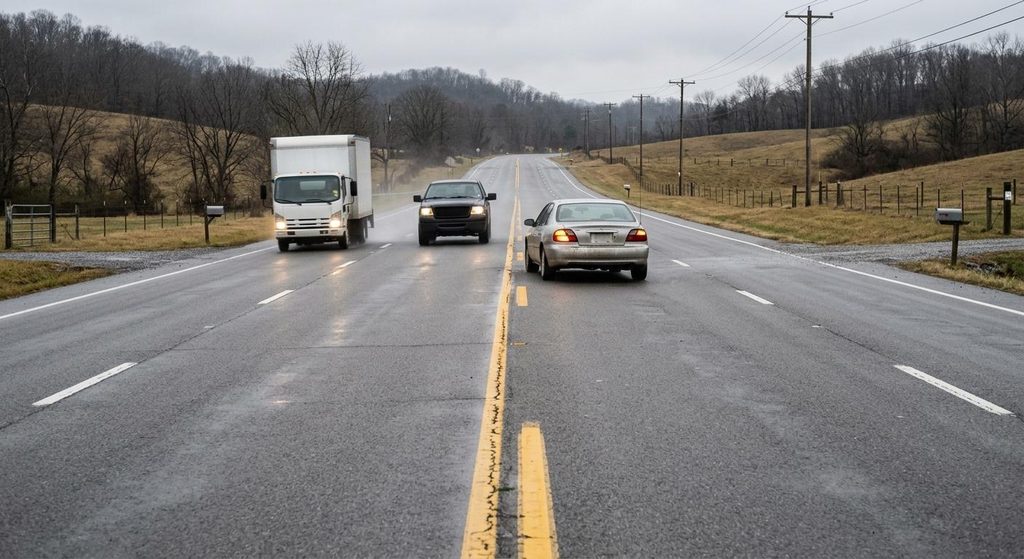
And here is the part that rules out the easy explanations. The share of crashes that are angle crashes is nearly identical on both halves: 37% inside the city, 41% outside it. It is not that more people are making dangerous turns out past Mascot. The same proportion of drivers are making the same turns. The turn simply kills them out there.
That is what an undivided four-lane highway does. A driver waiting to turn left is sitting in a live travel lane with no median refuge, and oncoming traffic is closing at 55 rather than 45. A driver pulling out of a driveway has to cross four lanes of traffic in one movement instead of two, with no protected place to pause in between. The gap you need is longer, the consequence of misjudging it is far worse, and there is nowhere to hide if you get it wrong.
The contrast with rear-end crashes makes the point from the other direction. Rear-end collisions are the second-largest crash type on this corridor, 327 of them, and in the 45 mph zone 225 rear-end crashes produced zero deaths across eleven years. Following too closely in stop-and-go traffic on the divided half of Rutledge Pike wrecks cars. Turning across the undivided half kills people.
Rutledge Pike Crash Hotspots: Volume at One End, Fatalities at the Other
Every reported crash on the corridor was mapped to its nearest named junction. About 78 percent fall within 150 metres of one. Posted speed and responding jurisdiction are the values recorded with the crashes at each location.
| Junction | Crashes | Killed | Serious | Posted / Jurisdiction |
|---|---|---|---|---|
| Divided section, inside Knoxville city limits | ||||
| Loves Creek Rd and N. Chilhowee Dr | 112 | 0 | 6 | 45 mph, Knoxville PD |
| Spring Hill Road | 106 | 1 | 5 | 45 mph, Knoxville PD |
| Ault Road | 92 | 0 | 3 | 45 mph, Knoxville PD |
| Timothy Street | 52 | 0 | 0 | 45 mph, Knoxville PD |
| Chester Road | 39 | 0 | 3 | 45 mph, Knoxville PD |
| McCalla Avenue | 37 | 0 | 1 | 45 mph, Knoxville PD |
| North Burns Road | 24 | 0 | 1 | 45 mph, Knoxville PD |
| The transition, where the median runs out | ||||
| Parker Drive | 36 | 1 | 2 | 50 mph, Knoxville PD |
| Harris Road | 34 | 0 | 4 | 50 mph, Knoxville PD |
| Undivided section, unincorporated Knox County | ||||
| Mine Road | 59 | 1 | 6 | 55 mph, Sheriff or THP |
| Roberts Road, near Mascot | 31 | 3 | 4 | 55 mph, Sheriff or THP |
| Shipetown Road | 31 | 1 | 8 | 55 mph, Sheriff or THP |
| Circle Road | 14 | 0 | 3 | 55 mph, Sheriff or THP |
| Apache Road | 8 | 2 | 0 | 55 mph, Sheriff or THP |
| Not at any named junction | ||||
| Mid-block and private driveways | 240 | 3 | 14 | Corridor-wide |
Why do the busiest intersections have almost no deaths?
Because they sit on the divided half of the road. Loves Creek Road, Spring Hill Road, Ault Road, Timothy Street, Chester Road, McCalla Avenue and North Burns Road together account for roughly 460 crashes and one death. There is a median, the posted limit is 45, and traffic is dense enough that most collisions happen at low closing speeds. That is a lot of damaged cars and a lot of injuries, but very few fatalities.
Roberts Road has only 31 crashes. Why does it matter?
Because three of them were fatal. That is a rate of about 97 deaths per 1,000 crashes, roughly seven times the corridor average and nearly forty times the rate on Kingston Pike. Four of the corridor’s fifteen fatal crashes sit in the Roberts Road and Shipetown Road area. A junction can be low volume and still be the most dangerous place on a road.
My crash was at a driveway, not an intersection. Does that make it a weaker case?
No. Roughly 240 crashes on this corridor did not fall at any named junction, and they produced three deaths and fourteen serious injuries. On an undivided four-lane highway lined with homes, truck yards and small businesses, a driveway crash is the same left-turn-across-traffic problem without a signal, a stop sign or a line of waiting witnesses. If anything it makes the physical evidence and any nearby camera footage more important, not less.
Junction figures come from OEB Law’s crash-data analysis of the Knox County Transportation Planning Organization (Knox TPO) Interactive Crash Map, reported crashes 2015 through 2026, with each crash located by its recorded coordinates and matched to the nearest named intersection within 150 metres. Current as of October 2026. Responding agency reflects the jurisdiction recorded with the crashes at each location and is a general guide, not a determination about any individual crash.
Where Crashes Cluster on Rutledge Pike
We mapped all 1,088 crash locations against the corridor’s named intersections. About 78% of them fall within 150 meters of a junction. The pattern at junction level repeats the corridor-level pattern exactly, which is how we know the split is real and not an artifact of how the data is grouped.
The Inner Junctions: Volume Without Fatalities
Loves Creek Road and North Chilhowee Drive is the busiest point on the corridor, with 112 crashes and zero deaths. Spring Hill Road follows with 106 crashes and one death. Ault Road records 92 crashes and no deaths. Timothy Street, Chester Road, McCalla Avenue and North Burns Road together add well over a hundred more crashes with none at all.
Those seven junctions are all inside Knoxville city limits, all posted at 45, all on the divided section, and together they carry roughly 460 crashes and a single fatality. This is the stretch currently being milled and resurfaced by TDOT, with nightly lane closures between Spring Hill Road and Timothy Avenue. If you were hurt here, you were almost certainly hurt in a high-volume, survivable collision, and your case will turn on injury documentation rather than on catastrophic loss.
Parker Drive and Harris Road: The Transition
Parker Drive and Harris Road sit at the hinge, posted at 50, with 36 and 34 crashes and one death between them. This is roughly where the city gives way to the county and the median runs out.
The Outer Junctions: Fatalities Without Volume
Past that transition the numbers invert. Roberts Road, near Mascot, records 31 crashes and three deaths. That is a rate of 96.8 deaths per 1,000 crashes, about seven times the corridor average and nearly forty times the rate at Kingston Pike. The Tennessee Highway Patrol took the preliminary report on a fatal crash at that intersection in 2023.
Apache Road records only eight crashes in eleven years but two of them were fatal. Shipetown Road shows 31 crashes, one death and eight serious injuries, the heaviest concentration of serious injury at any single junction on the road. Mine Road adds 59 crashes, one death and six serious injuries. Circle Road, where the Sheriff’s Office worked a fatal hit-and-run, shows 14 crashes and three serious injuries.
Four of the corridor’s fifteen fatal crashes cluster in the Roberts Road and Shipetown Road area alone.
Between the Junctions
The 240 crashes that did not snap to any named intersection are their own story. On an undivided arterial lined with homes, small businesses, truck yards and farm entrances, a crash that is not at a named junction is usually a turn into or out of a private driveway. Those 240 crashes produced three deaths and fourteen serious injuries. If your wreck happened at a driveway rather than an intersection, do not assume that makes it a minor matter or that fault is obvious. It is the same left-turn-across-traffic problem without the benefit of a signal, a stop sign or a witness who was waiting at the light.
The Other Hazards the Data Confirms
Trucks: Common Here, But Not What Is Killing People
Rutledge Pike carries the highest commercial vehicle involvement of any Knox County arterial we measured. Trucks or buses were involved in 96 crashes, or 8.8% of the corridor total, against 6.4% for Knox County as a whole.
That share has a specific local cause, and it is not through-freight headed for the Tri-Cities. The heaviest truck involvement is inside the city, at 10.3%, against 5.8% out in the county. This is the John Sevier industrial area: a Norfolk Southern rail yard just south of the community inside the city limits, quarry and aggregate operations off Governor John Sevier Highway, truck sales and service lots along the corridor, and the business park traffic near Mascot.
We want to be straight with you about what the data does and does not show. Those 96 truck crashes produced one death. Trucks are not driving the fatality count on this road. What they do drive is injury severity: those same 96 crashes produced 14 serious injuries, a serious-injury rate roughly double the corridor average. A truck on Rutledge Pike is about twice as likely to put someone in the hospital with a life-altering injury, even though the fatal crashes here are overwhelmingly passenger vehicles turning across traffic.
That distinction matters for your claim. A commercial case brings a different insurer, a different set of federal records and usually a much larger policy, and federal trucking regulations open evidence that an ordinary car wreck does not. It also brings the question of whether the case belongs in state or federal court.
Motorcycles: 1.4% of Crashes, 20% of the Deaths
Fifteen motorcycle crashes are recorded on the corridor. Three of them were fatal. That is one and a half percent of the crashes producing a fifth of the deaths, and three of the fifteen fatal crashes on Rutledge Pike involved a motorcycle.
The reason sits in the same geometry already described. The crash that kills a motorcyclist is the one where a car turns across their path, and this is a road built to produce exactly that collision. Evidence in a motorcycle case has to be gathered quickly and carefully, because the rider is frequently the only person who can describe what happened and is frequently in no condition to do it.
Darkness Without Streetlights
The corridor’s lighting splits the same way everything else does. Crashes in the dark where the road is lit: 96, with zero deaths. Crashes in the dark where it is not lit: 122, with four deaths, a rate of 32.8 per 1,000. Four of the fifteen fatal crashes happened in unlit darkness, and the unlit stretches are the unincorporated ones.
What the Data Rules Out
Two things people assume about a road like this turn out not to be true, and we mention them because an honest picture is more useful than a scary one.
Alcohol is not the story. Nineteen crashes on the corridor, 1.7% of the total, involved alcohol, and none of them was fatal. Weather is not the story either. Eight hundred of the 1,088 crashes happened in clear conditions, and those clear-weather crashes account for twelve of the fifteen deaths. Rain produced 112 crashes and one death. The fatal crash on Rutledge Pike is typically a sober driver in good weather in daylight, turning across four undivided lanes.
A Road Nobody Is About to Fix
Rutledge Pike is on the Knoxville regional High Injury Network, with two Tier 1 segments covering half a mile and six Tier 2 segments covering about a mile and a half. That is a real designation and it reflects real harm, though the corridor’s Tier 1 mileage is modest compared with Clinton Highway or Chapman Highway.
There is work happening and work planned, but notice where it is.
The active project is pavement. TDOT’s September 2026 East Tennessee construction report listed milling and resurfacing on US-11W between Spring Hill Road and Timothy Avenue, with nightly lane closures. That is the inner, divided, 45 mph stretch where almost nobody dies.
The major planned project is at the far southern end. A study of the Magnolia Avenue, Rutledge Pike and Asheville Highway interchange recommends replacing the existing three-legged interchange with a four-legged signalized intersection, to improve mobility and connectivity through the Burlington area. It is carried in the regional transportation improvement program as a project of roughly $15.8 million with a target in the 2030 range, and schedules of that kind move.
What there is no funded project for is the undivided 55 mph stretch from the industrial corridor out through Mascot and Shipetown, where two thirds of the deaths occur. No median is being installed. No signals are being added at Roberts Road or Apache Road. The posted limit is not being lowered.
Why This Matters Legally
Roadwork changes who may be responsible for your crash. Inside an active work zone, a highway contractor’s traffic control plan, signage, lane shifts and striping all become potential evidence, and a contractor can be a defendant alongside the at-fault driver. If your crash happened during the resurfacing work on the inner stretch, the contractor’s records are worth preserving immediately.
The absence of a project matters too. A pattern of crashes at a specific junction, documented in the public crash record, is part of what establishes that a hazard was known. That does not by itself create a claim against a government entity, and Tennessee law places real limits on suits against the state and its subdivisions, but it is a line of inquiry worth pursuing in a serious case at a junction with a history.
First Steps: Emergency and Medical Response in East Knox County
Three Agencies, One Road
Most Knoxville corridors have one responding agency. Rutledge Pike has three, and which one responds depends on where along the road you were hurt.
Inside Knoxville city limits, the Knoxville Police Department investigates. A KPD-investigated fatal crash at Rutledge Pike and Spring Hill Road involved a sedan turning left onto Spring Hill Road and struck by a southbound truck, which is precisely the crash pattern this guide describes.
Outside the city limits, the Knox County Sheriff’s Office responds. KCSO patrol zones straddle this corridor: one zone runs from Tazewell Pike and East Emory Road over to Rutledge Pike, another lies between Rutledge Pike and Asheville Highway and contains the Mascot and Shipetown communities, and a third lies between Rutledge Pike and the Tennessee River. The Sheriff’s Office has worked fatal crashes on the corridor, including a hit-and-run near Circle Road.
On the state route, the Tennessee Highway Patrol may take the preliminary report, as it did for the 2023 fatal crash at Roberts Road.
This is not a technicality. It determines which agency holds your crash report, where you request it, how long it takes, which agency’s reconstruction unit worked the scene, and whose dash and body camera footage exists. It also determines how quickly the report becomes available, and Tennessee’s one-year deadline does not pause while you track down the right agency. If you are not certain which jurisdiction your crash was in, the simplest marker is the median: if there was one, you were almost certainly in the city.
Local Trauma and Emergency Care
The University of Tennessee Medical Center is the region’s only Level I trauma center and the referral center for Knox County and the counties around it. It sits on Alcoa Highway, on the opposite side of the county from this corridor.
That distance is part of the picture out past Mascot. Rural Metro Fire responds on the unincorporated end, and UT LIFESTAR, the medical center’s helicopter program, has been dispatched to serious crashes on Rutledge Pike. If a helicopter was called to your crash, that fact alone tells you something about how the responders assessed the injuries at the scene, and the flight and transport records belong in your file.
Get evaluated even if you feel able to refuse transport. Insurers treat a gap between the crash date and the first medical visit as evidence that the injury came from something else, and on a corridor where a serious case often becomes an underinsured motorist claim, the medical timeline is frequently the whole argument.
Protecting the Evidence in a Rutledge Pike Crash Claim
Every corridor has a signature piece of evidence. On a retail strip it is storefront security video. On a residential road it is doorbell cameras. On Rutledge Pike it is something else again, because the fatal half of this road runs past industrial yards, truck lots, a business park and scattered homes rather than through either a shopping district or a subdivision.
Commercial and Industrial Cameras
The businesses along this corridor are the ones most likely to have recorded your crash, and they are also the ones most likely to overwrite the footage on a short cycle. Truck sales and service lots, quarry and aggregate operations, warehouse and distribution sites and the business park near Mascot commonly run cameras covering their entrances, and an entrance camera pointed at the highway captures exactly the turning movement that these cases turn on. Many of these systems retain video for days rather than weeks, and no business preserves footage of someone else’s crash unless asked.
Vehicle Data
Nearly every modern vehicle stores crash data in its event data recorder: speed, braking, throttle position and steering input in the seconds before impact. In a left-turn case this is often decisive, because it shows how fast the oncoming vehicle was actually traveling and whether it braked. Commercial trucks carry considerably more, including engine control module data and, increasingly, forward-facing camera footage. That data can be lost when a vehicle is repaired, sold or scrapped.
The Roadside Itself
Photograph the scene before it changes. On this corridor the useful details are the ones that establish sight lines and geometry: where the median ends, whether there was a turn lane, what the posted limit was at that exact point, how far you could see in the direction the other vehicle came from, and whether anything blocked that view. Tire marks, debris fields and the resting positions of the vehicles all disappear within hours.
The Spoliation Letter
A spoliation letter is a formal demand that a person or business preserve specific evidence, sent before it is destroyed in the ordinary course. It is the single most time-sensitive thing a lawyer does in these cases. On Rutledge Pike it needs to go to the businesses with cameras near the crash point, to the owner of any commercial vehicle involved, and to the insurer holding the other vehicle. Sent in week one it usually works. Sent in month two it is often too late, and the loss of that footage can be the difference between a clear liability case and a disputed one.
Evidence to Lock Down After a Serious Rutledge Pike Crash
This corridor is neither a shopping strip nor a subdivision. The fatal half runs past truck yards, quarry and aggregate operations, a business park and scattered homes, and that changes which camera recorded your crash.
A camera covering a commercial driveway is pointed at exactly the turning movement these cases turn on. Many of these systems hold days rather than weeks, and no business preserves footage of a stranger’s crash unless it is asked to in writing.
What is a spoliation letter?
It is a formal legal notice telling a business, driver, company or insurer to preserve all evidence relating to the crash. Once it is served, they have a duty to keep that evidence, and a court can penalize them for destroying it, sometimes by instructing the jury to assume the lost material would have hurt that party’s case.
How quickly does Rutledge Pike crash evidence disappear?
Within days for the material that matters most. Business camera systems along this corridor commonly retain footage for days rather than the 30 days people assume, and the crash data stored in the other vehicle can be gone the moment it is repaired, sold or scrapped. A preservation letter sent in the first week usually works. Sent in the second month it is often too late, and that loss can turn a clear liability case into a disputed one.
Who Is Liable for a Rutledge Pike Crash
The At-Fault Driver
In most cases this is the driver who turned across traffic or pulled out from a side road or driveway without yielding. But on this corridor the question of who was at fault is genuinely contested more often than on an ordinary road, because a left turn at 55 mph across undivided lanes invites an argument about whether the turning driver misjudged the gap or the oncoming driver was traveling too fast for conditions. Both can be true, and Tennessee law has a specific answer for that situation, covered below.
The Commercial Carrier
If a truck or bus was involved, the employer is usually responsible for the driver’s conduct, and a commercial policy is typically many times the size of a personal auto policy. Federal regulations also require carriers to keep records that an ordinary driver does not have, including hours-of-service logs, maintenance files and driver qualification records.
A Business Property Owner
On an undivided arterial lined with commercial entrances, how a business lays out its driveway matters. An exit that forces a driver to cross four lanes blind, landscaping or signage that blocks the view of oncoming traffic, or an entrance placed just over a crest can all contribute to a crash and can expose the property owner.
A Highway Contractor
In an active work zone, the contractor responsible for traffic control, signage and lane markings can share liability if the plan was inadequate or was not followed.
A Government Entity
Claims against a city, county or state entity over road design or maintenance are possible in Tennessee but are governed by their own rules, with shorter notice requirements and significant limits. They need to be evaluated early, not as an afterthought.
Your Own Insurance
This deserves its own line on this corridor. Serious injuries out past Mascot regularly exceed the at-fault driver’s policy limits, and one of the corridor’s fatal crashes was a hit-and-run. In both situations your own uninsured and underinsured motorist coverage becomes the source of recovery, and how that coverage works after a hit-and-run has specific requirements in Tennessee that are easy to get wrong.
Who Can Be Held Liable in a Rutledge Pike Crash
A crash on an undivided four-lane state route can involve more than the two drivers, and each party may carry its own insurance policy.
I was turning left and the other driver hit me. Am I automatically at fault?
No, and this is the most important thing to understand about a crash on this road. A turning driver has a duty to yield, but an oncoming driver still has a duty to travel at a reasonable speed and to keep a proper lookout. Tennessee apportions fault between them, so the question is never simply who was turning. It is how fast the oncoming vehicle was actually traveling, whether it braked, what the sight line allowed you to see, and whether a median or turn lane should have existed at that point. The insurer will open by assigning you a large share. The evidence frequently says otherwise.
Can a business be responsible for how its driveway is laid out?
Sometimes. On an undivided arterial, a commercial exit that forces drivers to cross four lanes blind, landscaping or signage that hides oncoming traffic, or an entrance placed just beyond a crest can all contribute to a crash and can expose the property owner. It takes an early site inspection to document, because vegetation gets cut back and signs get moved after a serious wreck.
The driver who hit me did not have enough insurance. What then?
This happens regularly in serious crashes on the rural half of this corridor, and one of the corridor’s fatal crashes was a hit-and-run where no driver was identified at the scene. In both situations your own uninsured and underinsured motorist coverage becomes the source of recovery. Tennessee has specific requirements for those claims, including how and when the carrier must be notified, and they are easy to get wrong without help.
Tennessee Accident Law and Local Courts
Tennessee’s Strict One-Year Deadline
Tennessee gives you one year from the date of the crash to file a personal injury lawsuit, under T.C.A. section 28-3-104(a)(1). Wrongful death claims are governed by Tennessee Code section 20-5-106 and carry the same one-year period. This is among the shortest deadlines in the United States, and most states allow two or three years. Miss it and the claim is gone regardless of how clear the fault was. Claims against government entities can carry even shorter notice requirements.
Modified Comparative Fault
Tennessee follows modified comparative fault, adopted in McIntyre v. Balentine in 1992. You can recover damages only if your share of the fault is less than the other party’s, and whatever you recover is reduced by your own percentage. At a 50/50 split in a two-vehicle case, you recover nothing.
On Rutledge Pike this rule is not academic. The signature crash on this corridor is a left turn across undivided lanes, and the insurer’s opening move in almost every one of those cases is to assign a share of the fault to the turning driver. Pushing that percentage from 40 to 51 costs them nothing and costs you everything. This is precisely why the event data recorder download, the speed evidence and the camera footage matter so much here. Comparative negligence in Tennessee car accidents is worth understanding before you give a recorded statement to anyone.
Which Court Hears Your Case
A crash anywhere along the Knox County portion of Rutledge Pike, whether inside the city limits or out past Mascot, is a Knox County case and is generally filed in Knox County Circuit Court in Knoxville. That is true even though the responding agency differs along the corridor. If your crash happened past the county line in Blaine, you are in Grainger County, and that is a different courthouse with different scheduling and a different jury pool. The corridor crosses that line, so it is worth confirming which side of it your crash was on.
Tennessee Accident Law at a Glance
- Clock starts on the crash date
- One of the shortest in the U.S.
- Shorter still against an agency
- Recover only if under 50% at fault
- Award reduced by your share
- In a left-turn case, this is the fight
- Cap on non-economic damages
- Rises to $1M if catastrophic
- No cap on economic damages
- Knoxville Police Department responds inside the city limits, which covers the divided 45 mph section and 741 of the corridor’s 1,088 reported crashes.
- Knox County Sheriff’s Office responds in unincorporated Knox County, where only 345 of the crashes but 10 of the 15 deaths occurred. Its patrol zones straddle this corridor and take in the Mascot and Shipetown communities.
- Tennessee Highway Patrol takes the preliminary report on some crashes here, including fatalities, because Rutledge Pike is a state route.
- Knox County Circuit Court, City County Building, 400 Main Street, Knoxville, hears the claim either way. Unincorporated Knox County is still Knox County for venue. Past the county line in Blaine you are in Grainger County, which is a different courthouse.
How long do I have to file an accident claim in Tennessee?
Generally one year from the date of the crash under T.C.A. section 28-3-104. Wrongful death claims under Tennessee Code section 20-5-106 carry the same one-year period. If a government agency may share fault, the notice requirements can be shorter still, so speak with an attorney soon after the wreck.
Can I still recover money if I was partly at fault?
Yes, as long as your share of the fault is less than the other party’s. Your award is reduced by your percentage. If you are found half or more to blame in a two-vehicle case, Tennessee law bars any recovery. That rule is exactly why the insurer in a left-turn case works so hard to move your percentage up a few points.
Is there a limit on accident compensation in Tennessee?
Non-economic damages such as pain and suffering are capped at $750,000, or $1,000,000 for catastrophic injuries as defined by statute. There is no cap on economic damages like medical bills and lost wages.
What Your Rutledge Pike Accident Claim May Be Worth
No honest lawyer can value your case from a web page. What we can do is explain what goes into the number.
Economic Damages
These are the documented, countable losses: emergency transport including air ambulance, hospital and surgical bills, rehabilitation, prescriptions, assistive equipment, home modifications, lost wages and reduced future earning capacity, and vehicle damage. In a serious case the future figures usually dwarf the bills already received, and they require medical and vocational expert support to establish.
Non-Economic Damages
These cover pain, suffering, permanent impairment, disfigurement and loss of enjoyment of life. They are real and often substantial, and they are where insurers push back hardest. Documentation of how the injury changed daily life carries more weight here than adjectives.
Tennessee’s Cap on Non-Economic Damages
Tennessee caps non-economic damages in most injury cases, with higher limits available in catastrophic circumstances defined by statute. Economic damages are not capped. Whether a case qualifies for the higher tier depends on the specific injuries, and it is one of the first questions worth evaluating in a severe-injury claim.
Injured in a Rutledge Pike Crash? Get a Free Case Review.
On this corridor the camera that recorded your crash usually belongs to a business, and many of those systems overwrite in days rather than weeks. The crash data stored in the other vehicle can be gone the moment it is repaired or scrapped. The insurer, meanwhile, is already working out how much of the fault it can place on the driver who was turning. Call or text OEB Law now for a free, no obligation consultation. You don’t pay unless we win.
Our team is standing by 24/7.Why Choose OEB Law for Your Rutledge Pike Case
When a crash happens on Rutledge Pike, the other driver’s insurer will treat it as a routine wreck on a four-lane highway. It is not. Our attorneys know the difference between the divided, signalized, 45 mph stretch inside the city and the undivided 55 mph stretch past Mascot where two thirds of the deaths occur. We know whether the Knoxville Police Department, the Sheriff’s Office or the Highway Patrol wrote your report, and where to get it. We know to send preservation letters to the truck yards and businesses with cameras pointed at the highway before the footage rolls over, to pull the event data recorder before the vehicle is scrapped, and to document the sight lines and the missing median that explain why the turn went wrong. We know the insurer will try to load fault onto the turning driver, and we know what it takes to push back. We identify every liable party, from an at-fault driver to a commercial carrier, a property owner or a contractor, and we fight to recover the full value of your claim while you focus on healing. You can learn more about our background from Timothy G. Elrod and our experienced attorneys. Best of all, you don’t pay unless we win, so pursuing justice carries no financial risk.
Who is OEB Law and Why Are They Good for the Community?
Led by Managing Attorney Timothy G. Elrod and Our Experienced Legal Team
Founded in 2004 in Knoxville, Tennessee, OEB Law has grown over nearly two decades to now serve clients across multiple states. Tim Elrod established the firm with a simple but powerful mission: we care and we help people. Today, our team brings over 50 years of combined experience representing clients throughout Tennessee in personal injury and criminal defense cases.
Our Legal Expertise
Our attorneys have built their reputation through:
- Successfully representing thousands of personal injury and criminal defense clients
- Developing specialized knowledge across all types of accident and injury cases
- Mastering the complexities of Tennessee’s legal system through decades of practice
Why Trust Us
At OEB Law, our reputation speaks for itself:
- Proven Results: We’ve recovered significant compensation for our clients through both settlements and courtroom verdicts
- Client Satisfaction: Our numerous 5 Star Google Reviews showcase our commitment to responsive, caring, and effective legal representation
- No Fee Unless We Win: You don’t pay attorney fees unless we successfully secure compensation in your case
- Local Knowledge: As East Tennessee natives, we understand our community and care deeply about the people we serve
- Personalized Approach: We personalize each case to meet our clients’ specific needs, ensuring you’re never just another file number
Community Commitment
Our dedication extends beyond the courtroom. We proudly support:
- Local high school football programs through Rivalry Thursday sponsorships, part of over $500,000 donated to the community across 16 years
- The Knoxville Ice Bears and community fundraising initiatives
- Numerous youth, student, and community organizations throughout East Tennessee
As Tim Elrod says, “We don’t just take, we give back because the people you’re giving back to are the people who are supporting your firm.“
Have a personal injury or criminal defense case? We’re available 24/7 to help.
Get In Touch
- Call or Text: (865) 546-1111
- Visit: https://oeblawtn.com/
- Available: Standing by 24/7
Why OEB Law? Because They’re Good For The Community.
TEXT or CALL (865) 546-1111 for HELP NOW. Standing By 24/7.
Follow Us on Social Media
Stay connected with OEB Law for the latest Knoxville and East Tennessee legal insights, community updates, and important legal information. Follow us on X, YouTube, Facebook, Instagram, LinkedIn, and TikTok for exclusive content, client stories, and expert legal guidance from our team.
Frequently Asked Questions
Why is the quiet end of Rutledge Pike more dangerous than the busy end?
Because the median ends. From East Knoxville out to I-40, Rutledge Pike is a divided four-lane road posted at 45, and 594 crashes there have produced one death. Past I-40 the four lanes continue but the median stops and the limit rises to 55, and 417 crashes there have produced twelve. A driver waiting to turn left on the undivided half is sitting in a live travel lane with nowhere to take refuge, and oncoming traffic is closing ten miles an hour faster. Traffic volume roughly halves out there, and the fatality rate per crash goes up about seventeen times.
Who writes the crash report for an accident on Rutledge Pike?
It depends where along the road you were hurt, and this corridor has three possible answers. The Knoxville Police Department responds inside the city limits, which covers the divided section and 741 of the corridor’s 1,088 reported crashes. The Knox County Sheriff’s Office responds in unincorporated Knox County, which includes Mascot and Shipetown and is where ten of the fifteen deaths occurred. Because Rutledge Pike is a state route, the Tennessee Highway Patrol also works crashes here, particularly fatalities. Requesting your report from the wrong agency is a common way to lose two or three weeks against a one-year deadline.
I was turning left when I was hit. Will the insurance company blame me?
Almost certainly it will try, and Tennessee’s comparative fault rule gives it a strong incentive. Under McIntyre v. Balentine you recover only if your share of the fault is less than the other party’s, so moving you from 40 percent to 51 percent costs the insurer nothing and costs you everything. A turning driver does have a duty to yield, but the oncoming driver still has a duty to travel at a reasonable speed and keep a proper lookout. The answer usually comes from objective evidence: the event data recorder in the other vehicle showing its actual speed and whether it braked, any camera covering the roadway, and the sight lines at that exact point.
Are truck accidents the main danger on Rutledge Pike?
Trucks are unusually common here but they are not what is killing people, and we would rather tell you that plainly. Trucks or buses were involved in 8.8 percent of crashes on this corridor, the highest share of any Knox County arterial we measured, against 6.4 percent countywide. Most of that is inside the city, near the rail yard and the quarry and aggregate traffic, rather than through-freight heading toward Grainger County. Those 96 truck crashes produced one death but 14 serious injuries, roughly double the corridor’s serious injury rate, so a truck here is about twice as likely to cause a life-altering injury even though the fatal crashes are overwhelmingly passenger vehicles turning across traffic.
A business camera may have recorded my crash. How fast do I need to act?
Within days. The fatal half of this corridor runs past truck yards, quarry entrances, warehouses and a business park, and an entrance camera at one of those sites is pointed at exactly the turning movement these cases turn on. Many of those systems hold footage for days rather than the 30 days people assume, and no business preserves video of a crash it was not involved in unless somebody asks in writing. If you are able, photograph the nearest businesses and note any visible camera before you leave the scene, because a preservation letter can only go to an address somebody identified while the video still existed.
How soon after a Rutledge Pike crash should I contact a lawyer?
As soon as you are able, ideally within days. Tennessee’s one-year filing deadline under T.C.A. section 28-3-104 is only part of the reason. The business camera footage that could prove your case is often gone within a week, the other vehicle’s crash data disappears when it is repaired or scrapped, and tire marks and debris are gone after one rain. Serious crashes on the rural half of this corridor also regularly exceed the at-fault driver’s policy limits, which turns the case into an underinsured motorist claim with its own notice requirements. If you or a loved one was hurt on Rutledge Pike, call or text Knoxville attorney Tim Elrod for a free, no obligation consultation. You don’t pay unless we win.

