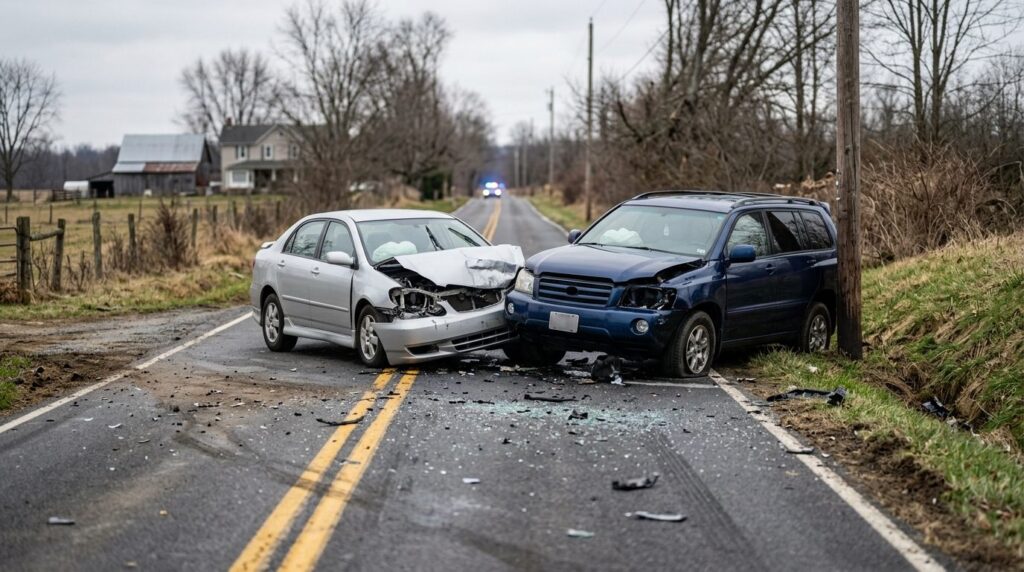
Emory Road does not look dangerous. It has no 55 mph sections, no interstate ramps, and it carries a fraction of the traffic of Knoxville’s big arterials. It is also one of the deadliest roads in Knox County. Known as State Route 131, it runs roughly 25 miles east to west across the top of the county, from Karns and Oak Ridge Highway through Powell, across I-75 at Exit 112, on through Halls and Gibbs toward Corryton and Rutledge Pike. Our own database of Tennessee crash records shows 3,975 reported wrecks and 31 people killed along the corridor since 2015. What makes it lethal is not speed limits. It is geometry. Roughly half of the crash records on this corridor sit on a two-lane undivided road with no shoulder, and on that kind of road the crash that kills you is the one that comes across the centerline. At OEB Law, our Knoxville-based team handles these cases, and we have mapped this corridor junction by junction. In this blog post, Knoxville attorney Tim Elrod discusses what to do after a car accident on Emory Road (SR-131) in North Knox County.
Key Takeaways
- Head-on collisions are only 2.5% of crashes on Emory Road but cause 35% of the deaths. That is the single most important fact about this road.
- Our crash-record database shows 3,975 reported wrecks, 31 people killed, and 133 seriously injured along the corridor from 2015 through 2026.
- About 90% of the deaths happen outside Knoxville city limits, in unincorporated Knox County, where the Sheriff’s Office responds rather than the Knoxville Police Department.
- East Emory Road is a Tier 1 High Injury Network corridor, with six Tier 1 segments covering 1.50 miles, among the worst stretches in the region.
- The evidence here is different. This is a residential rural corridor, so the cameras that recorded your crash usually belong to the people who live beside the road.
- Tennessee gives you only one year to file a personal injury claim, one of the shortest deadlines in the country.
To Discuss Your Case, Call or Text Our Team Standing By 24/7: (865) 546-1111
About OEB Law, Your Knoxville Legal Team

This guide is provided by the experienced attorneys at OEB Law, led by Managing Attorney Timothy G. Elrod. Founded in Knoxville in 2004, our firm has over 50 years of combined experience navigating East Tennessee’s legal system.
We have successfully represented thousands of personal injury clients, developing deep expertise in Tennessee’s complex wrongful death and accident laws. As East Tennessee natives, we have a direct understanding of the local court systems, law enforcement agencies, and community needs. Our commitment is to provide trusted, authoritative information to our neighbors in Knoxville and the surrounding Tennessee communities. However, this information does not constitute legal advice. If you or a loved one has been injured in an accident or needs legal help, call us today for a free, no obligation, initial consultation.
The Emory Road Danger Zone: Karns to Corryton
Emory Road is the east to west spine of North Knox County. As State Route 131, it connects Karns and Oak Ridge Highway in the west to Powell, the I-75 interchange at Exit 112, Halls, Gibbs, and ultimately the Corryton and Rutledge Pike area in the east.
The corridor passes through a string of communities that have grown faster than the road under them:
- Karns and the western end near Oak Ridge Highway
- Powell, the Clinton Highway junction, and the I-75 Exit 112 interchange
- The Blueberry Road and Dannaher Drive medical and commercial strip
- Halls, Maynardville Pike, and the Norris Freeway junction
- Gibbs, Brown Gap Road, and the Tazewell Pike area
- Corryton and the rural eastern end
Here is what the numbers actually say about this road. Our records put the median traffic volume at roughly 13,800 vehicles a day, which is modest, about two thirds of what Clinton Highway carries. The posted limit never exceeds 45 mph anywhere on the corridor in our records. And yet Emory Road has killed 31 people since 2015.
The reason shows up in the road’s cross-section. Our crash records split almost evenly between a two-lane road and a four-lane road, because Emory Road has been widened in pieces over decades and large stretches remain exactly what they always were: a two-lane country road with a painted centerline, no median, no shoulder to recover onto, and utility poles, mailboxes, and mature trees sitting a few feet from the travel lane. The regional safety planners agree. The Knoxville Regional Transportation Planning Organization’s High Injury Network flags East Emory Road with six Tier 1 segments covering 1.50 miles, plus four more Tier 2 segments, placing it among the highest-risk corridors in the region.
Emory Road (SR-131) Hazard Map
West to east across North Knox County, from Karns through Powell and Halls to Gibbs and Corryton
Road
Dannaher
Exit 112
Crossings
Brown Gap
east end
Which part of Emory Road has the most crashes?
The Conner Road junction in Powell is the busiest in our records, with 286 reported crashes, followed by the Dannaher and Blueberry Road area and the Central Avenue Pike and Heiskell Road crossing. All of these sit on the widened, signalized western half of the corridor, where crashes are frequent but rarely fatal.
Which part of Emory Road is the most deadly?
The two-lane rural stretches through Gibbs and toward Corryton at the eastern end. Those junctions show only a few dozen crashes each, yet they carry a disproportionate share of the corridor’s 31 deaths. With no median and no shoulder, a vehicle that leaves its lane there has nowhere to go except into oncoming traffic or into a ditch, a utility pole, or a tree.
Where Crashes Cluster on Emory Road
We mapped every reported crash on the corridor to the nearest named junction. As on every road we study, the busiest places and the deadliest places are not the same places, and on Emory Road the gap between them is extreme.
Conner Road, Powell
The busiest crash location on the corridor, with 286 reported wrecks in our records, and not a single fatality. Nearly half are rear-end collisions. This is the widened, signalized, four-lane commercial end of the road doing what widened commercial roads do: generating a very high volume of relatively survivable crashes.
Dannaher Lane and Blueberry Road
The Dannaher junction accounts for 156 reported crashes and the Blueberry Road junction another 121. This is the Powell medical and commercial strip, and it currently sits inside an active TDOT work zone, with roadway construction and nightly lane closures tied to the interchange project just to the west.
Central Avenue Pike and Heiskell Road, Dry Gap Pike, and Maynardville Pike
These three junctions account for 145, 140, and 120 reported crashes respectively. They are the crossroads where the north to south pikes of North Knox County meet Emory Road, and angle collisions make up a much larger share of crashes here than they do at the commercial end.
The Norris Freeway Junction
Roughly 99 reported crashes, and the highest rear-end share of any major junction on the corridor at about 71 percent. Traffic arriving from the Norris Freeway meets stopped or turning vehicles on Emory Road.
Greenwell Road and the Rural East End
This is where the deaths are. The Greenwell Road area carries only about 31 reported crashes in our records, a tiny fraction of the corridor total, yet it accounts for four deaths. Three of those came from a single crash in which a commercial utility truck crossed multiple lanes into oncoming traffic and struck a pickup head-on. Across the rural eastern half of the corridor, through Gibbs and toward Corryton, junction after junction shows the same profile: very few crashes, and a disproportionate number of them fatal.
Between the Junctions
Nearly 900 crashes in our records, about 22 percent of the corridor total, happen more than 150 meters from any named junction, and they carry 8 of the 31 deaths. On a two-lane road, a great many serious crashes do not happen at an intersection at all.
Emory Road (SR-131) Car Accidents: By the Numbers
Reported crashes, 2015–2026 · Source: OEB Law’s database of Tennessee traffic-crash records
The rarest crash on this road is the one that kills
Reported crashes by first point of impact, with the deaths each type produced.
| Crash Type | Reported Crashes | People Killed | Share of Deaths |
|---|---|---|---|
| Rear-end | 1,419 | 2 | 6% |
| Angle (T-bone) | 1,123 | 7 | 23% |
| Ran off road, no other vehicle | 702 | 10 | 32% |
| Sideswipe, same direction | 291 | 0 | 0% |
| Sideswipe, opposite direction | 201 | 0 | 0% |
| Head-on | 101 | 11 | 35% |
Where the crashes cluster
Reported crashes mapped to the nearest named junction, 2015–2026.
| Junction | Reported Crashes | Killed |
|---|---|---|
| Conner Road (Powell) | 286 | 0 |
| Dannaher Lane | 156 | 2 |
| Central Avenue Pike & Heiskell Road | 145 | 1 |
| Dry Gap Pike | 140 | 0 |
| Blueberry Road | 121 | 0 |
| Maynardville Pike (Halls) | 120 | 0 |
| Greenwell Road (rural east end) | 31 | 4 |
City limits or county road
Which agency responds, and what the outcomes look like on each side.
| Area | Crashes | Killed | Deaths / 1,000 |
|---|---|---|---|
| Inside Knoxville city limits | 743 | 3 | 4.0 |
| Unincorporated Knox County | 3,232 | 28 | 8.7 |
The posted limit on Emory Road never exceeds 45 mph anywhere in our records, and the median traffic volume is about 13,800 vehicles a day, roughly two thirds of Clinton Highway’s. What drives the death toll is the road’s shape: our crash records split almost evenly between two-lane and four-lane sections, and the two-lane stretches have no median and no shoulder. Among crashes where no other vehicle was struck, the objects hit most often are ditches, utility poles, earth embankments, mailboxes and trees.
Even when no one is taken from the scene by ambulance, injuries such as whiplash, concussions, and soft-tissue damage often surface hours or days later once the adrenaline fades. If you were involved in a crash here, it is wise to be checked by a doctor and to speak with an attorney about your options.
Why Crashes Happen on Emory Road
Proving fault means identifying the exact mechanism of the crash. On Emory Road, the mechanisms are those of a two-lane rural road, and they are very different from the ones that dominate a commercial strip or a highway.
Crossing the Centerline
This is the defining hazard of the corridor. Head-on collisions account for just 101 reported crashes on Emory Road, about 2.5 percent of the total, and they caused 11 of the 31 deaths. Add opposite-direction sideswipes, which are the near-miss version of the same failure, and centerline-crossing crashes total roughly 302 reported wrecks and 11 deaths. There is no median here and often no shoulder, so a driver who drifts, overcorrects, or misjudges a curve has nowhere to go except into oncoming traffic. Understanding how lighting and roadway conditions affect nighttime liability matters on a corridor where much of the road is unlit.
Running Off the Road Into Something Solid
Our records show 702 crashes on Emory Road in which no other vehicle was struck at all, and those caused 10 deaths. The recorded first point of impact tells the story of the roadside: ditches, utility poles, earth embankments, mailboxes, and standing trees, along with deer. Taken together, head-on crashes and run-off-road crashes are about 20 percent of the wrecks on this corridor and roughly two thirds of the deaths.
Left Turns Without a Turn Lane
Large stretches of Emory Road have no dedicated left-turn lane, so a driver waiting to turn into a side road or a driveway sits stopped in a 45 mph through lane with traffic closing behind them. The result is a distinctive two-part failure: the following driver either rear-ends the turning car or swerves to avoid it and leaves the road. Residents at one Gibbs intersection documented this pattern on their own cameras repeatedly over several years, and it is visible in our crash records as well.
Angle Crashes at the Rural Crossroads
At the pike crossings, drivers pulling out from a stop sign have to judge a gap in traffic moving at 45 mph with sight distance limited by curves, grade, and vegetation. Angle collisions account for 1,123 reported crashes on the corridor and 7 deaths. A Knoxville personal injury attorney who understands rural crossroads can spot sight-distance and signage issues that an out-of-town firm would never think to look for.
A Road Being Rebuilt Around a Problem
Emory Road is changing, and the changes matter to your claim.
TDOT is reconstructing the I-75 interchange at Exit 112, converting the existing diamond interchange at SR-131 into a Diverging Diamond Interchange, a design that routes traffic briefly onto the opposite side of the road to move higher volumes through the junction. Public reporting has put the project between roughly 30 and 40 percent complete during 2026, with an estimated completion in 2028. Related roadway work along Emory Road between Blueberry Road and Dannaher Drive has brought shoulder closures and nightly lane closures to the Powell stretch.
What has not been rebuilt is just as important. At the East Emory Road and Brown Gap Road intersection in Gibbs, residents have reported crashes in their yard for years. Local television covered the intersection in 2022 after a household at the corner reported four wrecks in fifteen days, describing vehicles in the yard, a knocked-down mailbox, and replaced telephone poles. In August 2025 a road safety and operations proposal was presented to the Knox County Commission documenting more than fifteen crashes and near-misses recorded on residents’ own cameras at that one intersection, and noting that aside from crossroad warning signs, no intersection-level safety project had been built there. The proposal asked for turn lanes, lighting, speed feedback signs, sight-triangle clearing, and eventually a signal or roundabout.
Why This Matters Legally
When a crash happens in an active work zone, an investigation has to look past the drivers to the traffic control plan, the signage, and the contractor’s own records for that day. And when a crash happens at a location with a long documented history of the same failure, that history can matter. Claims that reach a government agency follow special rules, including shorter notice deadlines, so these questions have to be raised early rather than discovered late.
First Steps: Emergency and Medical Response in North Knox County
What you do in the first hours after a crash shapes both your recovery and your claim. On Emory Road, the most common surprise for injured people is which agency shows up.
The Sheriff’s Office, Not the City Police
This is the single most practical thing to know about an Emory Road crash. Our records show that 3,232 of the corridor’s 3,975 reported crashes, and 28 of the 31 deaths, happened outside Knoxville city limits. The mailing address still says Knoxville, but the road is unincorporated Knox County:
- Knox County Sheriff’s Office (KCSO): Responds to the large majority of Emory Road crashes, and investigates most of the serious and fatal ones on the corridor.
- Knoxville Police Department (KPD): Responds only on the limited portions inside city limits.
- Tennessee Highway Patrol (THP): Because Emory Road is a state route, THP also works crashes on the corridor, particularly fatalities.
That distinction decides which agency wrote your crash report and where you request it, and it is a common reason people waste weeks asking the wrong department. It also affects the investigation itself, as we have explained in more detail on why Knox County Sheriff reports matter in rural road crashes.
Local Trauma and Emergency Care
- Tennova Healthcare, North Knoxville Medical Center: Located at 7565 Dannaher Drive in Powell, this hospital sits directly on the corridor near the Dannaher and Blueberry junctions, and it is the closest emergency department for most of Emory Road.
- The University of Tennessee Medical Center: Severe trauma, head injuries, and critical spinal injuries are routed to UT Medical Center at 1924 Alcoa Highway, the region’s only Level I Trauma Center. From the rural eastern end of Emory Road that is a long transport, which is one reason head-on crashes out in Gibbs and Corryton are so often fatal.
Legal Tip: Your medical records form the backbone of your injury claim. Gaps in treatment give the insurance company room to argue that your injuries were minor or pre-existing. Steady, documented care links your injuries directly to the crash and protects your right to fair compensation.
Protecting the Evidence in an Emory Road Crash Claim
On a commercial strip the best evidence is a store’s security camera. On a controlled-access highway there are no cameras at all. Emory Road is a third thing, and it has an advantage the other two do not: the cameras here usually belong to the people who live beside the road.
Residential Cameras Are the Key Evidence
Much of Emory Road runs past houses with doorbell cameras, driveway cameras, and security systems pointed at the road, along with farm and barn cameras at the rural end. The safety proposal presented to the Knox County Commission in 2025 was built almost entirely from footage neighbors recorded at a single intersection, which is proof that this evidence exists in quantity. The catch is that consumer camera systems and cloud plans typically overwrite within days or a few weeks, far faster than a commercial system’s 30-day loop. Nobody is going to save it for you, and after a week most of it is simply gone. You can read more about how surveillance video evidence helps prove a case.
The Roadside Itself
On a road where mailboxes, utility poles, and trees are the objects most often struck, the roadside is evidence. Gouges, broken poles, tire marks through a yard, and the damage pattern on a fixed object let a reconstruction expert establish path and speed. Property owners repair this damage quickly, and weather erases the rest, so it needs to be photographed and measured within days.
Vehicle and Commercial Data
The Event Data Recorder, or black box, captures pre-crash speed, throttle, and braking, which is decisive in a centerline-crossing case where the only question is who left their lane. When a commercial truck is involved, and Emory Road carries everything from utility trucks to propane tankers, the Electronic Logging Device, maintenance records, and dashcam footage come into play, along with the employer’s liability for its driver.
The Spoliation Letter
To stop a neighbor’s system, a company, or an insurer from erasing or routinely purging key records, your attorney sends a spoliation of evidence letter right away. Once a party receives this notice, Tennessee law gives them a duty to preserve the evidence. If they destroy it anyway, a court can punish them, sometimes by instructing the jury to assume the lost evidence would have hurt that party’s case.
“Emory Road is the one corridor where I tell people to knock on doors before they do anything else. The house on the corner has probably got the whole thing on a doorbell camera, and that footage is gone in a week. On Kingston Pike we race a store’s 30-day loop. Out here we are racing a seven-day one.” – Knoxville attorney Tim Elrod
Evidence to Lock Down After a Serious Emory Road Crash
This is a residential rural corridor. There is no shopping center camera and no highway contractor, but there are houses, and the people in them are watching the road.
A commercial security system usually holds about 30 days of footage. A doorbell camera or a consumer cloud plan often holds a week or less, and some hold only a few days. On Emory Road the single most valuable piece of evidence is also the one that disappears first.
What is a spoliation letter?
It is a formal legal notice that tells a homeowner, business, driver, company, or insurer to preserve all evidence. Once served, they have a duty to keep it, and a court can penalize them if they destroy it, sometimes by instructing the jury to assume the lost evidence would have hurt that party’s case.
How quickly can Emory Road crash evidence disappear?
Faster than on any other corridor we handle. Residential doorbell and driveway camera footage is often overwritten within a few days, far quicker than the roughly 30-day loop on a commercial system. Broken mailboxes and poles get replaced within a week or two, and a single rain removes tire marks and debris. A preservation letter needs to go out within days, not weeks.
Who Is Liable for an Emory Road Crash
In a simple wreck, one driver is at fault. On this corridor, several parties may share the blame, and each may carry its own insurance policy. A careful investigation looks at every link in the chain so that no responsible party escapes and no source of compensation is left on the table.
The At-Fault Driver
The driver who caused the crash can be directly liable for drifting across the centerline, following too closely behind a car waiting to turn, pulling out from a stop sign without a safe gap, driving too fast for a curve, or driving impaired.
The Commercial Carrier
Emory Road carries utility trucks, delivery vehicles, propane and fuel tankers, and farm equipment. When a commercial vehicle is involved, the company is often responsible for its driver under a legal rule called respondeat superior. In plain terms, an employer answers for what its employee does on the job. The company can also be directly negligent when it hires an unsafe driver, sets schedules that force drivers to rush, or runs vehicles with known mechanical problems. On a two-lane road, a commercial vehicle that leaves its lane is close to a worst-case scenario.
The Highway Contractor
Near the I-75 interchange and the Powell work zone, a contractor may share liability for failing to follow the approved traffic control plan, for inadequate signage or lane markings, or for unprotected drop-offs and poorly placed barriers.
A Property Owner
Vegetation, fencing, or structures that block the sight line from a side road onto a 45 mph state route can contribute to an angle crash. Where a property’s condition helped cause the wreck, the owner may share responsibility.
A Government Entity
When dangerous road design, missing or inadequate signage, a known hazardous intersection, or poor maintenance helps cause a crash, a government agency may share the blame. These claims follow special rules, including shorter notice deadlines, so they demand fast action from an attorney who handles them.
Who Can Be Held Liable in an Emory Road Crash
A crash on a two-lane state route can involve more than the two drivers, and each party may carry its own insurance policy.
A commercial truck crossed the centerline and hit me. Who is responsible?
The driver, and very often the employer as well. Under a legal rule called respondeat superior, a company generally answers for what its employee does on the job, and it can also be directly at fault for hiring an unsafe driver, scheduling in a way that encourages fatigue, or running a vehicle with known defects. Emory Road carries utility trucks, delivery vehicles and fuel tankers, and on a two-lane road with no median a commercial vehicle that leaves its lane is close to a worst-case scenario.
Can overgrown vegetation or a blocked sight line make someone else liable?
Sometimes. At the rural crossroads along Emory Road, a driver pulling out from a stop sign has to judge a gap in 45 mph traffic, and curves, grade and vegetation can make that nearly impossible. Where a property owner’s vegetation or structures obstructed the sight triangle, or where a public agency failed to maintain or sign a known hazardous intersection, that can become part of the claim. It takes an early site inspection to document, because vegetation gets cut back after a serious crash.
Tennessee Accident Law and Local Courts
A strong claim must follow Tennessee’s rules exactly. Two of those rules can end a case before it starts.
Tennessee’s Strict One-Year Deadline
Under Tennessee Code Annotated section 28-3-104, you generally have just one year to file a personal injury lawsuit. This is one of the shortest windows in the nation. The clock starts on the day of the crash. If you miss it, you usually lose your right to recover anything at all, no matter how severe your injuries are.
Modified Comparative Fault and the 50% Bar
Tennessee follows a modified comparative fault rule, set by the state Supreme Court in the landmark case McIntyre v. Balentine. Two ideas matter most. First, the 50% bar means you can recover damages only if you are less than 50% at fault. If a jury finds you half or more to blame, you get nothing. Second, your award is reduced in proportion to your share of fault. In a head-on case on a two-lane road, the fight is almost always about who crossed the line, and the defense will argue you drifted first. Black box data and a neighbor’s camera are the strongest answers available.
Which Court Hears Your Case
- Knox County Circuit Court: Located at the City County Building, 400 Main Street in downtown Knoxville, this court handles essentially the entire Emory Road corridor, including the unincorporated areas, because unincorporated Knox County is still Knox County for venue purposes.
- Knox County General Sessions Court: Smaller claims may be filed here, in the same building.
- U.S. District Court for the Eastern District of Tennessee: This federal court often hears cases when an out-of-state trucking company removes the claim and the damages top $75,000.
Emory Road is simpler than some corridors on venue, since the road stays in Knox County for all but a short western tail. The complication here is not which county, it is which agency wrote the report and whether a government entity shares fault.
Tennessee Accident Law at a Glance
- Clock starts on the crash date
- One of the shortest in the U.S.
- Shorter still against an agency
- Recover only if under 50% at fault
- Award reduced by your share
- In a head-on, the fight is who drifted
- Cap on non-economic damages
- Rises to $1M if catastrophic
- No cap on economic damages
- Knox County Sheriff’s Office responds to most of the corridor, because 3,232 of its 3,975 reported crashes, and 28 of the 31 deaths, happened outside Knoxville city limits.
- Knoxville Police Department responds only on the limited portions inside the city.
- Tennessee Highway Patrol also works crashes here, particularly fatalities, because Emory Road is a state route.
- Knox County Circuit Court, City County Building, 400 Main Street, Knoxville, hears the claims either way. Unincorporated Knox County is still Knox County for venue.
How long do I have to file an accident claim in Tennessee?
Generally one year from the date of the crash under T.C.A. section 28-3-104. If a government agency may share fault, which can arise at a known hazardous intersection or in a work zone, the notice requirements can be shorter still. Speak with an attorney soon after the wreck so evidence and filing time are not lost.
Can I still recover money if I was partly at fault?
Yes, as long as you are less than 50% at fault. Your award is reduced by your percentage of fault. If you are found half or more to blame, Tennessee law bars any recovery.
Is there a limit on accident compensation in Tennessee?
Non-economic damages such as pain and suffering are capped at $750,000, or $1,000,000 for catastrophic injuries. There is no cap on economic damages like medical bills and lost wages.
What Your Emory Road Accident Claim May Be Worth
A head-on collision at 45 mph frequently causes life-altering harm. Tennessee law lets victims pursue two broad types of damages, and a full claim accounts for both. If you want a rough starting point, our tool to estimate your claim value can help, though only a detailed review captures the real picture.
Economic Damages
These are your measurable financial losses. They include medical costs such as ambulance transport, emergency care at Tennova North Knoxville or trauma care at UT Medical Center, surgeries, and imaging. They also include future care such as physical therapy and long-term equipment, plus lost income for the time you miss and any reduced earning power if you cannot return to your old job.
Non-Economic Damages
These cover the human costs that no receipt can measure, including physical pain and suffering, emotional distress and anxiety, and loss of enjoyment of life. When a crash takes a life, families may bring a wrongful death claim for their loss and financial support. These are the hardest cases we handle, and we treat every family with the care they deserve.
Tennessee’s Cap on Non-Economic Damages
Under Tennessee Code Annotated section 29-39-102, the state caps non-economic damages at $750,000 for most cases. That cap rises to $1,000,000 when the injury is catastrophic, such as paralysis from a spinal cord injury, the loss of a limb, severe burns, or the wrongful death of a parent who leaves behind minor children. Importantly, there is no cap on economic damages, so your medical bills and lost wages are recovered in full when proven.
Injured in an Emory Road Crash? Get a Free Case Review.
On Emory Road the best evidence is usually a neighbor’s doorbell camera, and a lot of those systems overwrite within days, not weeks. The broken pole and the tire marks in the yard will be gone almost as fast. Call or text OEB Law now for a free, no obligation consultation. You don’t pay unless we win.
Our team is standing by 24/7.Why Choose OEB Law for Your Emory Road Case
When a serious crash happens on Emory Road, the other driver’s insurer will treat it as a routine two-car wreck on a quiet country road. It is not. Our attorneys know the difference between the widened commercial end at Conner Road and the two-lane stretches through Gibbs and Corryton where the fatalities cluster. We know the Sheriff’s Office wrote your report, not the city police. We know to knock on doors for doorbell camera footage before it rolls over, to photograph the broken pole and the tire marks in the yard, and to demand the black box data that settles who crossed the centerline. We identify every liable party, from an at-fault driver to a commercial carrier or a contractor, and we fight to recover the full value of your claim while you focus on healing. You can learn more about our background from Timothy G. Elrod and our experienced attorneys. Best of all, you don’t pay unless we win, so pursuing justice carries no financial risk.
Who is OEB Law and Why Are They Good for the Community?
Led by Managing Attorney Timothy G. Elrod and Our Experienced Legal Team
Founded in 2004 in Knoxville, Tennessee, OEB Law has grown over nearly two decades to now serve clients across multiple states. Tim Elrod established the firm with a simple but powerful mission: we care and we help people. Today, our team brings over 50 years of combined experience representing clients throughout Tennessee in personal injury and criminal defense cases.
Our Legal Expertise
Our attorneys have built their reputation through:
- Successfully representing thousands of personal injury and criminal defense clients
- Developing specialized knowledge across all types of accident and injury cases
- Mastering the complexities of Tennessee’s legal system through decades of practice
Why Trust Us
At OEB Law, our reputation speaks for itself:
- Proven Results: We’ve recovered significant compensation for our clients through both settlements and courtroom verdicts
- Client Satisfaction: Our numerous 5 Star Google Reviews showcase our commitment to responsive, caring, and effective legal representation
- No Fee Unless We Win: You don’t pay attorney fees unless we successfully secure compensation in your case
- Local Knowledge: As East Tennessee natives, we understand our community and care deeply about the people we serve
- Personalized Approach: We personalize each case to meet our clients’ specific needs, ensuring you’re never just another file number
Community Commitment
Our dedication extends beyond the courtroom. We proudly support:
- Local high school football programs through Rivalry Thursday sponsorships, part of over $500,000 donated to the community across 16 years
- The Knoxville Ice Bears and community fundraising initiatives
- Numerous youth, student, and community organizations throughout East Tennessee
As Tim Elrod says, “We don’t just take, we give back because the people you’re giving back to are the people who are supporting your firm.“
Have a personal injury or criminal defense case? We’re available 24/7 to help.
Get In Touch
- Call or Text: (865) 546-1111
- Visit: https://oeblawtn.com/
- Available: Standing by 24/7
Why OEB Law? Because They’re Good For The Community.
TEXT or CALL (865) 546-1111 for HELP NOW. Standing By 24/7.
Follow Us on Social Media
Stay connected with OEB Law for the latest Knoxville and East Tennessee legal insights, community updates, and important legal information. Follow us on X, YouTube, Facebook, Instagram, LinkedIn, and TikTok for exclusive content, client stories, and expert legal guidance from our team.
Frequently Asked Questions
Who writes the crash report for an accident on Emory Road, the police or the Sheriff?
Usually the Knox County Sheriff’s Office, not the Knoxville Police Department. This surprises people because the mailing address still says Knoxville, but most of Emory Road is unincorporated Knox County. Our records show 3,232 of the corridor’s 3,975 reported crashes happened outside city limits. KPD responds only on the limited portions inside the city, and because Emory Road is a state route the Tennessee Highway Patrol also works crashes here, particularly fatalities. Asking the wrong agency for your report is a common way to lose two or three weeks.
Why is Emory Road so deadly when the speed limit is only 45?
Because the danger here is geometry, not posted speed. The limit never exceeds 45 mph anywhere on the corridor in our records, and the traffic volume is modest, yet 31 people have been killed since 2015. Our crash records split almost evenly between four-lane and two-lane sections, and on the two-lane stretches there is no median and often no shoulder. Head-on collisions are only about 2.5 percent of crashes on this road but cause 35 percent of the deaths, and run-off-road crashes into ditches, utility poles, mailboxes and trees cause another 32 percent. Together those two types are about a fifth of the crashes and two thirds of the fatalities.
A neighbor’s camera may have recorded my Emory Road crash. How fast do I need to act?
Within days. Emory Road is a residential corridor, so the footage that proves your case usually comes from a doorbell camera, a driveway camera, or a home security system belonging to someone who lives beside the road. Those consumer systems often overwrite within a week or less, much faster than the roughly 30-day loop on a commercial system. If you are able, note which nearby homes have a visible camera before you leave the scene, because an attorney can send a preservation letter only to an address that someone identified while the video still existed.
The other driver says I crossed the centerline, but I did not. How do I prove it?
This is the central fight in most serious Emory Road cases, and Tennessee’s 50% comparative fault rule gives the other side a strong incentive to make that claim. The best answers are objective. Your vehicle’s Event Data Recorder captures pre-crash speed, braking and steering in the seconds before impact. A neighbor’s camera may show the approach. And the physical evidence at the scene, including gouge marks, debris distribution, and the damage pattern on a pole or tree, lets a reconstruction expert establish the path each vehicle actually took. All of it is perishable, which is why the first days matter so much.
My crash happened near the I-75 Exit 112 construction. Does that change my claim?
It can. TDOT is converting the Exit 112 interchange at SR-131 into a Diverging Diamond Interchange, with related roadway work along Emory Road between Blueberry Road and Dannaher Drive, and reporting during 2026 put the interchange project roughly 30 to 40 percent complete with an estimated 2028 finish. A crash in or near an active work zone adds questions about the approved traffic control plan, signage, lane shifts and the contractor’s records for that date, and it can add a defendant. Claims involving a government agency also carry shorter notice deadlines, so these issues need raising early.
How soon after an Emory Road crash should I contact a lawyer?
As soon as possible, ideally within days. Tennessee’s one-year filing deadline is only part of the reason. On this corridor the residential camera footage that could prove your case is often gone within a week, broken mailboxes and utility poles are replaced quickly, and a single rain removes tire marks and debris from the roadside. If you or a loved one was hurt on Emory Road, call or text Knoxville attorney Tim Elrod for a free, no obligation consultation. You don’t pay unless we win.

