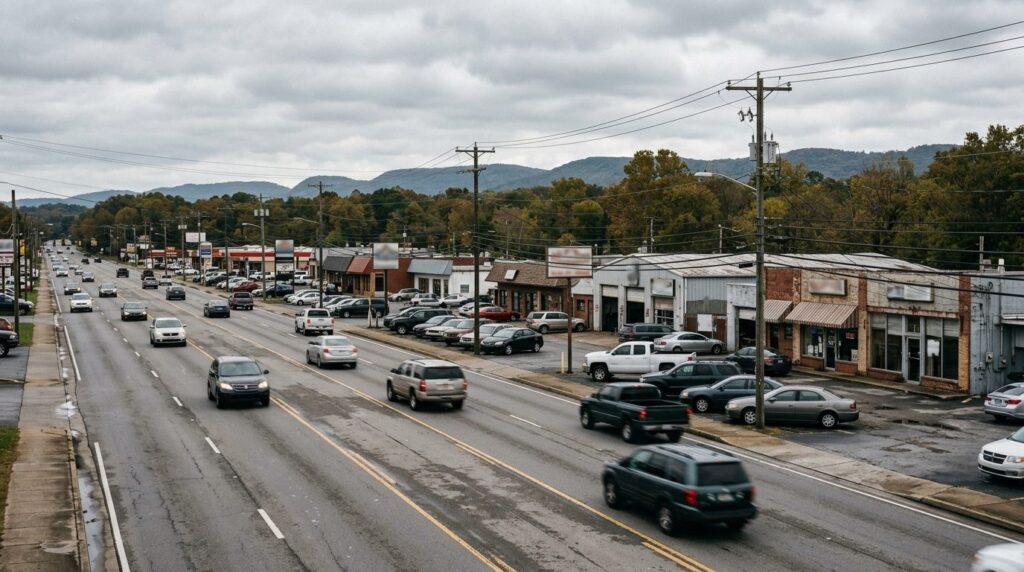
A car accident on Clinton Highway rarely looks like a routine fender bender. This is the road where a five-lane commercial strip is posted at 50 miles per hour, where hundreds of business driveways empty straight into traffic moving at highway speed, and where the pavement keeps that same speed limit as it leaves Knoxville, crosses into Anderson County, and turns into two rural lanes with no shoulder. Known officially as US-25W and State Route 9, Clinton Highway runs north from I-640 through Inskip and Powell, past Merchant Drive, Callahan Drive, Schaad Road, and Emory Road, then on through Claxton toward Clinton and Rocky Top. Our own database of Tennessee crash records shows 4,295 reported wrecks and 44 people killed along this corridor since 2015. It also shows something most drivers never suspect: the stretch with the fewest crashes is the stretch that kills the most people. At OEB Law, our Knoxville-based team handles these cases, and we have studied this road at the intersection level. In this blog post, Knoxville attorney Tim Elrod discusses what to do after a car accident on Clinton Highway (US-25W) in Knox and Anderson County.
Key Takeaways
- Clinton Highway is the single worst corridor on the region’s High Injury Network. Local transportation planners designate 2.69 miles of it as Tier 1, the highest-risk classification, which is more Tier 1 mileage than any other road in the Knoxville region, including Chapman Highway.
- Our crash-record database shows 4,295 reported wrecks, 44 people killed, and 218 seriously injured along the corridor from 2015 through 2026.
- The speed limit is the story. Roughly seven in ten of those crashes happened where the posted limit is 50 mph, and those locations account for 39 of the 44 deaths.
- The Anderson County stretch is far deadlier per crash. It carries only about one crash in five but nearly half of the deaths.
- Where the crash happened decides which courthouse hears your case, Knox County Circuit Court in Knoxville or Anderson County Circuit Court in Clinton, and Tennessee gives you only one year to file.
To Discuss Your Case, Call or Text Our Team Standing By 24/7: (865) 546-1111
About OEB Law, Your Knoxville Legal Team
This guide is provided by the experienced attorneys at OEB Law, led by Managing Attorney Timothy G. Elrod. Founded in Knoxville in 2004, our firm has over 50 years of combined experience navigating East Tennessee’s legal system.
We have successfully represented thousands of personal injury clients, developing deep expertise in Tennessee’s complex wrongful death and accident laws. As East Tennessee natives, we have a direct understanding of the local court systems, law enforcement agencies, and community needs. Our commitment is to provide trusted, authoritative information to our neighbors in Knoxville and the surrounding Tennessee communities. However, this information does not constitute legal advice. If you or a loved one has been injured in an accident or needs legal help, call us today for a free, no obligation, initial consultation.
The Clinton Highway Danger Zone: From I-640 to the Anderson County Line
Clinton Highway is North Knoxville’s commercial spine and its main route out of the county. As US-25W and State Route 9, it starts near I-640 and runs northwest through Inskip, past the Merchant Drive and Callahan Drive retail district, through Powell, and then out of Knox County entirely into Anderson County, where it continues through Claxton toward Clinton and Rocky Top.
The corridor passes through a string of very different communities and road environments:
- Inskip and the Merchant Drive commercial district
- The Callahan Drive and Schaad Road retail core
- Powell and the West Emory Road junction
- The Beaver Creek and Raccoon Valley area
- Claxton and the rural Anderson County stretch toward Clinton
What makes this road unusual is not its traffic volume. Our records show the corridor carries a median of roughly 21,000 vehicles a day, which is lighter than Kingston Pike across West Knoxville. What makes it dangerous is the combination of speed and access. Clinton Highway is posted at 50 miles per hour through most of its length, including sections lined with strip retail, auto dealerships, fast food, and used car lots, each with its own driveway cut into the highway. Drivers pull out of those driveways into traffic that is legally moving at 50, and a great many of the corridor’s worst crashes start exactly there.
That design is why the Knoxville Regional Transportation Planning Organization’s safety planning flags this road above every other in the region. Its High Injury Network identifies the segments where people are most likely to be killed or seriously hurt, and Clinton Highway carries 2.69 miles of Tier 1 segments, the highest-risk category. For comparison, Chapman Highway carries 2.25 Tier 1 miles and Kingston Pike carries 0.75. Recovering from a wreck here takes more than general legal knowledge. It takes a real understanding of how this specific road fails.
Clinton Highway (US-25W) Hazard Map
North from I-640 through Powell, then across the county line into rural Anderson County
Drive
Schaad Rd
Road
Road
County
Which part of Clinton Highway has the most crashes?
The Callahan Drive and Schaad Road area is the busiest crash location on the corridor in our records, followed by Merchant Drive, Old Callahan Drive, and the West Emory Road junction in Powell. All four sit in the commercial stretch between I-640 and the Knox County line, where dozens of business driveways open onto a highway posted at 50 mph.
Which part of Clinton Highway is the most deadly?
The Anderson County stretch north of Powell. It accounts for only about one crash in five on the corridor but nearly half of the deaths. The junctions there each show only a few dozen reported crashes, yet several carry multiple fatalities, because the road keeps its high speed limit while losing its shoulders, lighting, and traffic signals.
Crash Hotspots Along Clinton Highway
We mapped every reported crash on the corridor to the nearest named intersection. The pattern that emerged is the most important thing to understand about this road: the places with the most crashes and the places with the most deaths are not the same places.
Callahan Drive and Schaad Road
This is the busiest crash location on the entire corridor, with 274 reported wrecks in our records. It is also where three High Injury Network corridors meet, because Schaad Road and Merchant Drive both carry their own Tier 1 designations. Roughly a quarter of the crashes here are broadside, or T-bone, collisions, and about one in five happens after dark.
Merchant Drive
The Merchant Drive junction accounts for 223 reported crashes, with ten serious injuries. This is dense commercial traffic feeding a signalized intersection, and rear-end collisions are the dominant crash type, a signature of drivers approaching a light at 50 mph behind traffic that is already stopping.
Old Callahan Drive
219 reported crashes, and a notably high broadside share at 37 percent. Old Callahan is a secondary access point into the same retail district, and turning movements across the highway drive the pattern.
West Emory Road
214 reported crashes at the Powell junction, where Clinton Highway meets State Route 131. This intersection now sits inside an active construction footprint, because TDOT is rebuilding the I-75 Exit 112 interchange at Emory Road as a diverging diamond and performing roadway work along Emory Road between Blueberry Road and Dannaher Drive, with nightly lane closures. Changed traffic patterns and unfamiliar lane assignments add a layer of risk to an intersection that was already one of the corridor’s worst.
Tillery Road
179 reported crashes, and the highest broadside share of any high-volume junction on the corridor at 42 percent. When four in ten crashes at a location are angle collisions, the problem is almost always left turns and failure to yield rather than following distance.
The Anderson County Curves
North of the Knox County line, the crash counts fall sharply and the death counts do not. Junctions such as Old State Circle and Bull Run Road, the Causby Road and Shepard Lane area, and the Wolf Valley Road crossings each show only a few dozen reported crashes, yet each carries multiple fatalities. The Anderson County Sheriff’s Office publicly identified this stretch as a problem area in early 2026 and increased patrols after a fatal crash and at least eight other collisions, with a departmental captain naming speeding on the curves, particularly at a bend local deputies call Beck’s Curve, as the primary concern.
Clinton Highway (US-25W) Car Accidents: By the Numbers
Reported crashes, 2015–2026 · Source: OEB Law’s database of Tennessee traffic-crash records
Where crashes cluster on Clinton Highway
Reported crashes mapped to the nearest named intersection, 2015–2026.
| Intersection | Reported Crashes | Serious Injuries |
|---|---|---|
| Callahan Drive & Schaad Road | 274 | 10 |
| Merchant Drive | 223 | 10 |
| Old Callahan Drive | 219 | 6 |
| West Emory Road (Powell) | 214 | 5 |
| Tillery Road | 179 | 8 |
| Powell Drive | 173 | 7 |
Why the busiest stretch is not the deadliest stretch
The same corridor, split at the Knox and Anderson county line.
| Segment | Crashes | Killed | Deaths per 1,000 Crashes |
|---|---|---|---|
| Knox County (Knoxville and Powell) | 3,446 | 24 | 7.0 |
| Anderson County (Claxton to Clinton) | 849 | 20 | 23.6 |
The crash that is most common is not the crash that kills
Reported crashes by first point of impact, with the deaths each type produced.
| Crash Type | Reported Crashes | People Killed |
|---|---|---|
| Rear-end | 1,689 | 2 |
| Angle (T-bone) | 1,320 | 19 |
| Ran off road, no other vehicle | 631 | 14 |
| Sideswipe, same direction | 320 | 0 |
| Head-on | 102 | 7 |
Roughly seven in ten crashes on this corridor happened where the posted speed limit is 50 mph, and those locations account for 39 of the 44 deaths. About 23% of crashes happen after dark, but darkness accounts for 41% of the deaths. Motorcycles appear in under 2% of crashes yet account for 9 deaths, roughly one in five. Other contributing factors: 19% involved a teen driver, 3% involved alcohol, and 2% involved a truck or bus.
Even when no one is taken from the scene by ambulance, injuries such as whiplash, concussions, and soft-tissue damage often surface hours or days later once the adrenaline fades. If you were involved in a crash here, it is wise to be checked by a doctor and to speak with an attorney about your options.
Why Crashes Happen on Clinton Highway
Proving fault means identifying the exact mechanism of the crash. On Clinton Highway, four patterns account for the overwhelming majority of serious cases, and each one changes how a claim must be built.
The 50 MPH Commercial Strip
This is the defining hazard of the corridor. Roughly seven in ten crashes in our records occurred where the posted limit is 50 mph, and those locations produced 39 of the corridor’s 44 deaths. Where the limit drops to 45, the same database shows crashes are roughly three times less likely to kill someone. A driver waiting to turn left out of a strip mall has to judge a gap in traffic closing at 50 mph rather than 35 or 40, and the physics of the resulting impact are unforgiving. This is the reason a Clinton Highway wreck so often produces catastrophic injuries when a visually similar wreck on a slower arterial does not.
Left Turns and Broadside Collisions
Rear-end crashes are the most common type on this corridor by raw count, at 1,689 reported, but they caused only two deaths. Angle collisions tell the opposite story: 1,320 reported crashes and 19 deaths, plus 96 serious injuries. That single comparison is the most useful fact in this guide. The crash that is most likely to change your life here is the one where somebody turned across your path or pulled out in front of you. Establishing who had the right of way, and proving it, is the central fight in most serious Clinton Highway claims.
Motorcycles
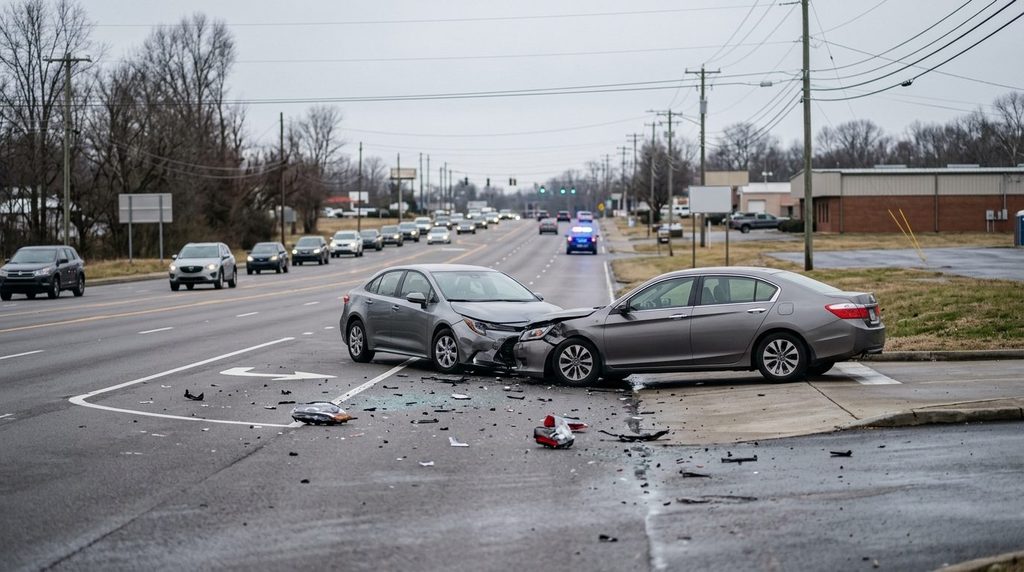
Motorcycles appear in only 1.7 percent of reported crashes on Clinton Highway, yet they account for 9 of the 44 deaths, roughly one in five. Local news reported multiple fatal motorcycle crashes on this corridor during 2026 alone, including one in Anderson County in which a vehicle turning left from a side road failed to yield to an oncoming motorcycle, and one in Knox County in which a vehicle pulled out of a commercial parking lot into the path of a rider. Both are the corridor’s signature failure mode. A motorcycle claim on this road frequently runs into an insurance adjuster’s assumption that the rider must have been speeding, which is why independent evidence matters so much.
Darkness and Running Off the Road
About 23 percent of crashes on the corridor happen in the dark, but those crashes account for 41 percent of the deaths. Separately, 631 reported crashes involved no collision with another vehicle at all. These are run-off-road wrecks, and the recorded first point of impact is frequently a ditch, an earth embankment, a guardrail face, or a utility pole. They caused 14 deaths. On the unlit rural sections north of Powell, a curve taken at the posted 50 with no shoulder to recover on is a genuinely lethal combination, which is precisely what the Anderson County Sheriff’s Office described. A Knoxville personal injury attorney who understands the corridor can spot roadway and lighting factors that an out-of-town firm would never look for.
First Steps: Emergency and Medical Response on the Corridor
What you do in the first hours after a crash shapes both your recovery and your claim. On Clinton Highway, the answer to “who responds” and “where will the ambulance take me” changes depending on which mile marker you are near.
Police Response Changes Three Times Along This Road
Clinton Highway crosses more jurisdictional boundaries than most Knoxville corridors, and the responding agency determines who writes your crash report:
- Knoxville Police Department (KPD): KPD has primary jurisdiction on the southern end, inside Knoxville city limits, which covers the Inskip and Merchant Drive area. For a serious or fatal crash, the KPD Crash Reconstruction Team responds.
- Knox County Sheriff’s Office (KCSO): Much of the corridor through Powell and north toward the county line is unincorporated Knox County, where the Sheriff’s Office responds rather than KPD. This catches people off guard, because the mailing address still says Knoxville.
- Anderson County Sheriff’s Office and THP: North of the county line, the Anderson County Sheriff’s Office and the Tennessee Highway Patrol handle crashes on the rural stretch through Claxton toward Clinton. THP typically investigates fatalities here.
Local Trauma and Emergency Care
Emergency crews choose a hospital based on injury severity and location on the corridor:
- Tennova Healthcare, North Knoxville Medical Center: Located at 7565 Dannaher Drive in Powell, just off the Emory Road junction, this is the closest full emergency department to the middle of the corridor.
- The University of Tennessee Medical Center: Severe trauma, head injuries, and critical spinal injuries are routed to UT Medical Center at 1924 Alcoa Highway, the region’s only Level I Trauma Center.
- Methodist Medical Center of Oak Ridge: For crashes on the Anderson County stretch, this Covenant Health hospital at 990 Oak Ridge Turnpike is the local emergency department, with trauma suites and a helipad for transfer to a Level I center when injuries require it.
Legal Tip: Your medical records form the backbone of your injury claim. Gaps in treatment give the insurance company room to argue that your injuries were minor or pre-existing. Steady, documented care links your injuries directly to the crash and protects your right to fair compensation.
Protecting the Evidence in a Clinton Highway Crash Claim
Clinton Highway has a problem that most corridor claims do not: it contains two completely different evidence environments, and the right strategy on one end is the wrong strategy on the other.
The Southern End: Business Cameras on a 30-Day Clock
From I-640 through Powell, Clinton Highway is lined with auto dealerships, tire shops, restaurants, convenience stores, and strip retail. Many of those businesses run security cameras that point toward the road and their own driveways, which means the moment of impact is often recorded. The problem is that most of these systems overwrite their footage automatically, frequently within about 30 days. Once it is gone, it is gone. An attorney has to identify which businesses had a view and send formal preservation letters within days, not months. You can read more about how surveillance video evidence helps prove a case.
The Northern End: No Cameras, So the Vehicle Becomes the Witness
North of Powell, that entire strategy stops working. There are no storefronts on the rural Anderson County curves, and often no independent witnesses either. On that stretch the case is usually built from the vehicles and the roadway itself: the Event Data Recorder, or black box, which captures pre-impact speed, throttle, and braking; the physical evidence of skid marks, gouges, and debris fields, which a single heavy rain can erase; the THP crash reconstruction file; and roadway records covering signage, lighting, and pavement condition. That evidence has an even shorter shelf life than store video, and it disappears quietly rather than on a predictable loop.
The Spoliation Letter
To stop a business, a trucking company, or an insurer from erasing or routinely purging key records, your attorney sends a spoliation of evidence letter right away. Once a party receives this notice, Tennessee law gives them a duty to preserve the evidence. If they destroy it anyway, a court can punish them, sometimes by instructing the jury to assume the lost evidence would have hurt that party’s case.
“Clinton Highway is really two roads wearing one name. South of Powell we are racing a store’s 30-day camera loop. North of Powell there is no camera at all, so we are racing the weather to get to the skid marks and the black box. Either way the clock started the second the crash did.” – Knoxville attorney Tim Elrod
Evidence to Lock Down After a Serious Clinton Highway Crash
This corridor has two different evidence environments. What saves a case on the Knoxville end does not exist on the Anderson County end, so the preservation strategy has to change with the mile marker.
What is a spoliation letter?
It is a formal legal notice that tells a business, driver, company, or insurer to preserve all evidence. Once served, they have a duty to keep it, and a court can penalize them if they destroy it, sometimes by instructing the jury to assume the lost evidence would have hurt that party’s case.
There were no cameras where my crash happened. Does that mean I have no proof?
No. On the rural stretch of Clinton Highway the case is usually built from the vehicles and the road itself. The Event Data Recorder in a modern vehicle records speed, throttle, and braking in the seconds before impact, and a reconstruction expert can work from skid marks, debris patterns, and vehicle damage. That evidence is perishable, which is why the first days after the crash matter so much.
Who Is Liable for a Clinton Highway Crash
In a simple wreck, one driver is at fault. On this corridor, several parties may share the blame, and each may carry its own insurance policy. A careful investigation looks at every link in the chain so that no responsible party escapes and no source of compensation is left on the table.
The At-Fault Driver
The driver who caused the crash can be directly liable for turning left across oncoming traffic without a safe gap, pulling out of a commercial driveway into 50 mph traffic, following too closely approaching a signal, driving too fast for a curve, or driving impaired.
The Commercial Property Owner
Clinton Highway’s southern half is a nearly continuous run of commercial driveways. When a property’s driveway placement, a sightline blocked by signage, landscaping, or parked inventory, or inadequate on-site traffic control helps cause a wreck at that access point, the property owner or manager may share liability. On a road posted at 50 mph, a driveway that gives a driver only a few seconds of visibility is a genuine hazard, not a technicality.
The Commercial Carrier
When a delivery truck, box truck, or tractor-trailer is involved, the company is often responsible for its driver under a legal rule called respondeat superior. In plain terms, an employer answers for what its employee does on the job. The company can also be directly negligent when it hires an unsafe driver, sets schedules that force drivers to rush, or runs trucks with known mechanical problems.
Maintenance Firms and Parts Makers
If a defective tire, a failed brake, or a botched repair contributed to the crash, the repair shop or the maker of that part may be liable under Tennessee product liability law. These claims require an early inspection before the vehicle is repaired or scrapped.
A Government Entity
When dangerous road design, a malfunctioning signal, missing or inadequate signage, or a poorly managed work zone helps cause a crash, a government agency may share the blame. With active construction around the Emory Road interchange, work zone conditions are worth examining on this corridor specifically. These claims follow special rules, including shorter notice deadlines, so they demand fast action.
Who Can Be Held Liable in a Clinton Highway Crash
A single crash on this corridor can involve several responsible parties, each with its own insurance policy.
Can a business be liable if someone pulled out of its parking lot and hit me?
Sometimes. The driver who failed to yield is the primary responsible party, but if the property’s driveway placement, a sign, landscaping, or parked inventory blocked that driver’s view of traffic moving at 50 mph, the property owner or manager may share liability. An investigation looks at the site layout, not just the vehicles.
Can more than one party be at fault in a Clinton Highway crash?
Yes. A driver, a commercial property, a delivery company, and a repair shop can all share fault. Identifying each one matters because every party may carry a separate insurance policy that helps cover your losses, which can be the difference between a claim that stops at policy limits and one that fully covers a catastrophic injury.
Tennessee Accident Law and Local Courts
A strong claim must follow Tennessee’s rules exactly. Two of those rules can end a case before it starts, and a third decides which courthouse hears it. On Clinton Highway, that third question is unusually important.
Tennessee’s Strict One-Year Deadline
Under Tennessee Code Annotated section 28-3-104, you generally have just one year to file a personal injury lawsuit. This is one of the shortest windows in the nation. The clock starts on the day of the crash. If you miss it, you usually lose your right to recover anything at all, no matter how severe your injuries are.
Modified Comparative Fault and the 50% Bar
Tennessee follows a modified comparative fault rule, set by the state Supreme Court in the landmark case McIntyre v. Balentine. Two ideas matter most. First, the 50% bar means you can recover damages only if you are less than 50% at fault. If a jury finds you half or more to blame, you get nothing. Second, your award is reduced in proportion to your share of fault. This rule is exactly why the defense works so hard to blame you, and on a road posted at 50 mph the accusation is almost always the same one: that you were speeding. Independent evidence, especially black box data, is the strongest answer to it.
Which Court Hears Your Case
This is where Clinton Highway differs from most corridor claims, because the county line cuts the road in half:
- Knox County Circuit Court: Located at the City County Building, 400 Main Street in downtown Knoxville, this court handles crashes on the Knoxville and Powell portions of the corridor.
- Anderson County Circuit Court: A crash north of the county line is filed in Anderson County, at the courthouse at 100 N. Main Street in Clinton. Different court, different jury pool, different local practice.
- U.S. District Court for the Eastern District of Tennessee: This federal court often hears cases when an out-of-state trucking company removes the claim and the damages top $75,000.
Confirming which side of the line your crash happened on is not a formality. Because the Anderson County stretch carries a disproportionate share of the corridor’s fatalities, the venue question comes up most often in exactly the cases where the stakes are highest.
Tennessee Accident Law at a Glance
- Clock starts on the crash date
- One of the shortest in the U.S.
- Miss it and recovery is barred
- Recover only if under 50% at fault
- Award reduced by your share
- Defense tries to shift blame to you
- Cap on non-economic damages
- Rises to $1M if catastrophic
- No cap on economic damages
- Knox County Circuit Court, City County Building, 400 Main Street, Knoxville. Covers the Knoxville and Powell portions of the corridor.
- Anderson County Circuit Court, 100 N. Main Street, Clinton. Covers the Claxton and rural stretch north of the county line, which is where a disproportionate share of the corridor’s fatal crashes happen.
How long do I have to file an accident claim in Tennessee?
Generally one year from the date of the crash under T.C.A. section 28-3-104. Because this deadline is so short, it is wise to speak with an attorney soon after the wreck so evidence and filing time are not lost.
Can I still recover money if I was partly at fault?
Yes, as long as you are less than 50% at fault. Your award is reduced by your percentage of fault. If you are found half or more to blame, Tennessee law bars any recovery.
Is there a limit on accident compensation in Tennessee?
Non-economic damages such as pain and suffering are capped at $750,000, or $1,000,000 for catastrophic injuries. There is no cap on economic damages like medical bills and lost wages.
What Your Clinton Highway Accident Claim May Be Worth
Crashes at 50 mph frequently cause life-altering harm. Tennessee law lets victims pursue two broad types of damages, and a full claim accounts for both. If you want a rough starting point, our tool to estimate your claim value can help, though only a detailed review captures the real picture.
Economic Damages
These are your measurable financial losses. They include medical costs such as ambulance transport, emergency care at Tennova North Knoxville, Methodist Medical Center, or UT Medical Center, surgeries, and imaging. They also include future care such as physical therapy and long-term equipment, plus lost income for the time you miss and any reduced earning power if you cannot return to your old job.
Non-Economic Damages
These cover the human costs that no receipt can measure, including physical pain and suffering, emotional distress and anxiety, and loss of enjoyment of life. When a crash takes a life, families may bring a wrongful death claim for their loss and financial support. These are the hardest cases we handle, and we treat every family with the care they deserve.
Tennessee’s Cap on Non-Economic Damages
Under Tennessee Code Annotated section 29-39-102, the state caps non-economic damages at $750,000 for most cases. That cap rises to $1,000,000 when the injury is catastrophic, such as paralysis from a spinal cord injury, the loss of a limb, severe burns, or the wrongful death of a parent who leaves behind minor children. Importantly, there is no cap on economic damages, so your medical bills and lost wages are recovered in full when proven.
Injured in a Clinton Highway Crash? Get a Free Case Review.
On Clinton Highway the evidence has a deadline. A nearby store’s camera may have recorded everything and can be erased in about 30 days, and on the rural stretch the skid marks can be gone after one heavy rain. Insurance companies move fast, and you should too. Call or text OEB Law now for a free, no obligation consultation. You don’t pay unless we win.
Our team is standing by 24/7.Why Choose OEB Law for Your Clinton Highway Case
When a serious crash happens on Clinton Highway, the other side’s insurance team goes to work immediately, and on this corridor their opening argument is usually that you were the one going too fast. You should not face that alone. Our attorneys know the difference between the Merchant Drive retail crush and the Anderson County curves, which agency will have written your report, which courthouse your claim belongs in, and where the evidence is hiding on each half of the road. We move fast to preserve business camera footage on the southern end and vehicle and roadway evidence on the northern end, we identify every liable party, and we fight to recover the full value of your claim while you focus on healing. You can learn more about our background from Timothy G. Elrod and our experienced attorneys. Best of all, you don’t pay unless we win, so pursuing justice carries no financial risk.
Who is OEB Law and Why Are They Good for the Community?
Led by Managing Attorney Timothy G. Elrod and Our Experienced Legal Team
Founded in 2004 in Knoxville, Tennessee, OEB Law has grown over nearly two decades to now serve clients across multiple states. Tim Elrod established the firm with a simple but powerful mission: we care and we help people. Today, our team brings over 50 years of combined experience representing clients throughout Tennessee in personal injury and criminal defense cases.
Our Legal Expertise
Our attorneys have built their reputation through:
- Successfully representing thousands of personal injury and criminal defense clients
- Developing specialized knowledge across all types of accident and injury cases
- Mastering the complexities of Tennessee’s legal system through decades of practice
Why Trust Us
At OEB Law, our reputation speaks for itself:
- Proven Results: We’ve recovered significant compensation for our clients through both settlements and courtroom verdicts
- Client Satisfaction: Our numerous 5 Star Google Reviews showcase our commitment to responsive, caring, and effective legal representation
- No Fee Unless We Win: You don’t pay attorney fees unless we successfully secure compensation in your case
- Local Knowledge: As East Tennessee natives, we understand our community and care deeply about the people we serve
- Personalized Approach: We personalize each case to meet our clients’ specific needs, ensuring you’re never just another file number
Community Commitment
Our dedication extends beyond the courtroom. We proudly support:
- Local high school football programs through Rivalry Thursday sponsorships, part of over $500,000 donated to the community across 16 years
- The Knoxville Ice Bears and community fundraising initiatives
- Numerous youth, student, and community organizations throughout East Tennessee
As Tim Elrod says, “We don’t just take, we give back because the people you’re giving back to are the people who are supporting your firm.“
Have a personal injury or criminal defense case? We’re available 24/7 to help.
Get In Touch
- Call or Text: (865) 546-1111
- Visit: https://oeblawtn.com/
- Available: Standing by 24/7
Why OEB Law? Because They’re Good For The Community.
TEXT or CALL (865) 546-1111 for HELP NOW. Standing By 24/7.
Follow Us on Social Media
Stay connected with OEB Law for the latest Knoxville and East Tennessee legal insights, community updates, and important legal information. Follow us on X, YouTube, Facebook, Instagram, LinkedIn, and TikTok for exclusive content, client stories, and expert legal guidance from our team.
Frequently Asked Questions
How do I get a copy of my crash report for an accident on Clinton Highway?
It depends on who responded, and Clinton Highway crosses three different jurisdictions. Inside Knoxville city limits on the southern end, the report is written by the Knoxville Police Department and can be requested through the KPD Records unit or the Tennessee Department of Safety and Homeland Security. Through much of Powell and north toward the county line the road is unincorporated Knox County, so the report comes from the Knox County Sheriff’s Office even though the mailing address still says Knoxville. North of the county line, the Anderson County Sheriff’s Office or the Tennessee Highway Patrol handles the report. Your attorney can identify the right agency and request the report for you.
Why is the Anderson County stretch of Clinton Highway so much more deadly?
Because the road keeps its speed while losing everything that makes speed survivable. Our crash records show the Anderson County portion accounts for about one crash in five on the corridor but nearly half of the deaths, roughly 23.6 deaths per 1,000 crashes compared with 7.0 in Knox County. North of Powell the highway narrows, the shoulders and lighting disappear, the curves tighten, and the traffic signals stop, yet the posted limit stays high. The Anderson County Sheriff’s Office publicly increased patrols on this stretch in early 2026 after a fatal crash and at least eight other collisions, citing speed on the curves as the main problem.
The insurance company says I was speeding on Clinton Highway. How do I fight that?
This is the most common defense on this corridor, because so much of Clinton Highway is posted at 50 mph and adjusters know Tennessee’s 50% comparative fault rule lets them reduce or defeat your claim by shifting blame onto you. The strongest answer is objective data rather than argument. Your vehicle’s Event Data Recorder, often called the black box, records pre-crash speed, throttle, and braking in the seconds before impact. Nearby business camera footage, scene measurements, and a crash reconstruction can corroborate it. All of that evidence is perishable, which is why an early preservation letter matters so much.
Why is business security camera footage so important after a Clinton Highway crash?
The southern half of Clinton Highway is lined with dealerships, tire shops, restaurants, and convenience stores whose cameras face the road and their own driveways, so the moment of impact is often recorded, including who pulled out and who had the right of way. The catch is that most of these systems overwrite their footage on a roughly 30-day loop. Once it is gone it cannot be recovered, so an attorney needs to identify which businesses had a view and send preservation letters within days of the crash.
What should I do if an insurance adjuster calls me after a Clinton Highway crash?
Do not give a recorded statement and do not sign any medical release. Adjusters are trained to ask questions designed to shift blame onto you under Tennessee’s 50% comparative fault rule. Politely decline and direct all communication to your attorney. A brief, friendly-sounding call can still be used to reduce or deny your claim.
How soon after a Clinton Highway crash should I contact a lawyer?
As soon as possible, ideally within days. Tennessee’s one-year filing deadline is only part of the reason. On the Knoxville end, the business camera footage that could prove your case is often overwritten within about 30 days. On the Anderson County end, the skid marks and debris that a reconstruction depends on can be washed away by a single heavy rain, and the vehicle holding the black box data can be repaired or scrapped. If you or a loved one was hurt on Clinton Highway, call or text Knoxville attorney Tim Elrod for a free, no obligation consultation. You don’t pay unless we win.
Note: This post draws on information from publicly available secondary sources. While we make every effort to present accurate information, OEB Law has not independently confirmed every detail of the incident described. If you notice an inaccuracy or something we missed, please contact OEB Law so we can review and update the post promptly.
Disclaimer: This post is offered for general informational purposes only and should not be treated as legal or medical advice. Reading it does not establish an attorney-client relationship with OEB Law. If you have been hurt in an accident, seek proper medical attention and speak with a qualified attorney about your legal options. Any images are for illustrative purposes only and do not show the actual accident scene or the people involved.

