By Timothy G. Elrod | Knoxville, Tennessee
What Happened
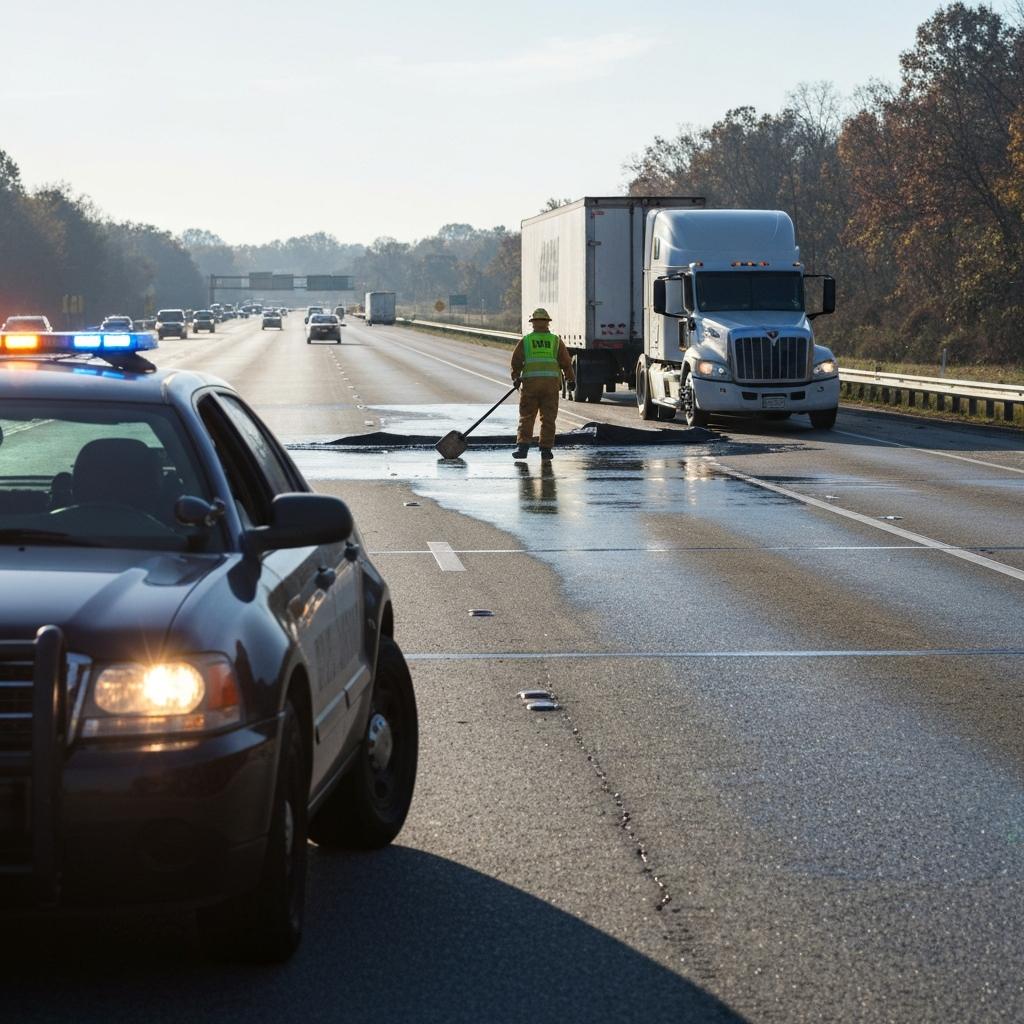
One lane of I-40 East near the Rutledge Pike interchange in Knox County closed Monday morning after a commercial vehicle spilled diesel fuel on the roadway, according to the Tennessee Highway Patrol. The spill occurred in the eastbound lanes in the area of Exit 394, a high-traffic freight corridor connecting East Knoxville to the I-81 interchange and serving distribution operations in the Forks of the River Industrial Park.
Tennessee Highway Patrol District 8 and the Knoxville Fire Department Hazmat Team responded to contain the spill and manage traffic. Knox County EMS was also dispatched to the scene. The Tennessee Department of Environment and Conservation’s East Tennessee Regional Office was notified, consistent with state reporting requirements for petroleum spills on public roadways. Significant backups were reported extending through the Holston Hills and Corryton corridors, with commuters diverted to Asheville Highway.
The affected lane remained closed during active cleanup and site inspection. The cause of the spill was under investigation by THP as of Monday morning. No confirmed injuries were reported in initial dispatches, though THP had not issued a final incident statement at the time of publication.
Sources: Tennessee Highway Patrol District 8, WBIR News, Knox County Emergency Communications
Tim’s Take

Tim’s Take: Attorney Timothy G. Elrod’s legal analysis of what Tennessee law says about this type of accident — written for the people who have to deal with it, not for other lawyers.
A diesel spill on I-40 doesn’t look like much from the overpass. But if a commercial truck caused that spill – and especially if anyone got hurt or had their vehicle damaged – there’s a whole lot of law that just got activated.
Here’s what most folks don’t know. A diesel spill on a Knox County interstate can involve the truck driver, the trucking company, the company that loaded the cargo, the maintenance contractor who last serviced those tanks, and in some cases even TDOT. That’s not one insurance policy. That’s potentially four or five. And every one of those parties has lawyers who started working the moment that truck pulled over.
Yours should be too.
Let’s start with the evidence — because it’s already disappearing.
Commercial trucks operating on Tennessee interstates are required by federal regulation to carry Electronic Logging Devices. Those ELDs record speed, braking, hours of service, and GPS location. The truck’s black box, the Engine Control Module, captures data from the moments before and during the incident. Dashcam footage, if the truck had a forward-facing camera, shows exactly what happened.
Here’s the thing. That data gets overwritten. In many systems, ELD and dashcam data cycles out within 48 to 72 hours unless someone sends a formal legal notice demanding it be preserved. That notice is called a spoliation letter. Without it, the trucking company can, and often does, allow that evidence to overwrite naturally. It’s not destruction. It’s just the normal operation of the system. And the evidence is gone just the same.
“In trucking accident cases, the evidence that matters most is often gone within three days. Dashcam footage, electronic logging data, maintenance records, if we don’t send a spoliation letter immediately, that evidence can disappear legally. This is why I tell every client: call us before you call the insurance company.” — Knoxville attorney Tim Elrod
Now let’s talk about who can actually be held responsible under Tennessee law.
Tennessee follows a modified comparative fault standard. Under T.C.A. § 29-11-103, you can recover compensation as long as you are found to be less than 50% at fault for what happened. If you’re 49% at fault, you can still recover — though your award is reduced by your percentage. If you’re 50% or more at fault, you recover nothing. That’s the law in Tennessee, and it’s different from what people assume.
In a commercial truck diesel spill, multiple parties can share fault. The driver may have been operating with a faulty tank valve or improperly secured cargo. The trucking company may have known about a maintenance issue and sent the truck out anyway. The freight loading company may have overfilled the tank. Each party carries separate coverage. Federal FMCSA regulations require commercial carriers hauling general freight to maintain a minimum of $750,000 in liability insurance, and carriers hauling placarded hazardous materials face minimums up to $5 million (49 C.F.R. § 387.9). That is a good bit more coverage than a standard auto policy.
If the driver was in violation of FMCSA Hours of Service rules, verifiable through that ELD data, that violation can establish what lawyers call negligence per se. In plain terms: breaking the federal rule makes the driver automatically negligent. You don’t have to prove they were careless. The violation proves it for you. (49 C.F.R. § 395.)
The statute of limitations in Tennessee is one year. That is not a suggestion.
Under T.C.A. § 28-3-104, personal injury claims in Tennessee must be filed within one year of the date of the accident. Not one year from when your symptoms got bad. Not one year from when you finally saw a doctor. One year from the day of the incident. Miss that deadline and your claim is permanently barred, no matter how strong your case is.
Property damage claims, vehicle damage, diesel contamination to your car’s undercarriage and components, carry a three-year deadline (T.C.A. § 28-3-105). But the personal injury clock is ticking right now, starting today.
“A lot of people think they have years to decide whether to pursue a claim. In Tennessee, for personal injury, you have one year. That clock starts the day of the accident. By the time most people realize they need an attorney, weeks or months have already passed. Do not wait.” — Knoxville attorney Tim Elrod
If you were involved, even if you feel fine right now, here’s what you should do today.
Adrenaline is a liar. It masks pain signals in the hours after a high-speed highway incident. Diesel fume exposure can cause respiratory irritation and headache symptoms that don’t peak until hours later. “I feel okay” at the scene is not a medical diagnosis, and it is not a legal statement you want attributed to you before you know the full picture.
- Move away from the spill area. Diesel fumes are a real health concern, not just a traffic inconvenience
- Call 911 and report directly to THP District 8, even if damage seems minor
- Seek medical evaluation at UT Medical Center or Fort Sanders Regional. Get it on record
- Photograph everything: the truck’s DOT number, company name on the cab, license plate, your vehicle, the road surface
- Request the THP crash report through tncrash.crashinfo.net — typically available within 10 days for approximately $4
- Do not give a recorded statement to any insurance adjuster, not the truck company’s, not your own, before speaking with an attorney
That last point matters more than most people realize. The insurance adjuster who calls you within 24 hours works for the carrier. Their job is to close your claim as cheaply as possible. Early statements get used to minimize what you’re owed. You have no obligation to give one.
I-40 Diesel Spill: Immediate Action Checklist
Steps to take right now to protect your health and legal rights.
Move to Safety
Immediately move your vehicle and yourself away from the spill area. Avoid inhaling diesel fumes, which can cause respiratory irritation.
Call 911 / THP District 8
Report the incident to emergency services. This creates an official record and dispatches the necessary response teams.
Seek Medical Care
Go to an emergency room like UT Medical Center or Fort Sanders Regional, even if you feel fine. Adrenaline can mask injuries.
Document Everything
Take photos of the truck’s DOT number, company name, license plate, road conditions, and any damage to your vehicle.
Request Crash Report
Order the official THP crash report at tncrash.tdot.tn.gov. It costs about $4 and is usually available in 10 days.
Do NOT Give a Recorded Statement
Decline to speak with any insurance adjuster—theirs or yours—until you have spoken with an attorney. Your words can be used against you.
Contact an Attorney Immediately
Critical evidence like dashcam footage and black box data can be legally overwritten within 72 hours. An attorney must send a spoliation letter to preserve it.
Frequently Asked Legal Questions
A spoliation letter is a formal legal demand sent to the trucking company requiring them to preserve ELD data, dashcam footage, maintenance records, and black box data before it is overwritten — typically within 72 hours. Without it, that evidence can be legally destroyed.
No. Insurance adjusters work for the carrier and their goal is to minimize your payout. Contact a Knoxville highway accident attorney before giving any statement.
Under T.C.A. § 29-11-103, you can recover damages if you are less than 50% at fault. Your recovery is reduced by your fault percentage. Example: 20% fault on a $100,000 claim = $80,000 recovery.
Yes. Tennessee treats them as separate claims with different deadlines — one year for personal injury, three years for property damage. An attorney can manage both timelines simultaneously.
What Tennessee law allows you to recover and what that actually looks like.
Tennessee personal injury law allows highway accident victims to pursue both economic and non-economic damages. Economic damages are the concrete losses: medical bills, future treatment costs, lost wages during recovery, lost earning capacity if a serious injury affects your ability to work. Non-economic damages cover pain and suffering, emotional distress, and loss of enjoyment of life. In cases involving reckless conduct or deliberate FMCSA violations, punitive damages may also be available under Tennessee common law principles of negligence per se.
In commercial truck cases specifically, the compensation picture is often larger than people expect, not because attorneys inflate numbers, but because the actual losses are larger. Medical treatment for spinal injuries, respiratory conditions, or traumatic brain injuries adds up fast. And when a carrier is running a $750,000 or multi-million dollar policy, the practical ceiling on recovery is much higher than in a standard passenger vehicle claim.
Tennessee Diesel Spill Accident: Legal Overview
Key state and federal rules that apply to your case.
| Legal Issue | Tennessee Rule | What It Means for You |
|---|---|---|
| Comparative Fault | T.C.A. § 29-11-103 — less than 50% fault required | You can recover even if partly at fault; award reduced by your percentage. |
| Personal Injury Deadline | T.C.A. § 28-3-104 — 1 year from incident | Miss this and your claim is permanently barred. |
| Property Damage Deadline | 3 years from incident | Covers vehicle damage and diesel contamination. |
| Commercial Insurance Minimum | FMCSA — $750,000 general freight / $5M hazmat | Higher coverage available in truck cases than standard auto. |
| Evidence Preservation Window | 72 hours for ELD/dashcam data | A spoliation letter must be sent out immediately to preserve evidence. |
| Liable Parties | Driver, carrier, loader, maintenance contractor, potentially TDOT | Multiple defendants often mean access to multiple insurance policies. |
Timothy G. Elrod is a Knoxville personal injury attorney and founder of OEB Law, PLLC. He has represented accident victims across East Tennessee for more than 20 years.
Tim's Take is published as a community information resource and does not constitute legal advice. Reading this column does not create an attorney-client relationship between the reader and Timothy G. Elrod or OEB Law, PLLC.

