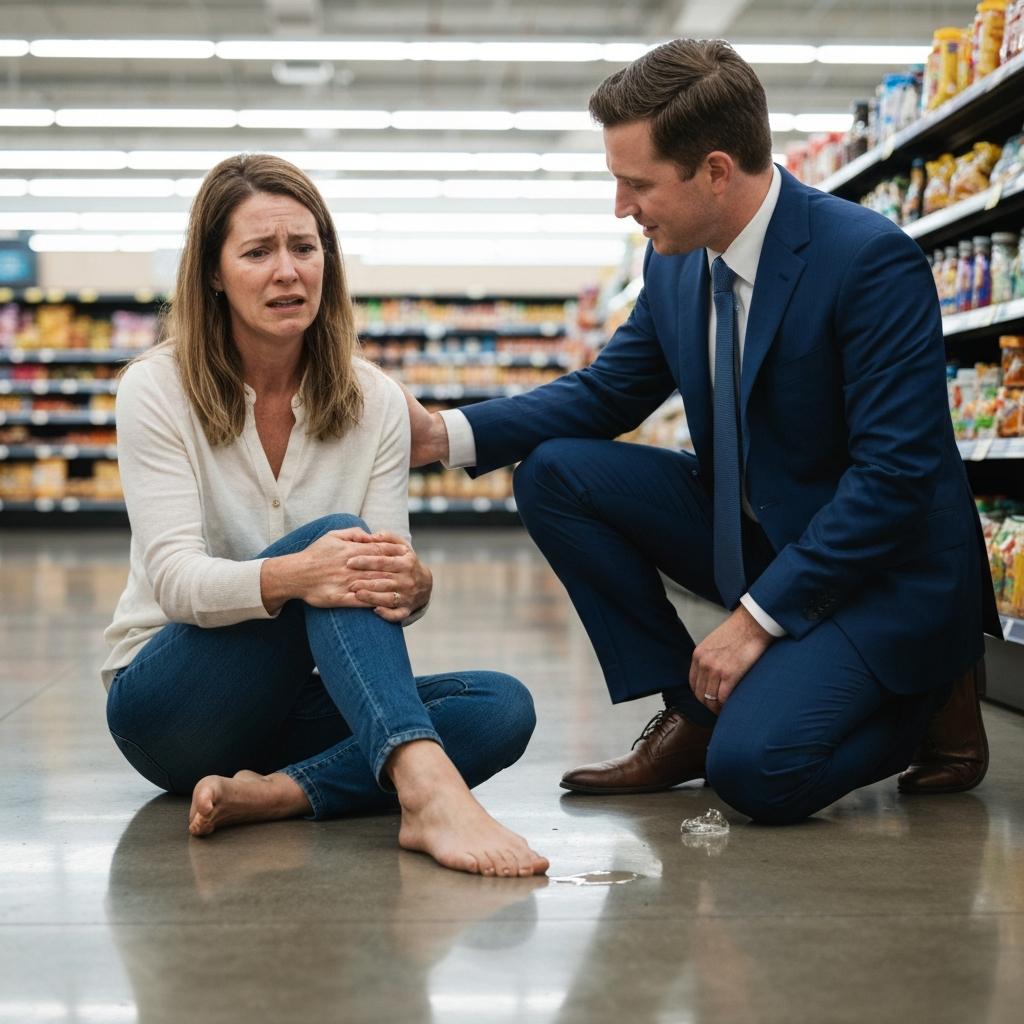
Grocery store slip and fall accidents happen every day across Knoxville, from spilled produce aisles at local Kroger locations to wet entryways at Food City stores throughout West and North Knoxville. When you are injured, the most urgent question becomes whether you can actually prove the store was responsible, and that question comes down to a legal concept known as the burden of proof. At OEB Law, our attorneys have represented Knoxville slip and fall victims for over two decades, helping injured shoppers understand exactly what they must demonstrate to win their case. In this blog post, Knoxville attorney Tim Elrod discusses the burden of proof in Knoxville slip and fall claims and how it applies to local grocery store accidents in Tennessee.
Key Takeaways
- Tennessee uses the preponderance of the evidence standard — you must show it is more likely than not that the grocery store’s negligence caused your injury.
- Four elements must be proven — duty of care, breach of that duty, causation, and damages are all required to establish liability.
- Actual or constructive notice is the hardest element — you must prove the store knew, or should have known, about the dangerous condition before your fall.
- Tennessee’s one-year statute of limitations applies — under T.C.A. § 28-3-104, you generally have one year from the date the cause of action accrued to file a claim.
In a Knoxville grocery store slip and fall claim, the injured shopper bears the burden of proving four elements — duty, breach, causation, and damages — by a preponderance of the evidence, meaning it is more likely than not that the store’s negligence caused the injury. The most contested element is typically notice: proving the store knew or should have known about the hazard before the fall occurred. Tennessee law does not require proof beyond a reasonable doubt, but meeting even this lower civil standard requires strong, well-preserved evidence.
To Discuss Your Case, Call or Text Our Team Standing By 24/7: (865) 546-1111
About OEB Law, Your Knoxville Legal Team

This guide is provided by the experienced attorneys at OEB Law, led by Managing Attorney Timothy G. Elrod. Founded in Knoxville in 2004, our firm has over 50 years of combined experience navigating East Tennessee’s legal system.
We have successfully represented thousands of personal injury clients, developing deep expertise in Tennessee’s complex wrongful death and accident laws. As East Tennessee natives, we have a direct understanding of the local court systems, law enforcement agencies, and community needs. Our commitment is to provide trusted, authoritative information to our neighbors in Knoxville and the surrounding Tennessee communities. However, this information does not constitute legal advice. If you or a loved one has been injured in an accident or needs legal help, call us today for a free, no obligation, initial consultation.
What Premises Liability Means for Knoxville Grocery Store Shoppers
Premises liability is the area of law that holds property owners and businesses responsible for injuries that occur on their property due to unsafe conditions. In Tennessee, grocery store customers are classified as “business invitees,” which is the category that receives the highest duty of care under the law. That classification matters because it sets a demanding legal standard for how Knoxville stores must manage safety on their premises.
Knoxville grocery stores, including major chains like Kroger, Food City, and Publix locations throughout the area, are legally required to inspect their premises regularly, address known hazards promptly, and warn customers of dangers they cannot immediately fix. However, simply saying “the store is responsible” is not enough to win a claim. The law requires proof of exactly how that responsibility was breached and how that breach led directly to your injury.
If you have been hurt in a store accident, consulting a Knoxville slip and fall attorney early in the process gives you the best chance of gathering the time-sensitive evidence these cases require. OEB Law has represented East Tennessee grocery store accident victims for over two decades and understands the specific evidence challenges that arise in Knox County premises liability cases.
The Four Elements You Must Prove in a Tennessee Slip and Fall Claim
Tennessee slip and fall law generally requires an injured shopper to prove the elements of negligence — duty, breach, causation, and damages — before a store can be held liable. Each element must be supported by evidence, and failing to establish even one of them can defeat an otherwise valid claim.
1. Duty of Care
Tennessee law imposes a duty on grocery stores to exercise reasonable care to keep premises reasonably safe for customers. Because shoppers are business invitees, stores must use reasonable care to inspect aisles, address hazards, and keep the premises reasonably safe.
2. Breach of Duty
A breach occurs when the store fails to meet its obligation. Common examples in Knoxville grocery stores include leaving a spill unmarked, ignoring leaking refrigerator condensation pooling in an aisle, or failing to place mats at entryways during rainy weather.
3. Causation
The breach must directly cause the injury. Tennessee courts require proof that the store’s negligence was a cause in fact and a proximate cause of the injury. A pre-existing condition or unrelated event can complicate this element significantly.
4. Damages
Actual, documentable harm must exist for a claim to succeed. Medical bills, lost wages, and pain and suffering are all compensable damages in Tennessee, covering both economic and non-economic losses.
“The element that trips up most Knoxville slip and fall cases is notice, specifically proving the store knew about the hazard long enough before the fall that a reasonable inspection would have caught it. That’s where your evidence strategy has to start.” – Knoxville attorney Tim Elrod
The Four Elements of Negligence in Tennessee Slip and Fall Cases
| Element | What It Means in Plain English | How It Applies to Grocery Store Cases in Knoxville |
|---|---|---|
| Duty of Care | The store has a legal obligation to keep customers safe | Knoxville grocery stores must inspect aisles, clean spills, and maintain safe conditions for shoppers |
| Breach of Duty | The store failed to meet that obligation | Leaving a wet floor unmarked or ignoring a known spill constitutes a breach |
| Causation | The breach directly caused your injury | Your fall must be a direct result of the store’s failure, not another cause |
| Damages | You suffered actual harm as a result | Medical bills, lost wages, and pain and suffering are all compensable damages in Tennessee |
Actual Notice vs. Constructive Notice: The Hardest Part of Your Burden of Proof
What Is Actual Notice?
Actual notice means the store had direct knowledge of the hazard before your fall. An employee may have seen the spill, a customer may have reported it, or the store itself may have created the dangerous condition. Actual notice is easier to prove when present, but it is less commonly the situation injured shoppers face.
What Is Constructive Notice?
Constructive notice is the more common, and more difficult, standard. It means the store should have known about the hazard through reasonable inspection practices. Tennessee courts examine how long the hazard existed and whether routine inspections would have discovered it before the fall occurred. Timothy G. Elrod has built extensive experience helping Knoxville clients navigate this challenging evidentiary requirement in East Tennessee premises liability cases.
The Evidence That Proves Notice in Knox County Cases
Building a notice argument requires collecting specific types of evidence quickly. The following are the most valuable forms of evidence in Knoxville grocery store slip and fall cases:
- Surveillance footage showing the hazard existed for an extended period before the fall
- Store inspection and cleaning logs, or the suspicious absence of them
- Witness statements from customers or employees who observed the hazard
- Photographs of dried or spread spill patterns indicating the hazard had been present for some time
- Prior incident reports involving the same aisle or type of hazard at that store location
Most Knoxville-area grocery stores overwrite surveillance footage within 30 to 72 hours of recording. Contacting an attorney immediately allows for a formal spoliation letter to be sent to the store, demanding that video evidence be preserved before it is deleted. Early medical documentation from UT Medical Center or a Knoxville urgent care facility also carries significant evidentiary weight when records are created close in time to the injury.
Knoxville Grocery Store Slip and Fall Evidence Preservation Timeline
Immediately After the Fall
Report to store management and request a written incident report. Photograph the hazard, your injuries, and the surrounding area with your phone.
Within 24 Hours
Seek medical evaluation at UT Medical Center or a Knoxville urgent care. Early medical records create strong evidence linking the fall to your injuries.
Within 24-72 Hours
Most Knoxville grocery stores overwrite security footage in this window. An attorney must send a spoliation letter to legally preserve video evidence.
Within the First Week
Gather contact information for any witnesses. Preserve the clothing and shoes you were wearing. Document all out-of-pocket expenses related to the fall.
Before One Year Has Passed
Tennessee has a strict one-year statute of limitations (T.C.A. § 28-3-104). You must file a lawsuit within this timeframe or your right to recover compensation is likely lost forever.
Common Grocery Store Defenses and Compensation
How Grocery Stores Fight Slip and Fall Claims
Grocery store chains and their insurance companies are experienced at defending these claims. Understanding their typical arguments helps injured shoppers prepare a stronger case from the start. Common defenses used in Tennessee grocery store cases include:
- A wet floor sign was posted, eliminating liability (Tennessee courts have found stores can still be liable if the sign was inadequate or improperly placed).
- The hazard existed for only a brief time, negating any argument of constructive notice.
- The injured shopper was partially at fault (Tennessee’s modified comparative fault rule under T.C.A. § 29-11-103 bars recovery if the injured party is 50% or more at fault).
- The shopper’s footwear may be used as comparative-fault evidence, which is why preserving the shoes worn during the incident can be important.
What Compensation Can Knoxville Slip and Fall Victims Recover?
Compensation in Tennessee slip and fall cases falls into two broad categories. Economic damages cover medical bills, future treatment costs, lost income, and rehabilitation expenses. Non-economic damages include pain and suffering, emotional distress, and loss of enjoyment of life. Tennessee does not impose a general cap on all compensatory damages in most personal injury cases, but the state does cap noneconomic damages in many cases under T.C.A. § 29-39-102.
Settlement values vary widely, but cases involving fractures, head injuries, or spinal damage typically produce significantly higher recoveries than soft tissue injuries. Tim Elrod and the OEB Law team handle these cases on a contingency fee basis, meaning injured clients pay nothing unless the firm wins their case.
“Grocery stores and their insurance companies know exactly how to fight these claims. They will look for any reason to minimize your injuries or shift blame to you. The stronger your evidence, and the faster you preserve it, the better your position at the negotiating table and in court.” – Knoxville attorney Tim Elrod
Why Choose OEB Law for Your Knoxville Slip and Fall Claim
When you’re facing a slip and fall claim, you need a law firm that understands the local landscape. The top attorneys in Knoxville at OEB Law understand Knox County courts, local grocery chain corporate structures, and the specific evidence challenges that arise in East Tennessee premises liability cases. Our firm has developed deep familiarity with how local insurance adjusters and defense attorneys approach grocery store accident claims, giving injured Knoxville shoppers a meaningful advantage when they choose OEB Law to represent them.
Since its founding in 2004, OEB Law has represented thousands of injury clients, building a track record that speaks for itself. Timothy G. Elrod and the experienced Knoxville attorneys at OEB Law work on a contingency fee basis, which means injured shoppers can access top-tier legal representation without any upfront costs. Our commitment to being available 24/7 ensures that when accidents happen, help is always a call or text away.
Who is OEB Law and Why Are They Good for the Community?
Led by Managing Attorney Timothy G. Elrod and Our Experienced Legal Team
Founded in 2004 in Knoxville, Tennessee, OEB Law has grown over nearly two decades to serve clients across East Tennessee. Tim Elrod established the firm with a simple but powerful mission: we care and we help people. Today, our team brings over 50 years of combined experience representing clients throughout Tennessee in personal injury and criminal defense cases.
Our Legal Expertise
Our attorneys have built their reputation through:
- Successfully representing thousands of personal injury and criminal defense clients
- Developing specialized knowledge across all types of accident and injury cases
- Mastering the complexities of Tennessee’s legal system through decades of practice
Why Trust Us
At OEB Law, our reputation speaks for itself:
- Proven Results: We work hard to pursue compensation for our clients through both settlements and courtroom verdicts.
- Client Satisfaction: Our 5 Star Google Reviews reflect our commitment to responsive, caring, and effective legal representation.
- No Fee Unless We Win: You don’t pay attorney fees unless we successfully secure compensation in your case.
- Local Knowledge: As East Tennessee natives, we understand our community and care deeply about the people we serve.
- Personalized Approach: We personalize each case to meet our clients’ specific needs, ensuring you’re never just another file number.
Community Commitment
Our dedication extends beyond the courtroom. We proudly support:
- Local high school football programs through Rivalry Thursday sponsorships
- The Knoxville Ice Bears and community fundraising initiatives
- Numerous youth, student, and community organizations throughout East Tennessee
“We don’t just take—we give back because the people you’re giving back to are the people who are supporting your firm.” – Tim Elrod
Have a personal injury or criminal defense case? We’re available 24/7 to help.
Get In Touch
- Call or Text: (865) 546-1111
- Visit: https://oeblawtn.com/
- Available: Standing by 24/7
Why OEB Law? Because They’re Good For The Community.
TEXT or CALL (865) 546-1111 for HELP NOW. Standing By 24/7.
Follow Us on Social Media
Stay connected with OEB Law for the latest Knoxville and East Tennessee legal insights, community updates, and important legal information. Follow us on X, YouTube, Facebook, Instagram, LinkedIn, and TikTok for exclusive content, client stories, and expert legal guidance from our team.
Frequently Asked Questions
In Tennessee, an injured shopper generally must prove duty of care, breach of that duty, causation, and damages to establish negligence in a slip and fall case. Each element must be supported by evidence, and the standard of proof is a preponderance of the evidence, meaning it is more likely than not that the store’s negligence caused the injury.
Compensation in a Knoxville grocery store slip and fall case depends on the injury’s severity and the evidence. Economic damages cover medical bills and lost wages, while non-economic damages cover pain and suffering. While Tennessee does not cap all compensatory damages, it does cap non-economic damages in most personal injury cases.
Tennessee generally imposes a one-year statute of limitations for personal injury claims, including grocery store slip and fall accidents. This means you typically have one year from the date of the incident to file a lawsuit. Because this is one of the shortest deadlines in the country, it is critical to contact an attorney quickly.

