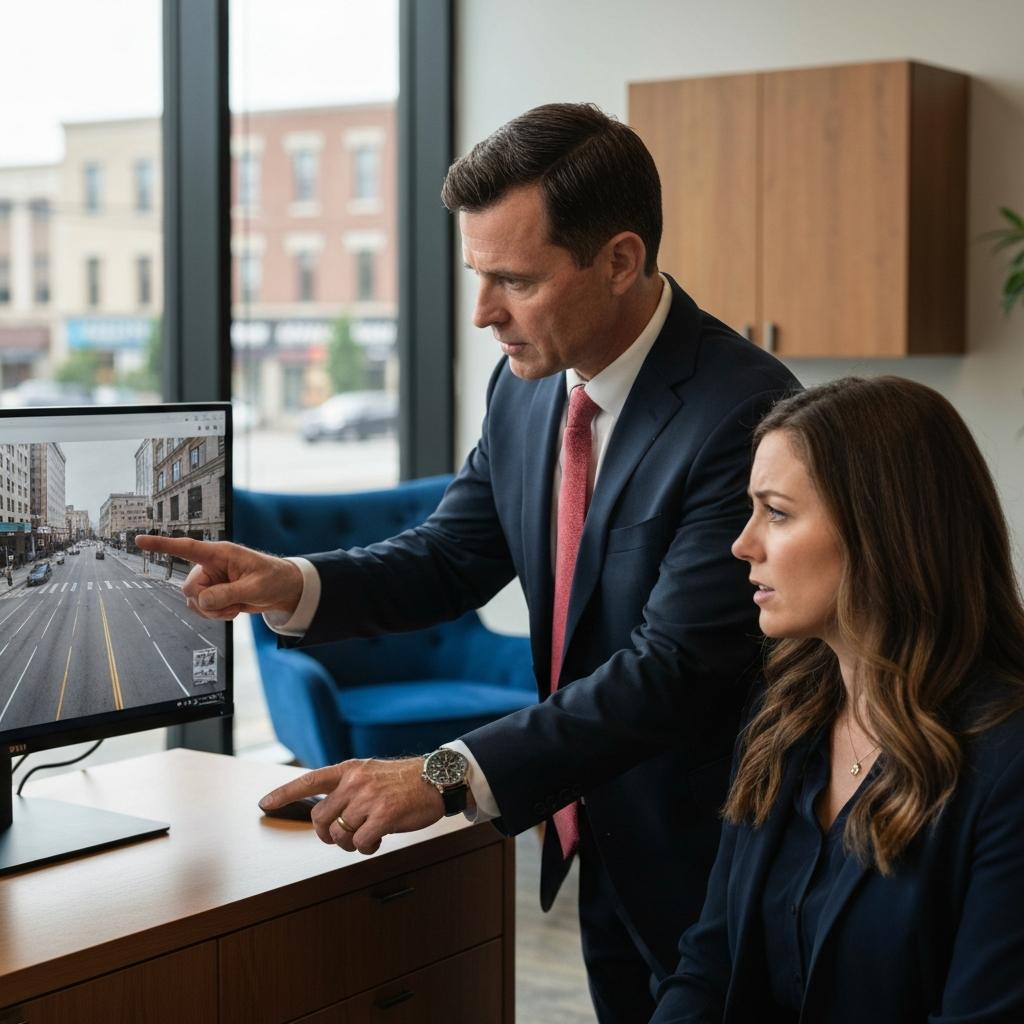
Market Square is one of downtown Knoxville’s busiest intersections, drawing heavy foot traffic, rideshare pickups, delivery vehicles, and through traffic every day of the week. When a crash happens there, the evidence you need to prove fault may already be captured on camera, but footage may be overwritten or otherwise become unavailable quickly depending on the camera system. OEB Law helps injured Knoxvillians act quickly to identify, preserve, and use traffic camera footage before it is gone. In this blog post, Knoxville attorney Tim Elrod discusses utilizing Knoxville’s traffic camera footage to prove fault in your Market Square accident.
Key Takeaways
- Market Square has multiple camera sources including TDOT SmartWay, KPD-operated red-light cameras, private business CCTV, and Knox County government building cameras.
- Act as soon as possible — some camera systems overwrite footage quickly, so immediate preservation requests can be critical.
- Tennessee’s modified comparative fault rule (T.C.A. § 29-11-103) means that if footage shows you were 50% or more at fault, you cannot recover damages.
- An attorney can obtain footage faster through formal preservation letters and subpoenas, often before a victim knows where to start.
To utilize Knoxville’s traffic camera footage to prove fault in a Market Square accident, you should first identify which cameras may have captured the crash — including TDOT SmartWay cameras, KPD camera systems, and private business surveillance — and then submit a public records request for government-held footage under Tennessee’s Public Records Act (T.C.A. § 10-7-503) while also seeking private footage directly from the business or its insurer. Government camera retention periods vary by agency, system, and vendor, so footage should be requested immediately. Because Tennessee follows modified comparative fault, footage showing the other driver’s actions can be the deciding factor in whether you recover full compensation.
To Discuss Your Case, Call or Text Our Team Standing By 24/7: (865) 546-1111
About OEB Law, Your Knoxville Legal Team

This guide is provided by the experienced attorneys at OEB Law, led by Managing Attorney Timothy G. Elrod. Founded in Knoxville in 2004, our firm has over 50 years of combined experience navigating East Tennessee’s legal system.
We have successfully represented thousands of personal injury clients, developing deep expertise in Tennessee’s complex wrongful death and accident laws. As East Tennessee natives, we have a direct understanding of the local court systems, law enforcement agencies, and community needs. Our commitment is to provide trusted, authoritative information to our neighbors in Knoxville and the surrounding Tennessee communities. However, this information does not constitute legal advice. If you or a loved one has been injured in an accident or needs legal help, call us today for a free, no obligation, initial consultation.
Where Are the Traffic Cameras Around Market Square in Knoxville?
This is the most important question to answer immediately after a Market Square collision. Knowing which cameras may have captured your crash determines which agencies you contact first — and how fast you need to move.
TDOT SmartWay Cameras
TDOT SmartWay cameras monitor Tennessee’s state highway corridors and approach routes feeding into downtown Knoxville. Near Market Square, these systems cover portions of James White Parkway and the Cumberland Avenue corridors. However, TDOT SmartWay operates primarily as a live traffic monitoring system. Whether archived footage is available for a specific incident varies by location and system configuration. An attorney can contact TDOT directly to confirm archiving capability and submit a preservation request.
KPD Red-Light and Intersection Cameras
The Knoxville Police Department operates red-light enforcement cameras at selected downtown intersections. The corridors surrounding Market Square — including Gay Street, Walnut Street, and adjacent downtown routes — may fall within KPD’s camera network. Red-light enforcement camera programs are governed by Tennessee law and local agency/vendor policies, and any footage they capture may sometimes be sought as evidence in a civil claim.
Private Business and Government Building Cameras
Market Square is ringed by restaurants, bars, and retail storefronts — many with exterior security cameras pointed directly at the street. These private cameras are not subject to public records law, but footage can often be obtained voluntarily. Additionally, the Knox County Courthouse and City-County Building sit within blocks of Market Square. Government building security footage may be subject to Tennessee’s Public Records Act and can be requested through the relevant public agency, while private business footage must be requested directly from the business.
Event-Specific Camera Coverage
Market Square hosts the Knoxville Farmers Market, First Friday events, and other community programming. These events bring in temporary security infrastructure and event organizers with their own camera systems. If your accident happened during a scheduled Market Square event, the event organizer may have footage that standard public records requests would miss entirely.
Camera sources to pursue after a Market Square accident include:
- TDOT SmartWay highway corridor cameras
- KPD red-light and intersection enforcement cameras
- Knox County Courthouse and City-County Building security cameras
- Private business CCTV along the square’s perimeter
- Event organizer and temporary security cameras
How to Request Traffic Camera Footage in Knoxville Before It Is Gone
Footage retention is not permanent, and the window to obtain it closes faster than most accident victims expect. Acting quickly is often the difference between having evidence and losing it forever.
Retention Timelines by Camera Type
Different systems follow different retention schedules:
- TDOT SmartWay: Primarily live monitoring; archived footage availability varies, so you should contact TDOT directly and promptly.
- KPD red-light cameras: Operated by third-party vendors; retention periods vary by contractor agreement.
- Third-party archives: May have their own retention windows, so the availability of archived footage should be confirmed directly with the service.
- Private business cameras: No legal retention requirement; footage may overwrite within 24 to 72 hours depending on system settings.
- Knox County government cameras: Subject to Tennessee Public Records Act; retention follows agency policy.
Step-by-Step: Making a Public Records Request
Tennessee law gives you the right to request government-held camera footage from public agencies subject to the Public Records Act. Follow these steps:
- Identify which agency controls the camera (KPD, TDOT, Knox County, City of Knoxville).
- Document the exact date, time, and intersection of your accident.
- Submit a written public records request under T.C.A. § 10-7-503 to the correct agency.
- Reference Tennessee’s Public Records Act in your request and ask the agency to respond promptly under applicable law.
- If the agency denies your request, contact the Tennessee Office of Open Records Counsel.
- For private business cameras, make an in-person or written request and explain the footage may be needed for a legal matter.
Why an Attorney Gets Footage Faster
An attorney can send a formal evidence preservation letter that puts the recipient on notice and helps protect against later spoliation arguments if relevant footage is destroyed. Once an agency receives notice of potential litigation, destroying footage can create legal liability. An attorney can also issue subpoenas for private footage that voluntary requests cannot compel.
“In Market Square accident cases, the clock starts the moment your crash happens. Government systems overwrite footage on their own schedule, and private businesses may delete recordings without even realizing they matter. Getting an attorney involved early is often the only way to make sure that evidence still exists when you need it.” – Knoxville attorney Tim Elrod
Knoxville Traffic Camera Footage Request Guide by Source Type
| Camera Type | Who Controls It | How to Request | Typical Retention | Cost Notes |
|---|---|---|---|---|
| TDOT SmartWay | Tennessee Dept. of Transportation | Written request to TDOT; smartway.tn.gov | Live monitoring; archive availability varies | T.C.A. § 10-7-506 may allow staff time charges |
| KPD Red-Light Cameras | Knoxville Police Dept. / Third-Party Vendor | Public records request to KPD; knoxvilletnpolice.gov | Varies by vendor contract | Possible fee for video media duplication |
| City of Knoxville Intersection Cameras | City of Knoxville | Public records request; knoxvilletn.gov | Policy-dependent; request promptly | Staff time fees may apply |
| Knox County Government Building Cameras | Knox County Sheriff / Building Security | Written request to Knox County | Agency retention schedule | T.C.A. § 10-7-503 governs |
| Private Business CCTV | Business owner | Voluntary request in person or in writing; attorney letter if refused | 24-72 hours typical before overwrite | No cost for voluntary; subpoena may be required |
| Third-Party Archives | knoxville.trafficcamarchive.com | Online subscription or request | Approx. 90 days | Subscription or per-request fees |
How Traffic Camera Footage Proves Fault Under Tennessee Law
Obtaining footage is only half the battle. How that footage is analyzed and presented under Tennessee’s legal framework determines whether it actually helps your case.
Tennessee’s Modified Comparative Fault Rule
Tennessee follows modified comparative fault under T.C.A. § 29-11-103, which reduces recovery by a plaintiff’s percentage of fault and bars recovery if the plaintiff is 50% or more at fault. This is the 50% bar rule: if you are found 50% or more at fault for an accident, you recover nothing under T.C.A. § 29-11-103. Camera footage showing a driver running a red light or failing to yield can shift fault attribution dramatically.
What Camera Footage Can Actually Prove
Traffic camera video can establish key facts that eyewitness accounts alone cannot reliably confirm:
- Speed and direction of vehicles at the moment of impact
- Red-light and stop sign compliance or violation
- Pedestrian and cyclist position relative to crosswalks
- Road and weather conditions at the time of the crash
- Driver behavior before, during, and after the collision
- Whether turn signals or headlights were in use
“Insurance adjusters know that footage from a Market Square intersection can make or break a fault determination. When we get involved early, we can make sure that footage is preserved and presented in a way that tells the full story of what happened to our client.” – Knoxville attorney Tim Elrod
If you have been injured in a collision, our Knoxville car accident attorneys can begin the evidence preservation process immediately.
Tennessee Modified Comparative Fault and Camera Evidence: How Footage Affects Your Recovery
Step 1: Accident at Market Square
An accident occurs. Was it captured by a camera?
Step 2: Identify Footage Controller
Who has the footage? TDOT, KPD, a private business, or Knox County?
Step 3: Preserve Evidence
Immediately send a Public Records Request or Attorney Preservation Letter.
Step 4: Attorney Review
The obtained footage is analyzed by an attorney for fault indicators.
Step 5: Fault Assessment
What percentage of fault does the footage assign to each party?
Result A: Fault is Under 50%
You can recover compensation, reduced by your percentage of fault, under T.C.A. § 29-11-103.
Result B: Fault is 50% or More
Tennessee law bars any financial recovery. You receive nothing.
Alternative Evidence Sources
If no camera footage exists, other evidence is critical: Witnesses, EDR (black box) data, KPD body cams, and private dashcam video.
What to Do If No Traffic Camera Captured Your Market Square Accident
Camera coverage is not always guaranteed, but Market Square’s high foot traffic creates other evidence opportunities worth pursuing immediately. The area’s density means numerous potential eyewitnesses are nearby at almost any time of day. Additionally, vendors, event organizers, and attendees may have recorded the collision on personal devices.
Beyond human witnesses, vehicle Event Data Recorders (EDRs), or “black boxes,” can capture speed, braking, and steering data in the seconds before impact. KPD body camera footage from responding officers may also capture post-accident scene conditions that support your account. A Knoxville personal injury attorney can pursue all these evidence sources, ensuring nothing is overlooked while you focus on recovery.
Why Choose OEB Law for Market Square Traffic Camera Evidence
When a Market Square accident happens, the first hours are critical. Navigating multiple public agencies, private businesses, and Tennessee’s evidence preservation rules is not something most accident victims can manage alone. OEB Law has been serving Knoxville since 2004, and the firm’s experienced attorneys understand the local processes involved in requesting and preserving evidence in East Tennessee cases. As top attorneys in Knoxville, we know how insurance companies use footage against claimants and how to counter that strategy.
Timothy G. Elrod and the OEB Law team can send preservation letters to multiple agencies, protect footage from deletion, and subpoena private business recordings when voluntary requests fail. If you have received a low settlement offer, use our car wreck settlement calculator to get a baseline sense of your claim’s value. Tim Elrod is recognized across multiple attorney rating platforms like FindLaw and Timothy G. Elrod on Avvo for his results and client commitment.
Who is OEB Law and Why Are They Good for the Community?
Led by Managing Attorney Timothy G. Elrod and Our Experienced Legal Team
Founded in 2004 in Knoxville, Tennessee, OEB Law has grown over nearly two decades to serve clients across Knoxville, Knox County, and East Tennessee. Tim Elrod established the firm with a simple but powerful mission: we care and we help people. Today, our team brings over 50 years of combined experience representing clients throughout Tennessee in personal injury and criminal defense cases.
Our Legal Expertise
Our attorneys have built their reputation through:
- Successfully representing thousands of personal injury and criminal defense clients
- Developing specialized knowledge across all types of accident and injury cases
- Mastering the complexities of Tennessee’s legal system through decades of practice
Why Trust Us
At OEB Law, our reputation speaks for itself:
- Proven Results: We’ve recovered significant compensation for our clients through both settlements and courtroom verdicts
- Client Satisfaction: Our numerous 5 Star Google Reviews showcase our commitment to responsive, caring, and effective legal representation
- No Fee Unless We Win: You don’t pay attorney fees unless we successfully secure compensation in your case
- Local Knowledge: As East Tennessee natives, we understand our community and care deeply about the people we serve
- Personalized Approach: We personalize each case to meet our clients’ specific needs, ensuring you’re never just another file number
Community Commitment
Our dedication extends beyond the courtroom. We proudly support:
- Local high school football programs through Rivalry Thursday sponsorships
- The Knoxville Ice Bears and community fundraising initiatives
- Numerous youth, student, and community organizations throughout East Tennessee
“We don’t just take—we give back because the people you’re giving back to are the people who are supporting your firm.” – Tim Elrod
Have a personal injury or criminal defense case? We’re available 24/7 to help.
Get In Touch
- Call or Text: (865) 546-1111
- Visit: https://oeblawtn.com/
- Available: Standing by 24/7
Why OEB Law? Because They’re Good For The Community.
TEXT or CALL (865) 546-1111 for HELP NOW. Standing By 24/7.
Follow Us on Social Media
Stay connected with OEB Law for the latest Knoxville and East Tennessee legal insights, community updates, and important legal information. Follow us on X, YouTube, Facebook, Instagram, LinkedIn, and TikTok for exclusive content, client stories, and expert legal guidance from our team.
Frequently Asked Questions
Retention timelines vary by camera type and agency. TDOT SmartWay operates primarily as a live monitoring system with limited archiving, while KPD red-light camera retention depends on the third-party vendor’s contract. Private business cameras may overwrite footage in as few as 24 to 72 hours, making it critical to act within the first 24 to 48 hours after your Market Square accident.
Tennessee follows modified comparative fault under T.C.A. § 29-11-103, which bars any recovery if you are found 50% or more at fault for the accident. Traffic camera footage can shift fault percentages significantly — either in your favor by showing the other driver ran a red light or failed to yield, or against you if insurers use the footage to argue you were partially responsible. Because a single percentage point above 50% eliminates your recovery entirely, how camera evidence is obtained and presented can be the deciding factor in your case.
Several alternative evidence sources are available even without camera footage. Eyewitness accounts from bystanders, Knoxville Farmers Market vendors, or First Friday event attendees can support your account of the crash. Vehicle Event Data Recorders can capture speed and braking data from the seconds before impact, and KPD body camera footage from responding officers may document post-accident scene conditions.
Can Insurance Companies Request Traffic Camera Footage After a Market Square Accident in Tennessee?
Yes, insurance companies can submit public records requests for government camera footage and may approach private businesses for voluntary disclosure. This is one reason acting quickly after a Market Square accident matters so much. Once an insurer obtains and analyzes footage first, they control how that evidence is framed in your claim. Tennessee’s modified comparative fault rule under T.C.A. § 29-11-103 means that if your fault is 50% or more, recovery is barred. An experienced Knoxville accident attorney can move to preserve footage before insurers obtain it and ensure the evidence is presented in the full context of what happened.

