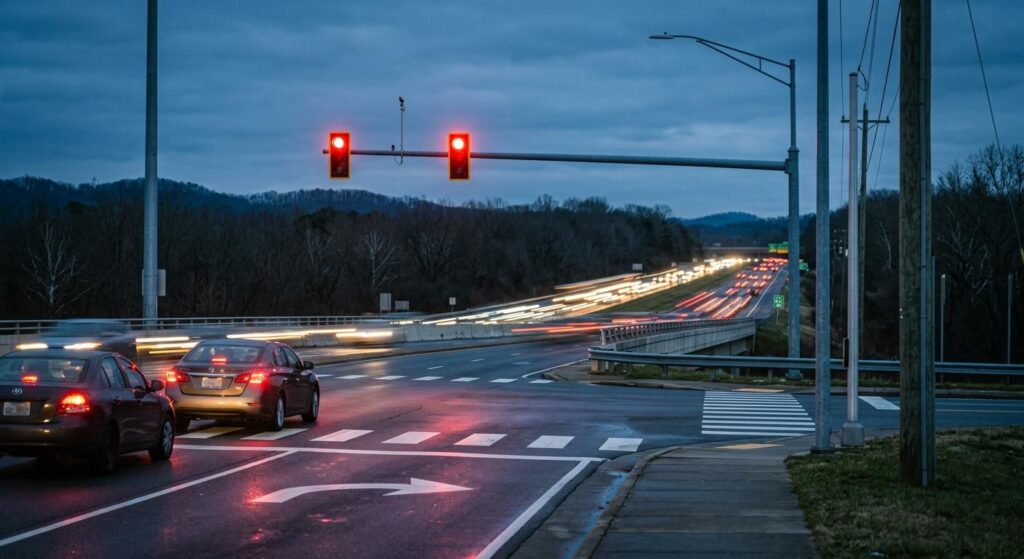
Traffic on I-40 through West Knoxville does not usually kill people. It pins them in a chain of stopped cars. The stretch running west from the I-640 split out past Farragut carries more than 180,000 vehicles a day at its busiest point, and it produces a very specific kind of wreck: a daylight, clear-weather, stop-and-go collision involving three or more vehicles, with a roughly one in five chance that one of them is a commercial truck. If that happened to you, the hard part is almost never proving a crash occurred. The hard part is proving which driver started it, because in a chain-reaction collision every insurer in the pile has a reason to point at you. At OEB Law, our Knoxville team handles these claims on this corridor, and we know how the interchanges, the responding agencies, and the Knox County courts actually work. In this blog post, Knoxville attorney Tim Elrod discusses what to do after a car accident on I-40 through West Knoxville.
Key Takeaways
- This corridor is a pileup corridor, not a fatality corridor. Roughly 88 percent of crashes on it involve more than one vehicle, and about 73 percent are rear-end or same-direction sideswipe collisions, per OEB Law’s crash-data analysis.
- You may have been on I-40 and I-75 at the same time. The two interstates share the same pavement for about 17 miles across West Knoxville, so your crash report may name the route you were not watching for.
- Chain-reaction fault is the whole fight. Tennessee uses modified comparative fault with a 50 percent bar, so an insurer that shifts even part of the blame onto you cuts your recovery.
- Tennessee gives you only one year to file a personal injury claim, which is one of the shortest deadlines in the country.
To Discuss Your Case, Call or Text Our Team Standing By 24/7: (865) 546-1111
About OEB Law, Your Knoxville Legal Team

This guide is provided by the experienced attorneys at OEB Law, led by Managing Attorney Timothy G. Elrod. Founded in Knoxville in 2004, our firm has over 50 years of combined experience navigating East Tennessee’s legal system.
We have successfully represented thousands of personal injury clients, developing deep expertise in Tennessee’s complex wrongful death and accident laws. As East Tennessee natives, we have a direct understanding of the local court systems, law enforcement agencies, and community needs. Our commitment is to provide trusted, authoritative information to our neighbors in Knoxville and the surrounding Tennessee communities. However, this information does not constitute legal advice. If you or a loved one has been injured in an accident or needs legal help, call us today for a free, no obligation, initial consultation.
The Shared Barrel: Why I-40 West Is Also I-75
Most drivers who crash in West Knoxville believe they were on I-40. Many of them were also on I-75 at the same moment, and that single fact causes more confusion in these claims than any other.
Interstate 40 and Interstate 75 run on the same pavement for about 17 miles across the west side of Knox County. The two routes join at the three-way interchange in Loudon County, where I-75 peels off to the southwest toward Chattanooga, and they stay joined until the interchange near the I-640 split west of downtown, where I-75 leaves to head north. Knoxville drivers have called that northern split Malfunction Junction since the 1970s. Everything between those two points is dual-signed, which means a single collision can legitimately be written up under either route number.
This is not a trivia point. It changes your paperwork. In OEB Law’s analysis of Knox County crash records, drawing on the Knox County Transportation Planning Organization’s Interactive Crash Map, roughly 1,260 crashes on this western shared segment were recorded under the I-75 route name rather than I-40. Those were real wrecks on the same concrete as the I-40 crashes beside them in the data. If you request your report by searching for an I-40 accident and nothing comes back, the record may be filed under I-75. If an adjuster tells you the location you described does not match the report, this is very often why.
It also matters for how heavily the corridor is used. Because the segment carries two interstates at once, it absorbs long-haul freight bound for Nashville and freight bound for Chattanooga on top of all of West Knoxville’s local commuting. That combination is what the traffic volume and the truck share in the data reflect, and it is why congestion here behaves differently from a normal urban interstate.
I-40 West Knoxville: A Pileup Corridor, Not a Fatality Corridor
Interstate 40 in Knox County, west of the I-640 split, 2015 through 2026.
How these crashes happen
| Segment | Crashes | Deaths | Deaths per 1,000 crashes |
|---|---|---|---|
| Knox County, west of the I-640 split | 9,542 | 43 | 4.5 |
| Knox County, east of the I-640 split | 6,979 | 53 | 7.6 |
| Loudon County, west of the I-75 split | 1,219 | 14 | 11.5 |
Figures come from OEB Law’s crash-data analysis drawing on the Knox County Transportation Planning Organization (Knox TPO) Interactive Crash Map. The 2026 figures are a partial year. Percentages are rounded. The west segment carries the most crashes of the three but the lowest death rate per crash, which is what high-volume, low-speed collisions look like in data.
Crash Hotspots From Exit 368 to Exit 385
The western segment is not uniformly dangerous. Crash density and traffic volume both climb steadily as you move east toward downtown, and the character of the wrecks changes along the way. The figures below come from OEB Law’s crash-data analysis drawing on the Knox TPO Interactive Crash Map, covering 2015 through 2026.
Dixie Lee Junction and the I-75 Split (Exit 368)
This is where the two interstates separate, on a left-hand exit, which is unusual and catches unfamiliar drivers out. West of here the road enters Loudon County, and that stretch behaves like a different highway: about 1,219 crashes with 14 deaths, which works out to the highest death rate per crash anywhere on I-40 in this region. Only about 70 percent of Loudon County’s I-40 crashes involve more than one vehicle, compared with roughly 88 percent on the Knox County side. Fewer cars, higher speeds, more single-vehicle departures from the roadway. The venue changes too, which we cover below.
Watt Road, the Truck Gateway (Exit 369)
Watt Road is where the freight gets on and off. It is the truck plaza interchange, and the data shows it: about 33 percent of the roughly 349 recorded Watt Road crashes involved a truck or bus, which is by a wide margin the highest commercial-vehicle share of any road we looked at in the corridor. Encouragingly, those crashes have produced no recorded deaths and no suspected serious injuries, which fits low-speed maneuvering rather than highway-speed impacts. The hazard Watt Road creates is not at Watt Road. It is the stream of heavy, slow-accelerating trucks it feeds onto the mainline just as traffic from Loudon County is coming up to speed.

Campbell Station Road and Farragut (Exit 373)
This interchange serves Farragut, and TDOT has it in the long-range plan for reconstruction. Within the town limits, I-40 has recorded roughly 1,950 crashes but only 3 deaths, with a truck involvement share around 23 percent. That combination, very high volume and very low lethality, is the clearest statistical picture of what this corridor is: constant low-speed collisions in dense traffic.
Lovell Road (Exit 374)
Lovell Road is the single worst feeder road on the western segment. The surface street itself has recorded roughly 2,418 crashes with 5 deaths, and about 95 percent of them involved more than one vehicle. Unlike the interstate, Lovell Road does carry a formal safety designation: it appears on the regional SS4A High Injury Network with about half a mile of Tier 1 segments and roughly 1.1 miles of Tier 2 segments. Knox County also has a project to widen Lovell Road from two lanes to four between Cedardale Lane and Middlebrook Park, with pedestrian and bicycle facilities included.
What that means in practice is that a crash “at Lovell Road” can be three different claims depending on a few hundred feet. On the ramp, on the mainline, or at the surface-street intersection are not the same case, they do not necessarily involve the same responding agency, and they do not carry the same evidence.
Pellissippi Parkway (Exit 376)
Pellissippi Parkway, signed as I-140 and State Route 162, joins here and carries the Oak Ridge, Hardin Valley, and Y-12 commuter flow. It adds a large, time-concentrated merge to a corridor that is already near capacity in the morning and evening peaks.
Cedar Bluff Road and Turkey Creek (Exit 378)
Cedar Bluff is the retail interchange, and it produces the most purely congestion-driven crash pattern in the corridor. Cedar Bluff Road has recorded roughly 1,862 crashes with 1 death, and about 97 percent of them involved more than one vehicle, the highest multi-vehicle share of any road we examined. Truck involvement is low, around 2 percent. Parkside Drive, the Turkey Creek retail spine behind this interchange, shows a similar pattern with roughly 1,177 crashes and about 96 percent multi-vehicle. Both roads carry Tier 2 High Injury Network mileage, and Cedar Bluff carries Tier 1 mileage as well.
Bridgewater, Walker Springs and Gallaher View (Exit 379)
A split diamond interchange ties I-40 to three local roads at once here. Short decision distances and multiple closely spaced ramp movements are the structural problem, and it sits immediately next to the Cedar Bluff retail volume.
West Hills, Papermill Drive and Malfunction Junction (Exits 380 to 385)
This is the busiest and the deadliest part of the western segment. Montvue Road serves West Hills at Exit 380, Papermill Drive and Northshore Drive share the parclo interchange at Exit 383, and I-75 finally leaves I-40 at Exit 385, the split locals call Malfunction Junction. Average daily traffic in the data peaks above 180,000 vehicles in the approach to that split, and the two-mile band right before it has recorded more deaths than any comparable stretch west of downtown. Papermill Drive itself has recorded roughly 880 crashes with 4 deaths and carries Tier 2 High Injury Network mileage.
One honest clarification is worth making here, because other corridor guides on our site do cite it. I-40 itself does not appear on the SS4A High Injury Network at all. That network covers local and surface roads, not interstates. So while Lovell Road, Cedar Bluff Road, Parkside Drive and Papermill Drive all carry formal Tier designations, the interstate they feed does not, and anyone who tells you I-40 is a designated Tier 1 corridor is misreading the source.
I-40 West Knoxville Interchanges: What Goes Wrong Where
| Interchange | Main Structural Hazard | Common Crash Type |
|---|---|---|
| I-75 Split (Exit 368) | Left-hand exit, route change, Knox and Loudon county line | Late lane changes, single-vehicle departures west of the split |
| Watt Road (Exit 369) | Truck plaza traffic, heavy slow-accelerating vehicles entering | Low-speed truck maneuvering, speed-gap rear-end on the merge |
| Campbell Station Road (Exit 373) | Farragut commuter volume, interchange slated for reconstruction | Queue-end rear-end collisions at the ramp backup |
| Lovell Road (Exit 374) | Busiest feeder on the segment, Tier 1 High Injury Network mileage, active widening project | Multi-vehicle collisions on the ramps and at the surface intersections |
| Pellissippi Parkway, I-140 (Exit 376) | Large peak-hour merge from the Oak Ridge and Hardin Valley commute | Merge sideswipes and weaving collisions |
| Cedar Bluff Road (Exit 378) | Turkey Creek retail congestion, dense curb cuts and signals | Stop-and-go rear-end chains, roughly 97 percent multi-vehicle |
| Bridgewater, Walker Springs, Gallaher View (Exit 379) | Split diamond serving three local roads, short decision distances | Closely spaced ramp conflicts, sideswipes |
| West Hills to the I-640 split (Exits 380 to 386) | Peak volume above 180,000 vehicles per day, I-75 departing north | High-occupancy rear-end chains, the deadliest band west of downtown |
Why does Watt Road have such a high truck crash share?
It is the truck plaza interchange for the corridor, so a large share of the vehicles using it are tractor-trailers. Roughly a third of its recorded crashes involved a truck or bus, but they have produced no recorded deaths or suspected serious injuries, which fits low-speed maneuvering rather than highway-speed impacts.
Why is Cedar Bluff almost entirely multi-vehicle crashes?
It serves the Turkey Creek retail district, so traffic is dense, slow, and constantly stopping for signals and turning movements. In that environment a driver rarely leaves the road alone. They hit the vehicle ahead, and sometimes several do in sequence.
Does it matter whether my crash was on the ramp or the mainline?
Yes, and at Lovell Road in particular it can change the case. The ramp, the interstate mainline, and the surface intersection can involve different responding agencies and different evidence, and the surface street carries a formal High Injury Network designation that the interstate does not.
Crash figures come from OEB Law’s crash-data analysis drawing on the Knox County Transportation Planning Organization (Knox TPO) Interactive Crash Map, 2015 through 2026. High Injury Network designations come from the regional SS4A High Injury Network, which covers local and surface roads and does not include interstates. Interchange reconstruction and widening references come from TDOT and Knox County project plans and are subject to change.
Related Reading: I-40 West and Malfunction Junction Crashes
More local guides from OEB Law on wrecks along the western half of I-40.
Why This Stretch Produces Chain-Reaction Crashes
The crash pattern on I-40 through West Knoxville is unusually consistent, and understanding it tells you what evidence your claim will turn on.
The Collisions Are Overwhelmingly From Behind
In OEB Law’s analysis of the Knox County records for this segment, about 53 percent of crashes were rear-end collisions and another 20 percent were same-direction sideswipes. Together that is roughly 73 percent of everything that happens out here. Head-on collisions account for about two tenths of one percent. This is a corridor where vehicles hit the vehicle in front of them or the vehicle in the next lane, which is the signature of volume and sudden deceleration rather than loss of control.
It Happens in Good Weather, in Daylight
About 71 percent of these crashes occurred in daylight and about 70 percent in clear weather. Rain accounts for roughly 17 percent. That matters because the defense in these cases often reaches for conditions as an explanation, and on this corridor the data does not support it. The ordinary West Knoxville wreck happens on a clear afternoon in heavy traffic.
Roughly One in Five Involves a Truck or Bus
Commercial vehicle involvement on the Knox County western segment runs near 20 percent. When a tractor-trailer is in a chain-reaction collision, two things change immediately. The physical damage is far worse for whoever is in front of it, because a loaded rig cannot stop in the distance a car can. And the claim becomes a commercial claim, with a carrier, a far larger liability policy, an insurer that dispatches investigators within hours, and electronic data on the truck that will be overwritten if nobody demands it.
The Road Is Being Studied Right Now
TDOT has an active Planning and Environmental Linkages study on this exact corridor, covering roughly 17 miles from the I-40 and I-75 interchange in Loudon County to the I-640 interchange west of downtown. The study is explicitly looking at congestion, safety, bottlenecks, crash concentrations in the 2022 through 2024 data, and design deficiencies, and it held a second round of public meetings at the end of June 2026. TDOT’s longer-range plan includes reconstruction of the Watt Road interchange and the Campbell Station Road interchange.
For an injured person, this is useful in two ways. It confirms that the conditions you experienced are documented and acknowledged rather than imagined. And in the narrow set of cases where roadway design itself contributed, a documented design deficiency is a meaningful fact, though claims against a government entity in Tennessee carry their own procedures and much shorter practical timelines.
The Chain-Reaction Fault Problem
This is the section that matters most on this corridor, and it is the part most people get wrong in the first week after their crash.
Everyone has heard that the driver who rear-ends someone is at fault. In a two-car collision that is usually where the analysis lands. In a four-car chain reaction on I-40 at rush hour it is close to meaningless, because the car that hit you may have been pushed into you by the car behind it. The physical evidence of who moved first is in the damage patterns, the resting positions, the sequence of impacts, and increasingly in the vehicles’ own electronic data, and almost none of that survives in a usable form if nobody collects it in the first days.
Tennessee’s 50 Percent Bar Is the Pressure Point
Tennessee uses modified comparative fault. Your recovery is reduced by whatever share of the blame is assigned to you, and if your share reaches 50 percent you recover nothing at all. In a multi-vehicle pile this creates a predictable dynamic: each insurer has a direct financial interest in assigning some fault to every other driver, including you. Following too closely, failing to react, being in the wrong lane, and braking too hard are all arguments you will hear. They do not have to prove you caused the crash. They only have to move your number up.
What Actually Decides It
In practice these claims turn on a short list of things.
- The sequence of impacts, established from damage patterns on each vehicle and the officer’s diagram.
- Electronic data, meaning the event data recorder in a passenger vehicle and the engine control module and telematics in a commercial truck. This is the strongest evidence of speed and braking, and it is the most perishable.
- Independent witnesses, who scatter within minutes on an interstate and are nearly impossible to find later.
- Video, from a dash camera, a nearby business, or a TDOT SmartWay traffic camera. TDOT camera feeds are generally not retained long, so a preservation request has to go out quickly to have any chance.
- Your own medical documentation, starting with being evaluated promptly even if you feel functional at the scene.
Get Checked Even If You Feel Fine
Low-speed and moderate-speed rear-end impacts are the classic mechanism for injuries that present late. Adrenaline at the scene masks a great deal, and soft-tissue neck and back injuries, concussions, and shoulder injuries routinely declare themselves a day or several days afterward. A gap between the crash date and your first medical visit is the single most common argument used to discount an otherwise strong claim. Get evaluated, and describe every symptom rather than only the worst one.
Chain-Reaction Crash: What Has to Be Preserved, and How Fast
In a multi-vehicle collision, the proof of who started it is the first thing to disappear. These are listed in the order they vanish.
On an interstate, uninvolved drivers who saw the sequence leave the scene almost immediately and are effectively unfindable afterward. A name and a phone number taken at the scene is worth more than anything else you can do in the first hour.
Where each vehicle came to rest helps establish the order of impacts, and the scene gets cleared fast on a corridor this busy. If it is safe to do so, photograph the whole scene before anything is moved, including the vehicles you were not involved with.
This corridor is heavily camera-covered, but traffic camera feeds are generally not retained for long. A written preservation request has to reach the right agency within days to have any realistic chance of capturing the sequence on video.
Private systems near the Cedar Bluff, Turkey Creek and Lovell Road interchanges typically overwrite on a short loop. The other drivers’ dash cameras are also evidence, and they are only obtainable through a formal request made early.
If a truck or bus was involved, the engine control module, telematics, and the driver’s hours-of-service records show speed, braking and duty time. Carriers are only obligated to retain much of this for limited periods, so a spoliation letter is the step that protects it.
Most modern cars record pre-impact speed and braking. That data leaves with the vehicle, so once an insurer totals and disposes of a car in the chain, the best evidence of what that driver did is gone. Do not authorize disposal of your own vehicle before it has been inspected.
A delay between the crash and your first evaluation is the most common argument used to reduce a claim. Get examined promptly, report every symptom rather than only the worst one, and follow through on referrals.
If a serious injury sent you to a Level III trauma center and then on to the Level I center across town, your records exist in two hospital systems. A complete record set has to be requested from both.
First Steps: Emergency and Medical Response in West Knoxville
Who responds to your crash depends on exactly where it happened, and that determines where your report lives.
Which Agency Writes Your Report
The Tennessee Highway Patrol has primary responsibility for crashes on the interstate mainline. Inside Knoxville city limits the Knoxville Police Department may also respond, and in unincorporated Knox County the Knox County Sheriff’s Office does. Farragut contracts its policing through the Knox County Sheriff’s Office rather than running its own department, so a crash at the Campbell Station interchange is typically a Sheriff’s Office matter. West of the I-75 split you are in Loudon County, with a different sheriff’s office and a different set of records.
The practical consequence is that “my crash report” can sit in any of several systems, and a report requested from the wrong agency comes back empty. If you were not sure which jurisdiction you were in, you were probably in more than one over the course of a few hundred feet of roadway.
Local Trauma Care
West Knoxville has solid emergency capacity close to this corridor. Tennova Healthcare Turkey Creek Medical Center sits right behind the Cedar Bluff and Parkside interchanges and is accredited by the Tennessee Department of Health as a Level III trauma center. It recently completed a three million dollar emergency department expansion that took it from 12 to 20 patient rooms and brought its trauma bays to three. Parkwest Medical Center, part of Covenant Health, is also nearby with a 24-hour emergency department.
The important distinction for a seriously injured person is that the region’s only Level I trauma center for both adults and children is the University of Tennessee Medical Center on Alcoa Highway, across the city from this corridor. A catastrophic I-40 West injury is frequently stabilized at Turkey Creek or Parkwest and then transferred to UT Medical Center. When that happens your medical records exist in two separate hospital systems, and a complete record set requires requesting from both. Claims get undervalued because a treatment gap in one system’s chart was really a transfer into another’s.
What To Do in the First Week
- Report the crash and make sure a report is actually written, even if the damage looks minor.
- Photograph every vehicle involved, not only yours, and photograph the resting positions before anything is moved if it is safe to do so.
- Get the names and phone numbers of every other driver and any witness, immediately.
- Be evaluated by a medical provider, and follow through on the referrals.
- Do not give a recorded statement to any insurer other than your own, and do not sign a blanket medical release.
- Contact a lawyer early enough that preservation letters can go out while the electronic data and any video still exist.
Who Can Be Held Liable
In a multi-vehicle crash on this corridor, liability is often shared, and finding every responsible party is what determines whether there is enough insurance coverage to make you whole.
Other Drivers
The most common answer, and in a chain reaction it is frequently more than one of them. Each driver carries their own policy, and Tennessee’s minimum limits are low relative to the cost of a serious injury, which is why identifying several liable drivers can matter more than identifying the single worst one.
A Trucking Company
If a commercial vehicle was involved, the carrier can be liable for its driver’s conduct, and separately for its own negligence in hiring, training, supervision, or maintenance. Commercial policies are far larger than personal ones. Federal motor carrier rules also create documentation that does not exist in an ordinary car crash, including hours-of-service records and inspection and maintenance files.
An Employer
A driver running an errand or traveling between job sites in the course of employment can expose their employer to liability. Given how much of this corridor’s peak traffic is commuting and commercial travel to Oak Ridge, Hardin Valley and the Turkey Creek business district, this comes up more often here than people expect.
A Vehicle or Parts Manufacturer
Where a crash involved a tire failure, a brake defect, or a restraint or airbag that did not perform, a product claim can run alongside the driver claim.
A Government Entity
Where roadway design or maintenance genuinely contributed, a claim against a governmental defendant may be possible. These are narrow, procedurally strict, and operate on much tighter practical deadlines than an ordinary injury claim, so they need to be evaluated early rather than late.
Who Can Be Held Liable for an I-40 West Knoxville Crash
In a chain-reaction collision, liability is usually shared. Finding every responsible party is what determines whether there is enough insurance coverage to cover a serious injury.
One or More Other Drivers
The usual answer, and on this corridor it is frequently more than one. Tennessee’s minimum liability limits are low against the cost of a serious injury, so identifying several liable drivers can matter more than identifying the worst one.
Turns on impact sequence, event data recorder output, witness accounts, the officer’s diagramA Trucking Company
If a commercial vehicle was in the pile, the carrier can be liable for its driver and separately for its own negligent hiring, training, supervision or maintenance. Commercial policies are far larger than personal ones.
Turns on engine control module data, telematics, hours-of-service logs, maintenance and inspection files, the driver qualification fileAn Employer
A driver traveling in the course of employment can expose their employer. Much of this corridor’s peak traffic is commuting and work travel to Oak Ridge, Hardin Valley and the Turkey Creek business district, so this comes up more often here than people expect.
Turns on the driver’s purpose for the trip, work schedules, mileage and expense records, phone recordsA Vehicle or Parts Manufacturer
Where a tire failed, brakes did not perform, or a seat belt or airbag did not function as designed, a product claim can run alongside the claim against the driver.
Turns on preserving the vehicle itself, component inspection, recall and service historyA Government Entity
Where roadway design or maintenance genuinely contributed, a claim against a governmental defendant may be possible. TDOT has an active study of this corridor examining bottlenecks, crash concentrations and design deficiencies.
Turns on design and maintenance records, notice of the hazard, and strict procedural requirements with short practical deadlinesYour Own Insurer
Not at fault, but often the party that actually pays. When the liable drivers carry low limits, uninsured and underinsured motorist coverage on your own policy is frequently the part of the claim that covers a serious injury.
Turns on your policy’s UM and UIM limits, and meeting the notice requirements on timeThis is general information about Tennessee law and is not legal advice about your specific crash. Which of these apply depends entirely on the facts, and some of them have to be investigated within days rather than months.
Tennessee Law and Which Court Hears Your Case
The One-Year Deadline
Tennessee requires most personal injury lawsuits to be filed within one year of the injury. This is among the shortest limitation periods in the United States, and missing it generally ends the claim no matter how strong the facts are. Settlement discussions do not pause the clock.
Modified Comparative Fault and the 50 Percent Bar
As covered above, your recovery is reduced by your percentage of fault and eliminated entirely at 50 percent. On a corridor where most crashes involve three or more vehicles, assume that some share of fault will be argued against you, and that rebutting it with evidence is a core part of the case rather than an afterthought.
Which Courthouse
Venue follows geography, and on this corridor the line is the I-75 split at Exit 368.
- A crash on the Knox County side is a Knox County matter, heard in Knox County Circuit Court in Knoxville, and that includes everything from the split east through Farragut, Lovell Road, Cedar Bluff and Malfunction Junction.
- A crash west of the split is in Loudon County, heard in Loudon County Circuit Court, with different local practice, a different jury pool, and different responding agencies.
Two wrecks a mile apart on the same interstate can therefore proceed in two different courthouses. Tennessee’s damages rules also include a statutory cap on non-economic damages in most cases, with exceptions for certain categories of catastrophic injury and for specific aggravating conduct, so an early and realistic assessment of how your injuries are categorized matters to the value of the claim.
Tennessee Law on an I-40 West Knoxville Claim
The three rules that decide most multi-vehicle injury claims in this state, plus where your case is actually heard.
Tennessee requires most personal injury lawsuits to be filed within one year of the injury, among the shortest limitation periods in the country. Ongoing settlement talks do not pause that clock, and missing it generally ends the claim regardless of how strong the facts are.
Your recovery is reduced by the share of fault assigned to you, and if your share reaches 50 percent you recover nothing. In a pile-up every insurer has a financial reason to push some fault onto every other driver, including you, so rebutting that with evidence is central to the case rather than an afterthought.
Tennessee caps non-economic damages such as pain and suffering in most cases, with exceptions for certain categories of catastrophic injury and for specific aggravating conduct. How your injuries are categorized therefore affects the value of the claim, which is a reason to get an accurate assessment early.
Which courthouse hears your case
East of the I-75 split: Knox County
- Knox County Circuit Court, Knoxville
- Covers Farragut, Lovell Road, Cedar Bluff, Turkey Creek, West Hills and the I-640 split
- Tennessee Highway Patrol on the mainline; Knoxville Police inside city limits; Knox County Sheriff in unincorporated areas and in Farragut
West of the I-75 split: Loudon County
- Loudon County Circuit Court
- Different local practice and a different jury pool
- Loudon County Sheriff’s Office and Tennessee Highway Patrol
- Highest death rate per crash of any segment of this corridor
Two crashes a mile apart on the same interstate can proceed in two different courthouses. This component is general information about Tennessee law, not legal advice about your crash.
What Your Claim May Be Worth
No honest lawyer quotes a number from a web page. What we can tell you is what goes into the number.
Economic Damages
These are the documented, calculable losses: emergency care, hospitalization, surgery, imaging, physical therapy, medication, assistive equipment, mileage to appointments, lost wages during recovery, and reduced earning capacity if the injury is permanent. Vehicle damage and diminished value sit alongside the injury claim.
Non-Economic Damages
These cover physical pain, mental suffering, permanent impairment and disfigurement, and the loss of enjoyment of life. On this corridor, injuries that look modest on day one and turn out to be chronic are common, which is exactly why documenting symptoms consistently from the beginning carries so much weight.
Why Multi-Vehicle Claims Take Longer
A chain-reaction case has more insurers, more adjusters, more competing fault theories, and more records to assemble than a two-car crash. Claims of this type generally resolve over a longer period than a simple collision, and an early offer made before the full extent of an injury is known is almost always below what the claim is worth. Where the liable drivers carry low limits, uninsured and underinsured motorist coverage on your own policy often becomes the part of the case that actually pays, and that has its own notice requirements worth getting right early.
Hurt in a Multi-Car Crash on I-40 West? Get a Free Case Review.
In a chain-reaction wreck, every other insurer is already building a case that part of it was your fault. Call or text OEB Law now for a free, no obligation consultation. You don’t pay unless we win.
Our team is standing by 24/7.Why Choose OEB Law for Your I-40 West Knoxville Car Accident Case
In a multi-vehicle crash, the other drivers’ insurers start building a fault theory against you within days, and if a commercial truck was involved its carrier has investigators working before you leave the hospital. You should not face that alone. Our attorneys know this corridor specifically: that the segment is dual-signed I-40 and I-75 and why that scrambles reports, which agency writes the report at which interchange, how Lovell Road and Cedar Bluff differ from the mainline, and how Knox County Circuit Court handles these cases. We move quickly to send preservation letters for electronic data and camera footage, we work to identify every liable party and every available policy, and we build the impact sequence before the evidence of it disappears. You can learn more about our background from Timothy G. Elrod and our experienced attorneys. Best of all, you don’t pay unless we win, so pursuing justice carries no financial risk.
Who is OEB Law and Why Are They Good for the Community?
Led by Managing Attorney Timothy G. Elrod and Our Experienced Legal Team
Founded in 2004 in Knoxville, Tennessee, OEB Law has grown over nearly two decades to now serve clients across multiple states. Tim Elrod established the firm with a simple but powerful mission: we care and we help people. Today, our team brings over 50 years of combined experience representing clients throughout Tennessee in personal injury and criminal defense cases.
Our Legal Expertise
Our attorneys have built their reputation through:
- Successfully representing thousands of personal injury and criminal defense clients
- Developing specialized knowledge across all types of accident and injury cases
- Mastering the complexities of Tennessee’s legal system through decades of practice
Why Trust Us
At OEB Law, our reputation speaks for itself:
- Proven Results: We’ve recovered significant compensation for our clients through both settlements and courtroom verdicts
- Client Satisfaction: Our numerous 5 Star Google Reviews showcase our commitment to responsive, caring, and effective legal representation
- No Fee Unless We Win: You don’t pay attorney fees unless we successfully secure compensation in your case
- Local Knowledge: As East Tennessee natives, we understand our community and care deeply about the people we serve
- Personalized Approach: We personalize each case to meet our clients’ specific needs, ensuring you’re never just another file number
Community Commitment
Our dedication extends beyond the courtroom. We proudly support:
- Local high school football programs through Rivalry Thursday sponsorships, part of over $500,000 donated to the community across 16 years
- The Knoxville Ice Bears and community fundraising initiatives
- Numerous youth, student, and community organizations throughout East Tennessee
As Tim Elrod says, “We don’t just take, we give back because the people you’re giving back to are the people who are supporting your firm.“
Have a personal injury or criminal defense case? We’re available 24/7 to help.
Get In Touch
- Call or Text: (865) 546-1111
- Visit: https://oeblawtn.com/
- Available: Standing by 24/7
Why OEB Law? Because They’re Good For The Community.
TEXT or CALL (865) 546-1111 for HELP NOW. Standing By 24/7.
Follow Us on Social Media
Stay connected with OEB Law for the latest Knoxville and East Tennessee legal insights, community updates, and important legal information. Follow us on X, YouTube, Facebook, Instagram, LinkedIn, and TikTok for exclusive content, client stories, and expert legal guidance from our team.
Frequently Asked Questions
Why does my crash report say I-75 when I was driving on I-40 in West Knoxville?
Because you were on both. Interstate 40 and Interstate 75 share the same pavement for roughly 17 miles across West Knoxville, from the I-75 split in Loudon County east to the interchange near the I-640 split. A crash on that stretch can be written up under either route number. In OEB Law’s crash-data analysis drawing on the Knox County Transportation Planning Organization Interactive Crash Map, about 1,260 crashes on that shared segment were recorded under I-75 rather than I-40. If a search for your I-40 report comes back empty, it may be filed under I-75.
In a chain-reaction crash on I-40, is the last driver in line always at fault?
No. The general rule that a rear driver is responsible works reasonably well in a two-car collision, but in a pile-up it often breaks down, because the car that struck you may itself have been pushed forward by the vehicle behind it. Fault is determined from the actual sequence of impacts, which is established through damage patterns, resting positions, witness accounts, and the electronic data recorded by the vehicles involved. That evidence is also the first thing to disappear.
Which police department handles a crash at the Lovell Road or Campbell Station interchange?
It depends on precisely where you were. The Tennessee Highway Patrol has primary responsibility for the interstate mainline. The Knoxville Police Department may respond inside city limits, and the Knox County Sheriff’s Office covers unincorporated Knox County. Farragut contracts its policing through the Knox County Sheriff’s Office rather than operating its own department, so a Campbell Station crash is typically a Sheriff’s Office matter. This matters because a report requested from the wrong agency comes back empty.
Do I still have a claim if I was in the middle of the pile-up?
Very often yes. Being struck from behind and pushed into the vehicle ahead of you is a common position in these crashes, and it does not automatically make you responsible for the second impact. Tennessee uses modified comparative fault, so your recovery is reduced by whatever share of the blame is assigned to you and eliminated only if your share reaches 50 percent. Establishing that you were pushed rather than that you failed to stop is exactly what the impact-sequence evidence is for.
How do I get a copy of my crash report for an I-40 West Knoxville accident?
Start by identifying which agency actually wrote it, since the mainline, the ramps, and the surface intersections can each involve a different one. Reports can generally be requested from the responding agency’s records unit or through the Tennessee Department of Safety and Homeland Security, and your attorney can request it for you. Try both route numbers when you search, because the shared I-40 and I-75 segment is filed under either one.
Does it matter that my crash happened west of the I-75 split?
Yes, in two ways. West of the split you are in Loudon County, so the case would be heard in Loudon County Circuit Court rather than Knox County Circuit Court in Knoxville, with different local practice and a different jury pool. The crash pattern also changes. In OEB Law’s analysis, the Loudon County stretch of I-40 shows the highest death rate per crash of any segment of this corridor, with a far higher share of single-vehicle collisions than the congested Knox County side.
How soon after an I-40 West Knoxville crash should I contact a lawyer?
Within days if you can. Tennessee’s one-year filing deadline is only part of the reason. Traffic camera footage is retained briefly, nearby business video overwrites on a short loop, a commercial truck’s electronic data is only retained for limited periods, and a passenger vehicle’s event data recorder leaves with the car when an insurer disposes of it. Preservation letters have to go out while that evidence still exists. If you or a loved one was hurt in a crash on I-40 through West Knoxville, call or text Knoxville attorney Tim Elrod for a free, no obligation consultation. You don’t pay unless we win.
Note: This post draws on information from publicly available secondary sources. While we make every effort to present accurate information, OEB Law has not independently confirmed every detail of the incident described. If you notice an inaccuracy or something we missed, please contact OEB Law so we can review and update the post promptly.
Disclaimer: This post is offered for general informational purposes only and should not be treated as legal or medical advice. Reading it does not establish an attorney-client relationship with OEB Law. If you have been hurt in an accident, seek proper medical attention and speak with a qualified attorney about your legal options. Any images are for illustrative purposes only and do not show the actual accident scene or the people involved.

